Tierra Verde
Island Living at the Mouth of Tampa Bay
Platted 1959; first homes after Bayway opened 1962
Established
Berlanti brothers (Louis & Fred), New York
Original Developer
667 acres across 6 areas; originally 15 islands
Geography
AE/VE — high coastal exposure
Flood Zone
3-8 ft above sea level
Elevation
3,836 residents; median age 60.6
Population (2020)
Neighborhood Overview
Tierra Verde is the chain of islands south of St. Petersburg connected by the Pinellas Bayway — an unincorporated CDP that runs from the Bayway entrance down through six distinct areas (Monte Cristo, Entrada, Pinellas Bayway, Sands Point, East Shore, West Shore) and ends at Fort De Soto Park. It's its own community, separate from St. Pete proper, with marinas, a few waterfront restaurants, and direct access to some of the best fishing and boating in Tampa Bay. The vibe is laid-back, boater-first, and unmistakably Florida. Almost every home on the island has water access of some kind — canal, bay, or open Gulf — and Oceanview Drive consistently shows up on lists of the most expensive streets in Tampa Bay.
From a flood-zone standpoint, this is high-exposure territory. Almost the entire island sits in AE or VE, with the outer edges (East Shore, ocean-facing lots) carrying the strictest VE designation — the zone where you have to build on pilings with breakaway walls below the base flood elevation. Hurricane Helene's storm surge in September 2024 flooded ground-level homes here just like it did on Snell Isle and Bayway Isles; Milton followed two weeks later. The 50% FEMA rule — which forces a full elevation if cumulative repairs exceed half the home's assessed value — is shaping every renovation conversation in Tierra Verde right now. Newer elevated builds and second-floor-living homes performed dramatically better than the original 1960s slab construction.
The reward for the risk is one of the most genuinely lifestyle-driven addresses in Tampa Bay. You're 10 minutes from Pass-a-Grille, you're at the gateway to Fort De Soto's 1,136 acres and seven miles of waterfront, you can drop a boat in at Tierra Verde Marina and be on the Skyway flats in fifteen minutes. Shell Key Preserve is a paddle away. The Bayway tolls are a daily reality — $1.00 northeast plaza, with a $50 annual commuter pass that most full-time residents buy — but they're also the moat that keeps this island feeling like an island. If that's the life you're buying, Tierra Verde delivers it. Just don't underestimate the carrying costs.
History & Origins
Platted 1959; community incorporated June 30, 1961
Louis and Fred Berlanti (Berlanti Construction, New York)
Mid-Century Resort Development (1959-1975)
Until 1959, Tierra Verde wasn't much more than fifteen undeveloped mangrove keys at the mouth of Tampa Bay — used historically by the Tocobaga, by Spanish sailors, and (according to local legend) by pirates. The largest of the keys was Cabbage Key at 289 acres. The development story really begins when Louis Berlanti — a New York contractor whose family company was building roads and bridges across the Northeast — and his son Fred bought the islands in 1960 with backing reportedly tied to Texas oil magnate Clint Murchison Sr. Their plan was ambitious: pump roughly nine million cubic yards of sand from the bay floor to enlarge three keys, connect them, and create a planned resort city for 50,000 residents on what would become Tierra Verde.
The infrastructure that made it possible was the Pinellas Bayway. The state approved final road and bridge plans in early 1960, financed through a $16.8 million bond issue, and by December 1962 there was a road and bridge connecting the islands to the mainland at Maximo Point and on out to St. Pete Beach. Guy Lombardo — yes, that Guy Lombardo — opened the Port O' Call Resort on Tierra Verde in January 1963, and within months Frank Sinatra, Marlene Dietrich, and Liberace had performed there. Two episodes of the TV show Route 66 were filmed on the island. For a brief moment, Tierra Verde looked like it might become Florida's next celebrity playground.
Then on August 16, 1963, the Berlanti brothers' private plane exploded over Lake Okeechobee. Both were killed. The development stalled for more than a decade. It wasn't until 1975 that the Mackle family's Deltona Corporation partnered to begin condominium construction in neighboring Isla del Sol, a golf course followed, and the broader development picked back up. In 1984 an exit ramp connected the Pinellas Bayway directly to I-275, and Tierra Verde gradually filled in with the mix you see today — original 1960s and 1970s mid-century ranches, gated condo and townhome communities, and modern elevated waterfront rebuilds. Today there are roughly 2,000 housing units supporting both full-time and seasonal residents, and the population sits around 3,800.
Architecture & What You'll Be Buying
Predominant Styles
Typical Year Built
1965-1985 for original stock; 2010-2025 for elevated rebuilds
Typical Size
Original ranches: 1,800-2,800 sq ft on canal lots. Modern rebuilds: 3,500-6,500 sq ft on pilings.
Construction
The original 1960s and 1970s homes were built slab-on-grade with concrete block walls, typical of Florida coastal construction of that era. Most have flat or low-slope roofs, terrazzo floors, single-pane jalousie or aluminum windows in their original form, and ground-level living space. After Helene, dozens of these homes hit the FEMA 50% substantial-damage threshold, which forces a full elevation on rebuild — usually to 13-15 feet of finished floor. Modern rebuilds are typically two-story over a parking/storage level, on driven pilings, with impact-rated windows and standing-seam metal roofs.
Materials & Streetscape
Concrete block original; modern construction uses ICF (insulated concrete forms), driven concrete pilings, fiber-cement siding, and Hardie/metal roofing rated for 150+ mph winds. Seawalls are universal on canal lots and a major maintenance/replacement item — a full seawall rebuild on a 75-foot lot can run $80K-$150K.
Pockets Within the Neighborhood
Monte Cristo Boulevard / Sands Point
The interior canal neighborhoods running off the central spine. Mix of original 1970s ranches and modern rebuilds, deep-water canal lots with private docks, mostly AE flood zone.
What sets it apart: The canal-front sweet spot. You get protected dockage, no direct ocean exposure, and the densest inventory of mid-priced single-family homes ($1.2M-$2.5M).
East Shore / Buttonwood / Oceanview
The outer Bay-facing edge of Tierra Verde, including parts of Oceanview Drive — which routinely makes Tampa Bay's most-expensive-streets lists. Big lots, open water views, VE flood zone, prevailing east wind.
What sets it apart: Trophy waterfront. Open Tampa Bay views, the most exposed VE construction, and the homes that took the worst of Helene's surge — also the homes being rebuilt at the highest spec.
West Shore / Madonna Boulevard
The west side facing the Intracoastal and Bayway channel. Mix of single-family, condos, and the marina district. Closer to Pass-a-Grille and the boat-out routes.
What sets it apart: Sunset side. Directly faces Pass-a-Grille across the channel, easier marina access, more condo and townhome inventory than the interior.
Pinellas Bayway corridor (north end)
The condo and townhome communities lining the entry road — Village at Tierra Verde, Tern Bay, and others. Skews retirees and seasonal residents.
What sets it apart: Lower entry point — condos here can start in the high $400Ks. Most of the rental inventory is on this stretch.
Then & Now
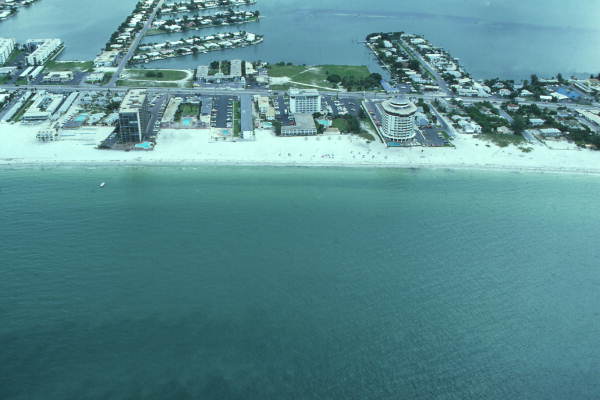 1976
1976Pinellas County aerial, 1976 — looking east over St. Pete Beach with Tierra Verde and the Pinellas Bayway visible. The development pattern that emerged after the Bayway opened in 1962 is clearly underway.
Florida Memory / State Archives of Florida — K024244
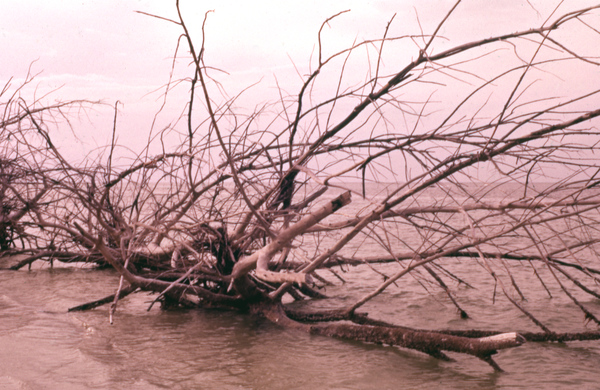 1957
1957Driftwood on Shell Island, 1957 — the same Shell Key paddlers from Tierra Verde reach today. Two years before the Berlanti brothers bought the islands, this was the character of the entire chain.
Florida Memory / State Archives of Florida — DGM0265
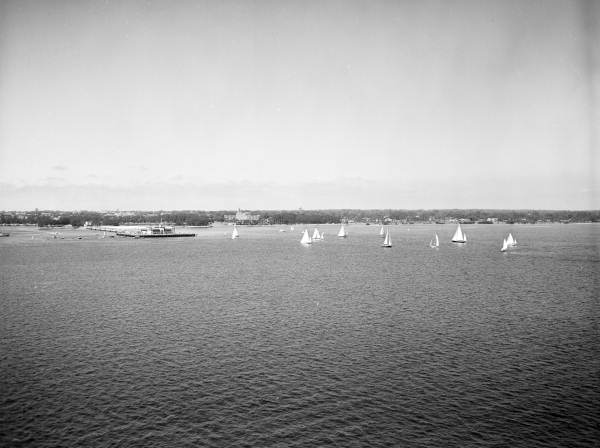 1955
1955Aerial of the Saint Petersburg-Havana Yacht Race start, 1955 — the open-water leg passes directly off what would soon become Tierra Verde. The mangrove keys are visible in the distance, four years before development began.
Florida Memory / State Archives of Florida — C20865
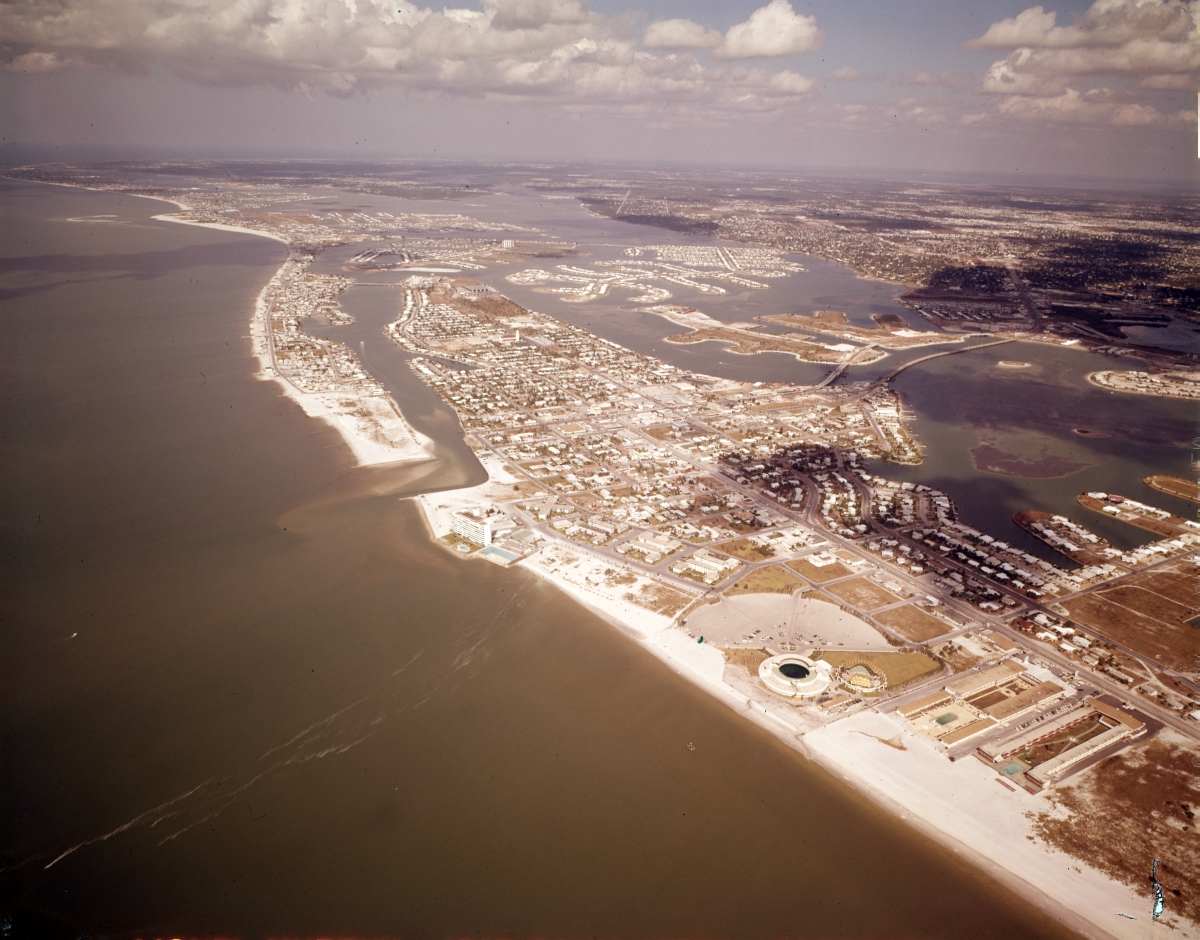 1964
19641964 aerial looking north over St. Pete Beach — two years after the Pinellas Bayway opened. The connection that transformed Tierra Verde from undeveloped mangrove keys into a planned resort community.
Florida Memory / State Archives of Florida — DC072619
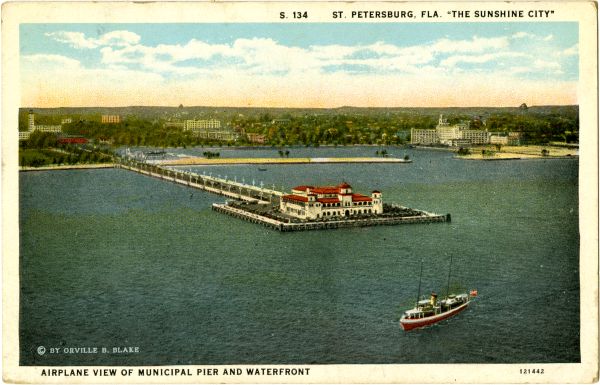 1926
19261926 aerial of the St. Petersburg waterfront — the city Tierra Verde residents drive into today. Thirty-three years before the Berlanti brothers bought the keys at the bay's mouth.
Florida Memory / State Archives of Florida — PC13231
Commute Times
Click any destination to see the mapped route with real-time traffic estimates.
Pros & Cons
The Pros
- True island living with waterfront in every direction
- Direct boat access to Tampa Bay flats, the Skyway, Egmont Key, and the Gulf
- Fort De Soto Park (1,136 acres, seven miles of waterfront, dog beach, fishing piers, historic fort) at the south end
- 10 minutes to Pass-a-Grille and St. Pete Beach; 18 minutes to downtown St. Pete
- Genuine lifestyle community — boaters, anglers, retirees, second-home owners
- Full-time community of ~3,800 keeps the island residential, not touristy
- Wide mix of inventory from mid-$400K condos to $8M+ trophy waterfront
- The Bayway tolls function as a soft moat — traffic and density stay low
The Cons
- Almost entirely AE or VE flood zone — among the highest hurricane exposure in Pinellas
- Hurricane Helene flooded ground-level homes islandwide; Milton followed two weeks later
- Combined insurance (flood + wind + windstorm) on older waterfront often $15K-$30K+ per year
- Mandatory hurricane evacuation zone — you leave for every named storm with surge potential
- 30+ minutes to Tampa, ~18 minutes to downtown St. Pete; only one road on and off
- Limited dining and shopping on the island itself — most errands require leaving
- Original 1960s-70s slab homes are the most vulnerable inventory; renovations triggering FEMA 50% rule force full elevation
- Pinellas Bayway tolls are a daily expense ($50/year resident pass mitigates this)
What You Need to Know
Who Should Live Here
Boaters, anglers, beach people, second-home buyers, and primary buyers who specifically want island lifestyle and have priced in the cost of carrying a coastal home. Tierra Verde rewards the buyer who's going to actually use the water — not the buyer who's just buying a view. Retirees who want the lifestyle without the maintenance often gravitate to the condos along the Bayway corridor. Buyers who've already absorbed the hurricane reality and are willing to either build elevated or buy already-elevated will do best here long-term.
What to Watch For
Substantial-damage status post-Helene is the single biggest issue — get the FEMA letter, the elevation certificate, and the city's permit history before you make an offer. Older slab homes from the 1960s-70s are the highest-risk inventory; if cumulative repairs cross 50% of assessed value the home has to be elevated to current base flood elevation, which can add $250K-$500K to a renovation. Get insurance quotes before you go under contract — flood (NFIP capped at $250K plus excess), wind, and standard hazard are three separate policies and they add up. Verify the seawall age on any canal lot. And confirm the specific flood zone (AE vs VE) of the lot — VE construction rules are dramatically stricter.
What to Expect
A real island community with marinas, a handful of waterfront restaurants, a community association, and a strong boater culture. 1960s-70s ranch homes mixed with modern elevated rebuilds and a corridor of condos and townhomes. Quiet streets, low through-traffic (the Bayway tolls keep tourists from cutting through), and the constant proximity to water in every direction. You'll learn the tide tables, you'll know your neighbors at the marina, and you'll spend more time on a boat than you ever planned to.
Aaron's Honest Take
Aaron & Aubrey Chand
Living in St. Pete · Excellecore Real Estate
Here's what I tell buyers who ask me about Tierra Verde: this is the neighborhood you buy when you actually want to live on the water — not the idea of it. The lifestyle is real. Fort De Soto is at the end of your road. You can keep a boat behind the house and be at the Skyway flats fishing tarpon in twenty minutes. Pass-a-Grille is a five-minute drive across the bridge. If you're a boater, an angler, or a beach person, very few addresses in Florida give you this much access this close to a real downtown.
But the hurricane math has changed. Helene took ground-level homes islandwide. Most of Tierra Verde is in AE or VE — those are the highest-risk flood zones FEMA assigns. You're going to pay flood insurance, wind insurance, and standard insurance, and on an older waterfront home that combined number can land north of $20K a year. The 50% rule means if you're buying a 1970s slab home and you want to renovate, you need to model what happens if cumulative repairs cross half the assessed value — because at that point you're elevating, and elevating a 2,500 sq ft home is a $300K-$500K conversation.
The honest cons: it's a haul to Tampa, it's a real haul to TPA, and one road in and out means evacuation traffic is brutal. Older inventory needs serious work, and the renovations that used to make sense pre-Helene don't always pencil now. But — and this is the part most buyers don't see — the trophy waterfront here, the modern elevated rebuilds on Oceanview and the East Shore, are the inventory that performed best in Helene. If you're buying for the long hold and you can either build elevated or pay for already-elevated, the math actually gets better, not worse. We've helped over 50 buyers relocate to Tampa Bay in the past couple years, and the ones who landed in Tierra Verde knew exactly what they were buying. That's the right way to do it here.
The Buying Reality
~45-90 days post-Helene; pre-storm comps not reliable
Elevated since fall 2024 — sellers offloading damaged or substantial-damage-flagged properties; well-renovated elevated homes still tight
Rare on damaged inventory; common on already-elevated turnkey waterfront
Get the FEMA substantial-damage status, elevation certificate, and four-point inspection before you make an offer. Line up flood, wind, and hazard quotes from three separate carriers — premiums vary by tens of thousands. If you're buying a renovation candidate, model the 50% rule with a contractor experienced in coastal elevation before you go under contract. Don't waive inspection.
Schools & Zoning
Magnet Options
Private / Independent
Pinellas County operates a controlled-choice attendance system, so zoning is one factor among several — magnet placements are competitive and don't depend on neighborhood. Tierra Verde's full-time population skews older (median age 60.6, with 37.5% aged 65+), so school-age inventory is smaller than other St. Pete neighborhoods. Buyers with school-age kids should plan for a longer drive — Gulfport Elementary is roughly 12 minutes off the island.
Insurance & Maintenance Reality
Pre-War Home Considerations
Insurance on a Tierra Verde home is its own conversation, and post-Helene it's the conversation that decides whether the deal pencils. Plan on three separate policies: NFIP flood (capped at $250,000 dwelling coverage, with private excess flood for higher values), wind/windstorm (often a separate carrier from your standard policy on coastal Pinellas), and standard hazard. Combined annual premiums on an older AE-zone waterfront home routinely run $12K-$25K. On a VE-zone trophy waterfront, $25K-$50K is realistic.
Risk Rating 2.0 has shifted NFIP pricing toward individual property characteristics rather than flat zone-based premiums — your specific elevation, distance to water, foundation type, and replacement cost now drive the number. Two homes a hundred yards apart can have flood premiums that differ by a factor of three. Get a current elevation certificate before you write an offer; without it you can't get an accurate quote.
The single biggest insurance variable is roof age. Anything over 15 years on a coastal home will narrow your wind carriers sharply. Over 20 years and you may need to roof before close to even bind a policy. Elevated homes built post-2010 to current code (impact windows, hip roof, secondary water resistance, hurricane straps) qualify for wind mitigation credits that can knock 30-50% off the wind portion. The math on a fully elevated, modern-spec home is meaningfully better than on the original 1970s stock — which is one of the reasons rebuilds are happening so quickly.
Storm Impact: Helene & Milton
Tierra Verde took a direct hit from Helene's storm surge in September 2024 and Milton's wind two weeks later. Ground-level homes flooded islandwide. Fort De Soto closed for months. The barrier islands from John's Pass to Tierra Verde lost potable water service and were under boil-water advisories for weeks. Newer elevated construction performed dramatically better than the original 1960s-70s slab homes — a pattern that's now driving every rebuild conversation on the island.
Hurricane Helene
Sep 2024Storm surge in the 5-8 foot range across the island. Most original-construction ground-level homes had finished living spaces flood. Fort De Soto Park's facilities, boat ramps, and fishing piers took heavy damage. Pinellas County's Gulf Beach Water Booster Station in St. Pete Beach flooded and went offline, leaving Tierra Verde and the southern barrier islands without water pressure for an extended period. Hundreds of homes on Tierra Verde have since been flagged with substantial-damage status under the FEMA 50% rule.
Hurricane Milton
Oct 2024Came through inland from the south two weeks after Helene; primary damage was wind-driven and roof-related. The compounding effect was the issue — homes already stripped or stressed by Helene took the second hit before any meaningful repairs could be completed. Tree loss was significant; downed power across the island lasted days.
Blocks to Watch
East Shore, Buttonwood, and the open-Bay-facing lots on Oceanview Drive (VE zone) saw the highest surge. Interior canal lots in Sands Point and along Monte Cristo were better protected by the canal system but still flooded at ground level. Newer elevated builds on pilings — across all sub-areas — were largely dry above the elevated finished floor. If you're shopping post-Helene, the pattern is consistent: elevated and impact-rated equals dry; original slab-on-grade equals damage.
Community & Events
Fort De Soto Park weekend boating, fishing, and beach use
Year-round
1,136 acres at the south end of Tierra Verde, with seven miles of waterfront, two fishing piers (1,000-ft Gulf Pier and 500-ft Bay Pier), a designated dog beach, kayak/SUP launches, and the historic Fort De Soto itself. The single biggest weekend draw on the island.
Shell Key Preserve paddle days
Year-round (best Oct-May)
Shell Key is a barrier-island preserve a short paddle south of Tierra Verde — pristine sandbars, sea turtles in summer, white pelicans in winter. The Pinellas Bayway Kayak and SUP Launch on Tierra Verde is the most popular put-in.
Tierra Verde Community Association meetings & events
Monthly
The TVCA is the civic backbone of the island — runs community engagement, coordinates with Pinellas County on fire/EMS/communications, and is the place to hear about marina expansion proposals, Bayway projects, and zoning issues that affect the island.
Saint Petersburg-Havana Yacht Race start
Historic / occasional
The historic regatta departed from this exact stretch of Tampa Bay (the 1955 Florida Memory aerial in the gallery shows the start). The modern revival of the race uses St. Pete waterfront staging, but the open-water leg passes directly off Tierra Verde.
Sunset gatherings at Billy's Stone Crab
Year-round; stone crab season Oct-May
The island's signature waterfront restaurant, open since 1972 at 1 Collany Rd. Cypress and pine decks, dock for boat-up dining, live music — the place full-time residents take visiting family.
What Residents Are Saying Online
Pulled from City-Data Tampa Bay forum threads on Tierra Verde. Residents consistently call out three things: the genuine boating lifestyle (waterfront density, marina access, proximity to Fort De Soto), the quiet/safe character of the island, and the one-road-in/one-road-out reality (tourist-season traffic, mandatory evacuation). Honest cons mentioned include limited entertainment for kids, the seasonal vacation-home turnover that thins out neighborhood camaraderie, and the mandatory evacuation zoning. The overall sentiment is consistent: people who live here love it, but they came in knowing what they were buying.
“It's very quiet and safe, although we do seem to have a high number of vehicle thefts lately.”
“This is a boating community; probably half the homes are waterfront and there's a marina for those who aren't.”
“People living in the condos tend to be older/retired. Those who live in the single family homes tend to be younger.”
“One of the downsides is how long it can take to get on and off the island during tourist season. Only one way on and off.”
“I grew up in Tierra Verde. My complaint would simply be that there's very little for kids to do within the distances kids can typically travel on their own.”
“When I lived there, half the waterfront homes were vacation homes so we didn't see some of the neighbors very often.”
“It's not in a mandatory flood evacuation zone like Tierra Verde.”
Further Reading & Resources
Civic & Preservation
Pinellas County — Fort De Soto Park
Official county page for Fort De Soto — 1,136 acres at the south end of Tierra Verde. Park hours, fishing pier info, dog beach, camping reservations, and historic fort access.
Pinellas County — Flood Information & Elevation Certificates
Where to look up your specific flood zone, request an elevation certificate from the county, and understand FEMA 50% substantial-damage rules.
FEMA Flood Map Service Center
Pull the official FIRM panel for any Tierra Verde address — the only authoritative source for AE vs VE zone designation and base flood elevation.
Pinellas Bayway SunPass Resident Plan
The $50/year unlimited commuter pass that most full-time Tierra Verde residents buy — covers all three Bayway plazas, renews each September.
Gulf Beaches Historical Museum — Tierra Verde Article
Long-form local history on the 1959 dream, the Berlanti brothers, and the rocky path to today's Tierra Verde and Isla del Sol.
Journalism
Tampa Bay Times — Tierra Verde Marina Redevelopment (2026)
March 2026 coverage of the scaled-back marina redevelopment proposal — an active issue in island politics.
Tampa Bay Times Archive — Mystery, Tragedy Swirled Over Tierra Verde in 1963
Archive feature on the Berlanti brothers' fatal plane explosion over Lake Okeechobee in August 1963 — the event that stalled the original development for more than a decade.
Tampa Bay Times Archive — It's Official: Tierra Verde Is Not Prone to Flooding (1996)
1996 archive piece worth reading for historical perspective — local engineers argued the channel/mangrove system protected the island. Helene in 2024 challenged that read.
FOX 13 — Tierra Verde Residents Push Back Against Marina Expansion
Local TV coverage of the original (larger) marina expansion proposal and resident pushback — useful context on island politics.
WUSF — Pinellas Barrier Islands Reopening After Helene
October 2024 coverage of the barrier islands' reopening — images and on-the-ground reporting on what Helene actually did to Tierra Verde and the southern Pinellas islands.
WTSP — Fort De Soto's Popular Beach Reopens After Hurricane Recovery
Coverage of Fort De Soto's North Beach reopening after months of cleanup from Helene and Milton — useful for understanding the timeline of recovery for the park infrastructure.
Neighborhood Association
Tierra Verde Community Association
The island's official 501(c)(4) civic association — events, member portal, community announcements, and coordination with Pinellas County on fire/EMS/communications.
Tierra Verde Florida — Community Site & Directory
Independent community directory with local business listings, history of the island, and current events. The 'About Tierra Verde' page is the best plain-English history available online.
More
Wikipedia — Tierra Verde, Florida
Best single-source overview — Berlanti history, Pinellas Bayway dates, Guy Lombardo / Port O'Call era, demographics, and the six neighborhood areas.
Wikipedia — Pinellas Bayway
Background on the toll system, the 1962 opening, and the modern bridge replacement that wrapped in 2021.
Niche — 33715 ZIP Code Profile
Crowd-sourced data and reviews on the 33715 zip — overall B+ grade, A-/A in nightlife, health & fitness, and outdoor activities.
What's Nearby
Fort De Soto Park
2 mi (south end of island)
Shell Key Preserve
Paddle access from Bayway launch
St. Pete Beach
5 mi
Pass-a-Grille
6 mi
Skyway Bridge / Tampa Bay Flats
3 mi
Tierra Verde Marina
0.5 mi
Billy's Stone Crab
On island
Sea Critters Cafe (waterfront, Pass-a-Grille)
6 mi
Don CeSar Hotel (St. Pete Beach)
4 mi
Downtown St. Pete waterfront / The Pier
9 mi
Egmont Key (boat access only)
5 mi by boat
Maximo Marina
3 mi (mainland end of Bayway)
Elevation & Flood Risk
5ft average elevation
FEMA Flood Zone AE across most of the island; VE on outer/exposed edges — flood insurance required
Thinking about Tierra Verde?
We've helped over 50 buyers relocate to Tampa Bay. Let's talk about whether Tierra Verde is the right fit for you.
Explore more neighborhoods
View All in Relocation Guide