Snell Isle
St. Pete's Built-From-The-Bay Estate Address
October 15, 1925
Opened
C. Perry Snell
Developer
275 acres (only 39 above high tide)
Original Acreage
AE / VE — high risk
Flood Zone
3-8 ft
Elevation
Vinoy Golf Course, Vinoy Resort, Snell Arcade
Anchor Landmarks
Neighborhood Overview
Snell Isle is the prestige waterfront address in St. Petersburg, and it's also one of the most physically improbable. C. Perry Snell — a Kentucky pharmacist turned land developer — bought a 275-acre marshy island in upper Coffee Pot Bayou where only 39 acres sat above the high tide line. Starting in 1925, he dredged sand from the bay, built concrete seawalls, laid out roads, and turned the rest into a master-planned residential island. When lot sales opened on October 15, 1925, his team sold roughly $2 million in property before lunch and over $7 million by the end of the day — about $128 million in today's dollars. The first nine homes on Brightwaters Boulevard were finished at a cost exceeding a million 1920s dollars, with statues, ornamental tile, and architectural details Snell personally collected on European buying trips.
What was built then is largely what defines the neighborhood now: Mediterranean Revival estates on Brightwaters and Coffee Pot, the Vinoy Golf Course (originally Snell's 1920 Coffee Pot Golf Club, redesigned by Wayne Stiles and John van Kleek in 1926, later Sunset Country Club, now affiliated with the Vinoy Resort), and a residential rhythm of big lots, low traffic, and limited entry points. On the older streets you still see Snell's hand — 375 Brightwaters was his own Italian villa, 321 Brightwaters was Villa Florentina built for Barney Google cartoonist Billy De Beck, and 416 Brightwaters is the Mefford Mansion designed by Kiehnel & Elliott (the same architects who did the Snell Arcade downtown). Many of these homes are still standing, though some have been demolished or are being marketed as land value only.
The hard reality of Snell Isle is that almost the entire island sits in flood zone AE, with VE exposure on the outer waterfront. Hurricane Helene in September 2024 was a worst-case event here. The city closed Snell Isle to non-residents during the surge, six Fire Rescue boats were deployed for search and rescue, and ground-floor living spaces flooded across the island. Insurance reset upward, the FEMA 50% rule is now front and center on every renovation conversation, and several homes — including the William Harvard-designed 411 Cordova Boulevard — were demolished post-storm. Buyers who succeed here go in clear-eyed: you're paying for a piece of 1920s waterfront Florida that comes with hurricane risk, premium insurance, and the possibility of substantial-improvement triggers on any major project.
History & Origins
Opened October 15, 1925
C. Perry Snell (with partner J.C. Hamlett earlier; Snell Isle was Snell's solo signature project)
Mid-1920s Florida Land Boom (1920-1926)
C. Perry Snell was born in 1869 in Bowling Green, Kentucky, trained as a pharmacist, and moved to St. Petersburg in 1904. His wife Lillian Allen's inheritance — her parents both died in 1901 — funded what became one of the most ambitious real estate careers in Florida history. Snell platted the Old Northeast (then 'North Shore') in 1911 with J.C. Hamlett, developed Granada Terrace, and helped make the early Vinoy Park Hotel possible. By 1920 he'd opened a nine-hole 'Coffee Pot Golf Club' on the marshy island sitting north of Coffee Pot Bayou. In 1925, with the Florida boom at peak, he committed to turning that island into Snell Isle.
The engineering was the story. Of the original 275 acres, only 39 were above the high tide line. Snell hired crews to dredge sand from Tampa Bay, pour concrete seawalls, and lay out streets starting in April 1925. Lot sales opened on October 15, 1925 — and by 11 a.m. on October 25, the team had moved $2 million in property, with all of the Brightwaters phase selling out that single day. The total project cost roughly $4.5 million in 1920s dollars (about $85 million today). Snell personally traveled Europe collecting statuary, antique tile, and architectural details for the first nine homes on Brightwaters Boulevard, which cost over $1 million combined. Local historian Walter Fuller later wrote that Snell 'deliberately impoverished himself in the pursuit of beauty.'
The 1926 land bust hit before the island was finished, and Snell ultimately lost ownership of both Snell Isle and the Snell Arcade downtown before completing his vision. He died in Laredo, Texas on October 23, 1942. His own Italian villa at 375 Brightwaters Blvd — a $125,000 1928 build with materials imported from Italy and 400 feet of waterfront on Coffee Pot Bayou — stayed in the family. His widow Louise Bishop lived there for 65 years, until 2005, when the home sold for $5.1 million. The original Snell House from earlier in his career was moved to USF St. Petersburg in 1993 and now houses the Florida Studies Program. The neighborhood marked its centenary in October 2025 — a hundred years from a marshy island to one of the most expensive residential addresses on Florida's west coast.
Architecture & What You'll Be Buying
Predominant Styles
Typical Year Built
1925-1940 on the original streets; 1950s-1970s on inner blocks; 2010-present on teardown rebuilds
Typical Size
3,500-7,000 sq ft on the original homes; modern teardowns frequently 6,000-12,000+ sq ft
Construction
The original Brightwaters and Coffee Pot homes were built when Mediterranean Revival was the dominant boom-era style: stucco over hollow tile, clay barrel tile roofs, arched openings, courtyards, towers, and ornamental ironwork. Lots are large by St. Pete standards — half-acre to two-plus acres on the deepwater streets, with seawalls and private docks standard. The newer modern coastal builds replacing teardowns are typically elevated CMU construction with concrete decks, impact glass, and ground-floor garage / storage that complies with current flood code. The architectural character on the older streets remains protected mostly by lot economics, not by historic district regulation — Snell Isle is not a designated historic district.
Materials & Streetscape
Hollow clay tile with stucco was the dominant 1920s system here, finished with imported clay barrel tile roofs, wrought iron, and (on Snell's own home and a few others) ornamental statuary, antique tile, and stone collected on European buying trips. The Mefford Mansion at 416 Brightwaters and Snell's Italian villa at 375 Brightwaters are the textbook examples. Driving the blocks you see European statuary — lions, panthers, mythological griffins — set into entry walls and front gardens, a direct legacy of Snell's original commissioning.
Notable Homes & Landmarks
375 Brightwaters Blvd NE
Built 1928
C. Perry Snell's own Italian villa — $125,000 in 1928 dollars, six bedrooms, six baths, on nearly two acres with 400 feet of waterfront on Coffee Pot Bayou. Materials imported from Italy including centuries-old tile. The tower was converted to an art studio. Snell's wife Louise Bishop lived in the home for 65 years (1939-2005) before it sold for $5.1 million.
Later occupied by cartoonist Wallace 'Wally' Bond Bishop (King Features, 'Muggs and Skeeter'), a founding board member of the Museum of Fine Arts.
416 Brightwaters Blvd NE — Mefford Mansion / 'Brightleaf'
Built 1925
Designed by the Kiehnel & Elliott architectural firm — the same architects behind the Snell Arcade downtown and the Rolyat Hotel in Gulfport. Built for prominent attorney and Florida Land Boom developer Robert J. Mefford and his wife Harriet. For its first decade it hosted lavish parties and political gatherings, until 75-year-old Robert Mefford died of a heart attack at a dinner party in the home in 1935. After a four-year restoration completed in 2024, the 6,045 sq ft, 5-bedroom, 5.5-bath estate was relisted in April 2026 at $12.5 million.
Later owners included St. Pete Mayor Don Spicer, Home Shopping Network president Gerald Hogan, and Florida House Speaker Peter Wallace. Current owner Lorna Taylor (Premier Eye Care) bought it in 2013 for $2,020,000.
321 Brightwaters Blvd NE — Villa Florentina
Built circa 1929
Mediterranean with Italian and Spanish influences — heavy red tile, Venetian windows, cement-walled entrance. Named for the Florence, Italy furnishings the De Becks brought back. Built for William 'Billy' De Beck (1890-1942), the cartoonist who created the 'Barney Google' comic strip in 1919 and coined the phrases 'horse feathers,' 'jeepers creepers,' and 'heebie-jeebies.' By 1922 he was one of America's highest-paid cartoonists. Interior featured an original Holbein print, custom Italian lamps, James Montgomery Flagg sketches, 16th-century wood carvings, and second-floor private studios.
After De Beck's death, his widow Mary died in a 1953 National Airlines DC-6 crash in the Gulf of Mexico. Property later sold to Vice-Mayor Eli Jenkins (1962).
307 Brightwaters Blvd NE
Built 1929
First waterfront site on Brightwaters Boulevard overlooking Coffee Pot Bayou. Hollow tile, steel, and stucco construction with five bedrooms and four baths. Built for Bayard Sylvester Cook (1880-1946), a Maryland-born Temple Law graduate who relocated to St. Pete in 1915 — Chamber of Commerce President and Rotary Club President.
Cook family marked by tragedy: son James died age 23, son Bayard Jr. died in 1948.
500 Brightwaters Blvd NE
Built 1928
Designed by Kiehnel & Elliott. 100-foot frontage facing Tampa Bay, seven bedrooms, five tile baths, double garage with servants' quarters, hardwood floors, tile kitchen, copper screens. Built for Rollin T. Reefy (1865-1950), the former owner-editor of the Elyria Democrat in Ohio.
Then & Now
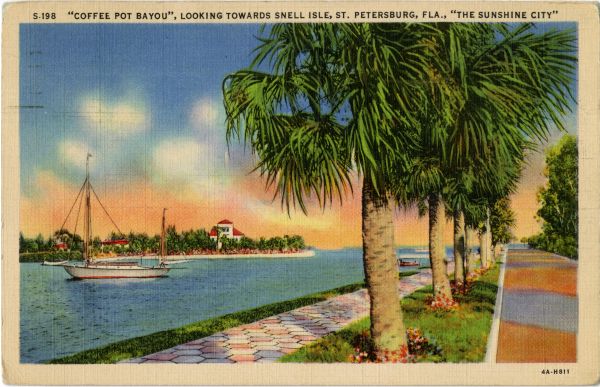
1934Coffee Pot Bayou looking toward Snell Isle, 1934 — the bayou frontage that defines the island's south and west edges.
Florida Memory / State Archives of Florida — pc14048
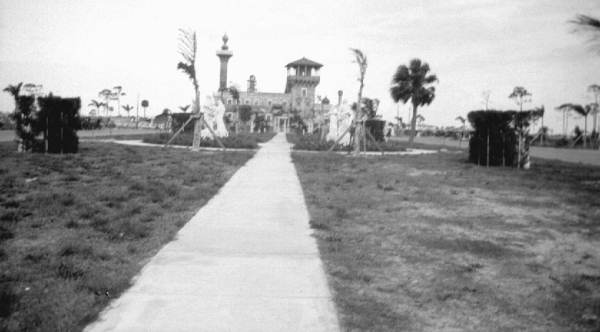 1926
1926Sidewalk leading to what was then the Sunset Golf and Country Club, 1926 — originally Snell's Coffee Pot Golf Club, today the Vinoy Golf Club.
Florida Memory / State Archives of Florida — pr09663
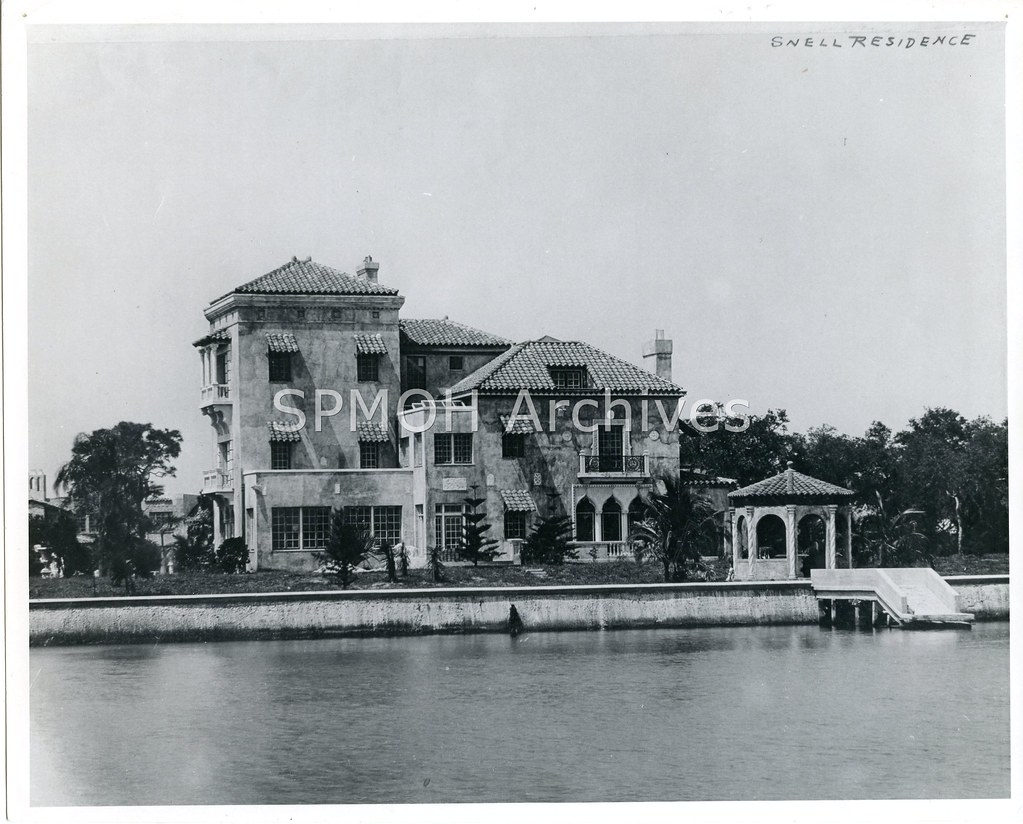 1931
1931C. Perry Snell's own home, c. 1931 — the developer who dredged Snell Isle out of Tampa Bay.
St. Petersburg Museum of History — p00466
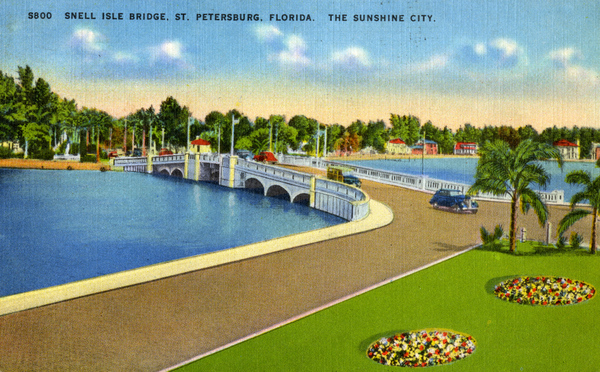 1950
1950The Snell Isle Bridge connecting the island to the Old Northeast — c. 1950 postcard.
Florida Memory / State Archives of Florida — pc07635
 1957
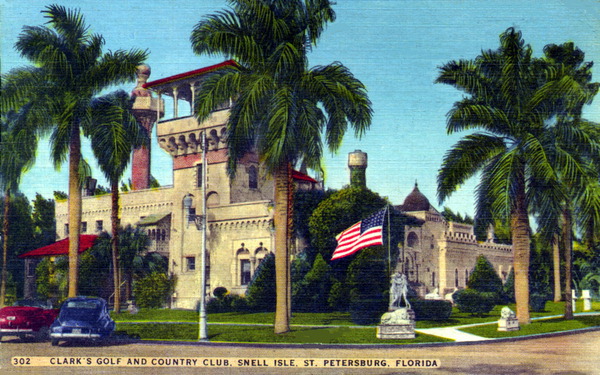
1957Clark's Golf and Country Club on Snell Isle, 1957 — purchased in 1932 by candy-bar entrepreneur D.L. Clark for $156,000 before becoming the Vinoy Golf Club in 1948.
Florida Memory / State Archives of Florida — pc4077
 1960
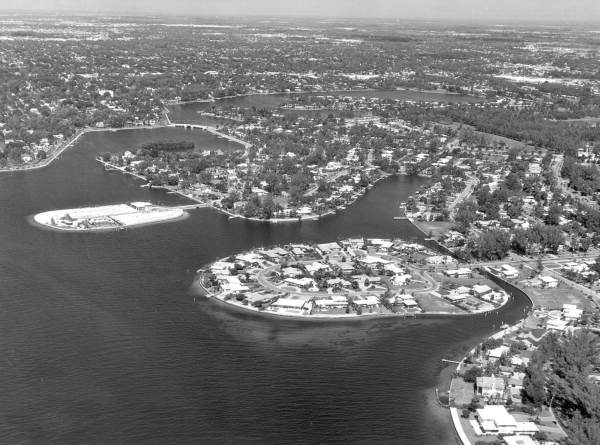
1960Aerial view of Snell Isle, 1960 — the dredged-and-filled island built by C. Perry Snell starting in 1925.
Florida Memory / State Archives of Florida — rc06818
Commute Times
Click any destination to see the mapped route with real-time traffic estimates.
Pros & Cons
The Pros
- St. Pete's most prestigious waterfront address — a hundred years of pedigree, from C. Perry Snell's original European-influenced estates to today's deepwater modern builds
- Deepwater lots on Coffee Pot Bayou and Tampa Bay with private docks and direct open-water access — a level of waterfront living that doesn't exist at this scale anywhere else in St. Pete
- Anchored by the Vinoy Golf Course (originally Snell's 1920 Coffee Pot Golf Club) and the Vinoy Resort & Golf Club, an Autograph Collection hotel listed on the National Register of Historic Places
- Quiet, low-traffic island with limited entry points — very different feel from the rest of St. Pete despite being seven minutes from downtown
- Mediterranean Revival, Italian villa, and Moorish Revival architecture from the 1920s on the older streets — Moorish Revival in Snell Isle is unique in the city per the city's design guidelines
- Strong long-term land value — even when structures are compromised, the lots themselves continue to trade at a premium
- The Vinoy Park Hotel, the Snell Arcade, and the original Snell House (now at USF St. Petersburg) are part of the same Snell-era story you live inside on the island
- Coffee Pot Bayou bird preserve, Coffee Pot Park, and the bayou waterfront walking path on the south side give the neighborhood unusual natural texture for a luxury enclave
The Cons
- Almost the entire island is in flood zone AE, with VE exposure on the outer waterfront — among the highest-risk neighborhoods in St. Pete
- Hurricane Helene (September 2024) caused widespread interior flooding across the island; the city closed Snell Isle to non-residents during the surge and Fire Rescue deployed boats for search and rescue
- Flood, wind, and windstorm insurance combined commonly run $15K-$30K+ per year on older non-elevated homes; carriers have tightened sharply post-Helene
- FEMA's 50% rule (substantial improvement / substantial damage) applies to most renovation conversations on older homes — repair or remodel costs exceeding 50% of structure value can trigger full elevation requirements
- Walk Score is low — almost everything outside the island requires a car, and the Vinoy Resort and downtown are a drive (or a long walk) rather than walkable in the way Old Northeast or Roser Park are
- Modern teardowns are changing the architectural character — several Snell-era homes including the William Harvard-designed 411 Cordova have been demolished post-Helene
- Snell Isle is not a designated local or National Register historic district — there is no architectural review board protecting the 1920s housing stock from teardown
What You Need to Know
Who Should Live Here
Buyers who specifically want a deepwater dock, can self-insure or absorb high carrying costs, and are buying for the long-term lifestyle — not the next 24-month appreciation cycle. Boaters, golfers (the Vinoy Golf Club is in your front yard), and buyers who've already lived through hurricane seasons in Florida and know what they're signing up for. The buyer who fits Snell Isle has done the math on an annual insurance premium that may rival a starter-home mortgage payment somewhere else, and they've decided the tradeoff is worth it.
What to Watch For
FEMA's 50% rule is the single most important conversation on Snell Isle right now. If you buy a 1950s or 1960s ground-level home and renovate over 50% of its market value, you may be required to elevate the entire structure — a project that frequently runs into seven figures on a Snell Isle waterfront lot. Before you write an offer, get the elevation certificate, the substantial-damage letter (if the home flooded during Helene or Milton), a wind-mitigation report, and real insurance quotes from at least two carriers. Look closely at the deed history post-Helene — several lots are now selling as land value only because the structure was substantially damaged. A buyer who treats insurance as an afterthought on Snell Isle gets in trouble.
What to Expect
Mediterranean Revival on the older streets near Brightwaters Boulevard, modern coastal teardowns on deepwater lots, the Vinoy Golf Club running through the middle of the island, and a vibe that's much more residential and quieter than the price tag suggests. The Vinoy Park Hotel, Coffee Pot Park, and the Snell Arcade all sit within a ten-minute drive — you're physically inside the Snell-era story of St. Pete. Big lots, big setbacks, low traffic. You will drive for almost everything except a walk along Coffee Pot Bayou.
Aaron's Honest Take
Aaron & Aubrey Chand
Living in St. Pete · Excellecore Real Estate
Here's what I tell buyers who ask me about Snell Isle: this is the most beautiful neighborhood in St. Pete and it's also the one that requires the most homework. C. Perry Snell built this island from the bay in 1925 — literally dredged it up out of the water — and a hundred years later it's still where the prestige waterfront homes are. Brightwaters Boulevard, Coffee Pot Bayou, the Vinoy Golf Club running through the middle. There is nothing else like it in the city. If you want a deepwater dock and a Mediterranean Revival estate with real architectural pedigree, this is the answer.
But Helene was the wake-up call. Almost the whole island is flood zone AE, parts of it are VE, and on September 26, 2024 the bay came over the seawalls and into living rooms across the island. The city closed Snell Isle. Fire Rescue ran boats. We had buyers who'd watched houses on Brightwaters for years suddenly looking at the same homes listed as land value only. The FEMA 50% rule is the conversation now — if you buy a 1950s ground-level house and repair or remodel more than 50% of the structure's value, you can be required to elevate the whole thing. That's a real number, and it's the difference between a project that pencils and one that doesn't.
The honest play on Snell Isle right now: buy the lot, not the surprise. Get the elevation certificate, the substantial-damage letter if there is one, real insurance quotes from two carriers, and a contractor who knows what an elevation project actually costs. Don't fall in love with a 1925 home until you've talked to your insurance agent. Aubrey and I have helped over 50 buyers relocate to Tampa Bay, and the buyers who come out ahead on Snell Isle are the ones who treat the math seriously. The reward is a piece of waterfront Florida that doesn't really exist at this scale anywhere else in St. Pete. The price of admission is doing your homework before you sign.
The Buying Reality
45-90 days for the typical $1.5M-$3M listing; longer for substantially-damaged structures and flagged properties
Moderate — usually 15-30 active listings island-wide, more after major storm events
Uncommon at the high end since 2024; modern elevated builds and lots without substantial-damage flags can still see competition
Show strong proof of funds (waterfront here is largely cash or jumbo). Get insurance quotes and a contractor walkthrough before you write. On post-Helene listings, ask explicitly for the substantial-damage letter and the most recent elevation certificate. Sellers will trade some price flexibility for a buyer who isn't going to renegotiate after inspection.
Schools & Zoning
Magnet Options
Private / Independent
Snell Isle's zoned schools sit at the north end of Coffee Pot Bayou — North Shore Elementary is a 95-year-old red-brick school under century-old oaks, John Hopkins Middle hosts the Center for Communications, Journalism & Multimedia magnet, and St. Petersburg High School (the city's oldest high school, with an IB program) is the zoned high school. Pinellas County operates a controlled-choice attendance system, so zoning is one factor among several. In practice, many Snell Isle households use Shorecrest, Canterbury, or Farragut for private.
Insurance & Maintenance Reality
Pre-War Home Considerations
Insurance on Snell Isle is its own conversation — start it before you make an offer, not after. Almost every home on the island sits in flood zone AE, with VE exposure on the outer waterfront. That means an NFIP flood policy is not optional on a financed purchase, and post-Helene the carriers have tightened sharply on older non-elevated structures. Older homes on the island commonly need a 4-point inspection (roof, electrical, plumbing, HVAC), a wind-mitigation report, and a current elevation certificate to bind a policy at all.
Real numbers: combined wind, flood, and windstorm premiums on a 1950s non-elevated waterfront home can run $15K-$30K+ per year. On a substantially-damaged structure, some carriers will not write at any price — buyers either have to pay cash, accept surplus-lines pricing, or commit to an elevation project as part of the renovation. Modern elevated CMU builds with impact glass and current-code construction insure significantly better.
The other conversation is the FEMA substantial-improvement / substantial-damage rule. On a home that flooded during Helene or Milton, the local floodplain administrator may have issued a substantial-damage letter — meaning any renovation has to bring the structure into current flood code, including elevation. Even on a home that didn't flood, any renovation exceeding 50% of the structure's market value triggers the same requirement. This is the single biggest piece of due diligence on a Snell Isle purchase right now: get the substantial-damage letter (or written confirmation it doesn't apply), get a real elevation certificate, and price an elevation project before you write the contract.
Storm Impact: Helene & Milton
Hurricane Helene (September 26, 2024) was a worst-case event for Snell Isle. The city closed the island to non-residents during the surge, Fire Rescue deployed six boats for search and rescue across Snell Isle, Shore Acres, and Venetian Isles, and the city recorded more than 6 feet of storm surge with 100.6 miles of roads impacted. Helene's surge came over the seawalls and into ground-floor living spaces across the island — including blocks that hadn't taken interior water in any prior storm. Hurricane Milton followed two weeks later as a wind-driven event with additional water in already-stressed areas.
Hurricane Helene
Sep 2024Widespread interior flooding across the island. Most homes on the original Snell-era streets near Brightwaters and Coffee Pot are 1925-1940 ground-level construction with no real elevation buffer to a 6+ foot surge. The William Bloxham Harvard-designed home at 411 Cordova Boulevard (1956) — believed to be among the first in St. Pete with steel framing — was demolished during Thanksgiving week 2024 after Helene damage. Several other lots on the island are now being marketed as land value only because of substantial-damage determinations.
Hurricane Milton
Oct 2024Came through inland from the south two weeks after Helene as a wind-driven event. Additional rain and wind damage on roofs already stressed by Helene; some additional flooding on lots that had not fully drained. Net effect for Snell Isle: a second insurance event stacking on top of the first, with carriers and adjusters still working through Helene claims when Milton hit.
Blocks to Watch
Almost the entire island is exposed, but the deepwater outer streets (Brightwaters Blvd north end, Eden Isle Blvd, Snell Isle Blvd's bayfront sections, Coffee Pot Blvd, Cordova Blvd) saw the worst Helene impact. Inner blocks closer to the center of the island sit slightly higher and fared somewhat better, but no part of Snell Isle is in flood zone X. Verify the specific lot's elevation certificate, FEMA flood zone (AE vs VE matters for premium), and any substantial-damage status before purchasing.
Community & Events
Snell Isle Property Owners Association meetings
Periodic
Voluntary association dedicated to the care and beautification of Snell Isle. Membership starts at $50/year. Publishes 'The Panther' monthly newsletter. P.O. Box 7053, St. Petersburg, FL 33734.
Coffee Pot Turkey Trot
Annual (Thanksgiving)
Annual 5K/1-mile run presented by North Shore Elementary School, looping the Coffee Pot Bayou waterfront path that fronts the south side of Snell Isle. One of the longest-running neighborhood race traditions in the area.
Vinoy Golf Club member events
Year-round
The Vinoy Golf Club — originally Snell's 1920 Coffee Pot Golf Club, redesigned by Stiles & van Kleek in 1926, later Sunset Country Club, redesigned by Ron Garl in 1992 — is the day-to-day social anchor of the island for many residents.
Snell Isle Centenary (2025)
October 2025 (centennial)
October 15, 2025 marked 100 years from the day C. Perry Snell opened lot sales on Snell Isle. The Gabber Newspaper and St. Pete Catalyst both ran centenary coverage.
What Residents Are Saying Online
Pulled from public discussions on Niche, Trulia, and city-data.com plus St Pete Catalyst comment threads. Residents consistently call out three things: how safe and family-quiet the island feels, the architectural character of the older Snell-era homes, and growing frustration with teardowns replacing historic homes. Post-Helene threads layer in flood damage, FEMA-50%-rule conversations, and demolitions. Note: some general-population forums (City-Data) returned demographic pages rather than direct quotes for Snell Isle specifically, so we kept the quote count to verified sources only.
“I generally like the older, Spanish-style architecture of many of the older buildings of my neighborhood. However, many of these houses are being torn down and replaced with expensive, modern housing that does not fit at all with the feel of our neighborhood.”
“We love how safe it is here and lots of kids of all ages on our street and throughout the area.”
“The people there have enough money to buy the house down the street (saw it). So they have a place to stay, while their home is being crushed, and an expensive custom home is being built in its place.”
“Investors are buying these homes for pennies on the dollar to rebuild as the County and FEMA won't allow owners to do the repairs necessary to a flooded house under the 50 percent rule.”
“My feelings are not dissimilar from what they were when the pier was torn down.”
“What matters most after Helene is not what they lost, but how much they still have.”
Further Reading & Resources
Civic & Preservation
City of St. Petersburg — Floodplain Management
Official city flood information page — flood zones, elevation certificates, substantial-damage process, FEMA 50% rule guidance.
City of St. Petersburg — Hurricane Helene Damage Assessment Update
Official city update on Helene damage assessment, including Snell Isle and other surge-impacted neighborhoods.
St. Petersburg Museum of History — C. Perry Snell: In the Pursuit of Beauty
Museum biography of C. Perry Snell, including the Snell Arcade and the financing that funded Snell Isle.
Preserve the 'Burg
Local historic preservation nonprofit — broader preservation context for St. Pete (Snell Isle is not a designated district, but the Snell Arcade and Vinoy are NRHP).
Wikipedia — Snell Isle
Overview article — founding, dredging, 275-acre original footprint, Vinoy Resort, and C. Perry Snell biography.
Journalism
The Gabber Newspaper — A Century of Snell Isle Living
2025 centenary feature on Snell Isle's October 15, 1925 opening, Snell's biography, and the neighborhood's first hundred years.
St Pete Catalyst — Snell Isle archives
Running archive of Snell Isle coverage — 'Jewel Box' home for sale, $15M Snell Isle estate listings, Harvard-designed home demolition, post-Helene coverage.
St Pete Catalyst — Harvard-designed Snell Isle home falls to the wrecking ball
Long-form on the post-Helene demolition of 411 Cordova Blvd — designed by William Bloxham Harvard for hotel operator John Knowlton in 1956.
Tampa Bay Times — Century-old Snell Isle mansion hits market for $12.5 million
April 2026 coverage of the Mefford Mansion ('Brightleaf') relisting at 416 Brightwaters Blvd after a four-year restoration.
Creative Loafing Tampa — St. Pete's historic Mefford Mansion is now on the market
Long-form on 416 Brightwaters Blvd — Kiehnel & Elliott design, Robert Mefford history, ownership chain through Don Spicer, Gerald Hogan, and Peter Wallace.
St Pete Rising — The remarkable history of the 100-year-old Vinoy Hotel
Long-form on the Vinoy Park Hotel — Henry L. Taylor architect, 1925 construction record, Snell Isle's golf course connection.
St Pete Rising — Historically St. Pete: The Snell Arcade nears 100 years
Long-form on the Snell Arcade — Kiehnel & Elliott design (same architects as the Mefford Mansion on Snell Isle), Snell's downtown anchor.
83 Degrees Media — Helene floodwaters and a flood of family and friends
First-person guest column from Snell Isle resident and longtime journalist Dave Scheiber on his family's experience during Helene.
Neighborhood Association
Schools
North Shore Elementary School
Snell Isle's zoned elementary school — red brick building under century-old oaks at 200 35th Ave NE, 95+ years of operation.
Pinellas County Schools — Zone Locator
Official PCSB tool to look up the specific zoned elementary, middle, and high school for any address on Snell Isle.
Cultural
Vinoy Golf Club
Member-owned club operating on the Snell-era golf course (originally Coffee Pot Golf Club 1920, redesigned 1926, renamed Sunset Country Club 1932, Vinoy Golf Club 1948, Ron Garl redesign 1992).
The Vinoy Resort & Golf Club, Autograph Collection
1925 Henry L. Taylor-designed hotel anchoring the Snell Isle / Coffee Pot Bayou waterfront — National Register of Historic Places.
Florida Historic Golf Trail — Vinoy Golf Club
Florida Department of State page on the Vinoy Golf Club's Snell-era origins, the 1926 Stiles & van Kleek redesign, and the 1992 Ron Garl restoration.
What's Nearby
Vinoy Golf Club
on island
Coffee Pot Bayou Bird Preserve
on island
Coffee Pot Park
0.4 mi
The Vinoy Resort & Golf Club, Autograph Collection
1.0 mi
Snell Arcade (downtown)
1.5 mi
North Shore Park
1.0 mi
Downtown St. Pete waterfront
1.6 mi
The Pier
1.8 mi
Saturday Morning Market
1.7 mi
Old Northeast / Beach Drive restaurants
1.3 mi
St. Pete Beach
10 mi
Elevation & Flood Risk
5ft average elevation
FEMA Flood Zone AE (most of island), VE on outer waterfront — flood insurance required
Thinking about Snell Isle?
We've helped over 50 buyers relocate to Tampa Bay. Let's talk about whether Snell Isle is the right fit for you.
Explore more neighborhoods
View All in Relocation Guide