Shore Acres
Affordable Waterfront — With Full Hurricane Reality
1923
First House Sold
1950s-1970s
Major Buildout
AE (most blocks)
Flood Zone
2-7 ft above sea level
Elevation
~82% of homes flooded
Helene Flooding
32
Walk Score
Neighborhood Overview
We have to be honest about Shore Acres because the whole point of this site is honesty. Shore Acres is a low-elevation peninsula in northeast St. Pete that has historically been the most accessible way to buy near the water — prices well below Snell Isle or Old Northeast, lots of canal-front options, and an easy 12-minute drive to downtown. The neighborhood was platted in the early 1920s by Duluth developer Nathaniel J. Upham, but the bulk of what's here today was built out by his sons during the 1950s-70s on land partially created from Gandy Bridge dredge spoil. That history matters: most of Shore Acres sits two to seven feet above sea level on fill, which is exactly why the flooding story is what it is.
Hurricane Helene was devastating here. On September 26-27, 2024, more than six feet of storm surge — the highest on record for the neighborhood — pushed into Shore Acres and flooded an estimated 82% of homes. Many had four feet or more of water in finished living spaces. Hurricane Milton hit a couple weeks later. Most of the neighborhood went through interior demolition, the FEMA 50% Substantial Improvement rule is in active play across hundreds of properties, and as of early 2026 the streetscape is still in mid-rebuild. Some homeowners have elevated, some have rebuilt as new modern coastal homes on stilts, some have sold for land value, and some are still working through Elevate Florida grants and insurance.
The honest take: this neighborhood is in transition. There are real opportunities for buyers who understand the post-storm math — land value is intact, newer elevated builds perform very differently than older 1960s slabs, and pricing has reset on the homes that haven't been raised. There's also real risk for buyers who skip the homework. We've helped over 50 buyers relocate to Tampa Bay in the past couple years, and Shore Acres is the single neighborhood where we slow down the most before we let anyone write an offer. We'd rather you know that going in than find out at closing.
History & Origins
Platted 1920s; first house sold 1923
Nathaniel J. Upham (original); William and Nathaniel G. Upham (1950s-70s buildout)
Mid-Century Suburban (1950s-1970s)
Nathaniel Janeway Upham was a real-estate developer from Duluth who bought the peninsula between Coffee Pot Bayou and what would become Weedon Island in the early 1920s. He platted Shore Acres as part of the Florida land boom and sold the first house in 1923. Upham's pitch was straightforward: a scenic waterfront route between St. Petersburg and Tampa via the Gandy Bridge, which had opened in 1924. A wooden bridge briefly connected Shore Acres to Weedon Island as part of that vision — the shortcut that never was. When the boom collapsed in 1926, Upham's neighborhood was left mostly empty, and it stayed that way for nearly thirty years.
What Upham did do during those quiet years was use the dredges from the Gandy Bridge project to extend the buildable land. That's the part of Shore Acres' history buyers should understand: significant portions of the neighborhood sit on dredge fill from Tampa Bay, raised just a few feet above sea level. The Overlook section was platted with streets named after states — Ohio, Georgia, Minnesota, Pennsylvania, Indiana, New York — reflecting the era's enthusiasm for state societies among Florida transplants. Upham died in 1942 having seen only modest development.
The real Shore Acres most people know was built by Upham's sons, William and Nathaniel G. ('Niel'), during the post-WWII boom. The first large-scale project was a 350-home development around Butterfly Lake in the mid-1950s, followed by Waterway Estates, Venetian Isles, and Ponderosa Shores — much of it built on or around an old golf course. By the early 1970s the neighborhood was largely complete: roughly 2,200 single-family homes, predominantly mid-century cinder-block ranch and split-level construction on slabs, with a smaller pocket of original 1920s homes that survived the gap years. The Shore Acres Civic Association formed and grew alongside the buildout, and by the 1990s it was one of the most active neighborhood associations in St. Pete. Then came the modern era of repeat flooding — Eta in 2020, Idalia in 2023, and finally Helene and Milton in 2024 — which has reshaped the neighborhood again, this time house by house.
Architecture & What You'll Be Buying
Predominant Styles
Typical Year Built
1955-1975 (with a growing share of post-2020 elevated rebuilds)
Typical Size
1,400-2,400 sq ft on 70-90 ft wide lots; canal lots typically 80-100 ft wide
Construction
Most homes are single-story concrete-block-stucco (CBS) on slab, built when slab elevation was minimal. Roof types are predominantly hip and low-pitch gable. The newer wave of construction post-Eta, Idalia, and Helene is fundamentally different: pile or pier foundations, finished living space lifted 8-13 feet above grade, breakaway walls below the flood-elevation line, hurricane-impact glazing, and metal or 130-mph-rated shingle roofs. The result is a neighborhood with two coexisting building types — original 1960s slabs and modern stilt homes — often right next door to each other.
Materials & Streetscape
Concrete block with stucco exterior dominates the original housing stock. Canal seawalls are concrete or composite, with most original 1960s walls now at or near end-of-life. Newer rebuilds use fiber-cement siding, standing-seam metal roofs, and FEMA-compliant flood vents on the enclosed ground levels.
Then & Now
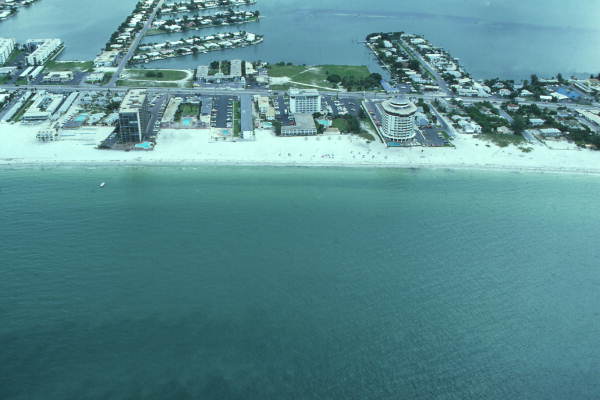 1970s
1970s1976 aerial of north Pinellas — Shore Acres' major buildout was substantially complete by this point, with canal lots and mid-century homes filling the peninsula.
Courtesy of State Archives of Florida, Florida Memory. K024244.
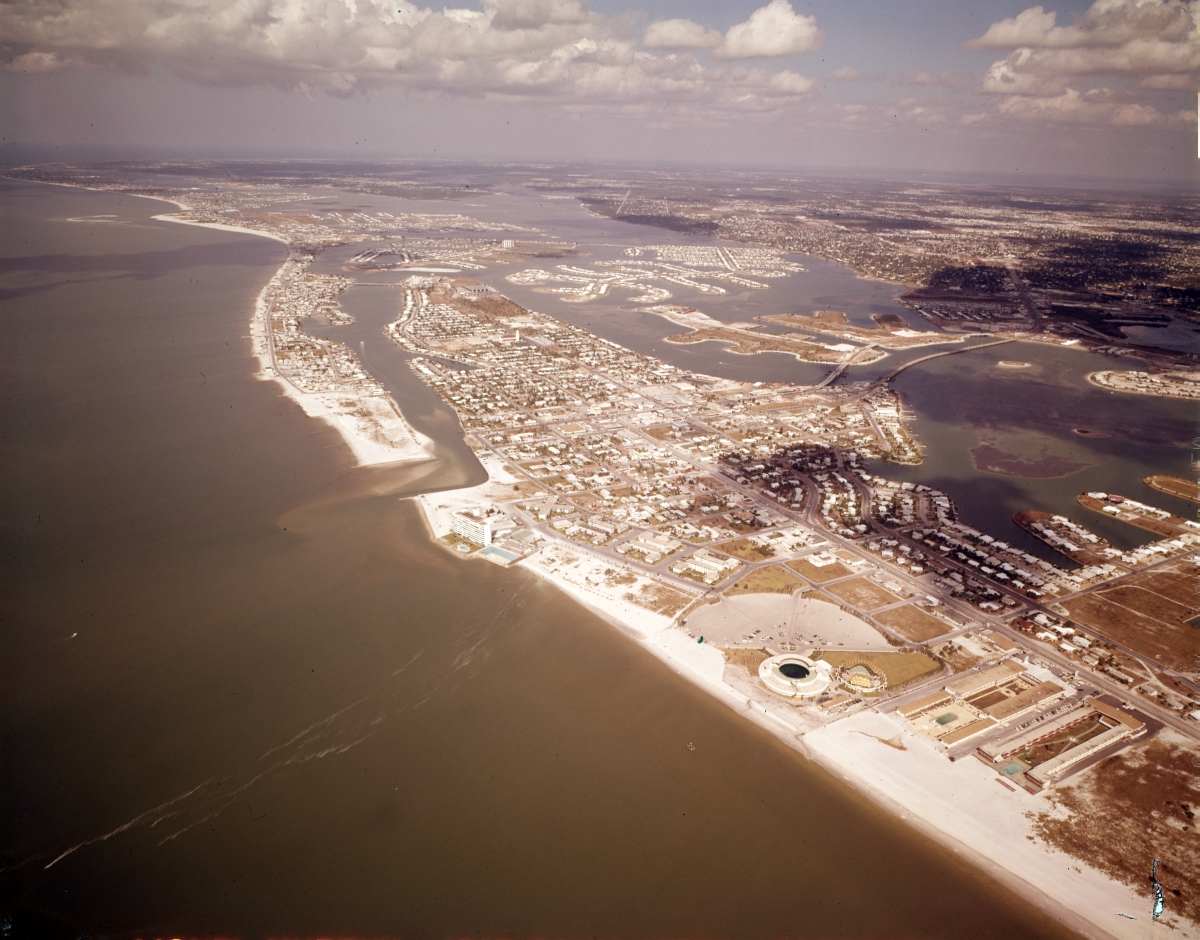 1960s
1960s1964 aerial — Shore Acres was in the middle of its post-WWII buildout, with new canals being dredged and the Overlook section starting to fill in.
Courtesy of State Archives of Florida, Florida Memory. DC072619.
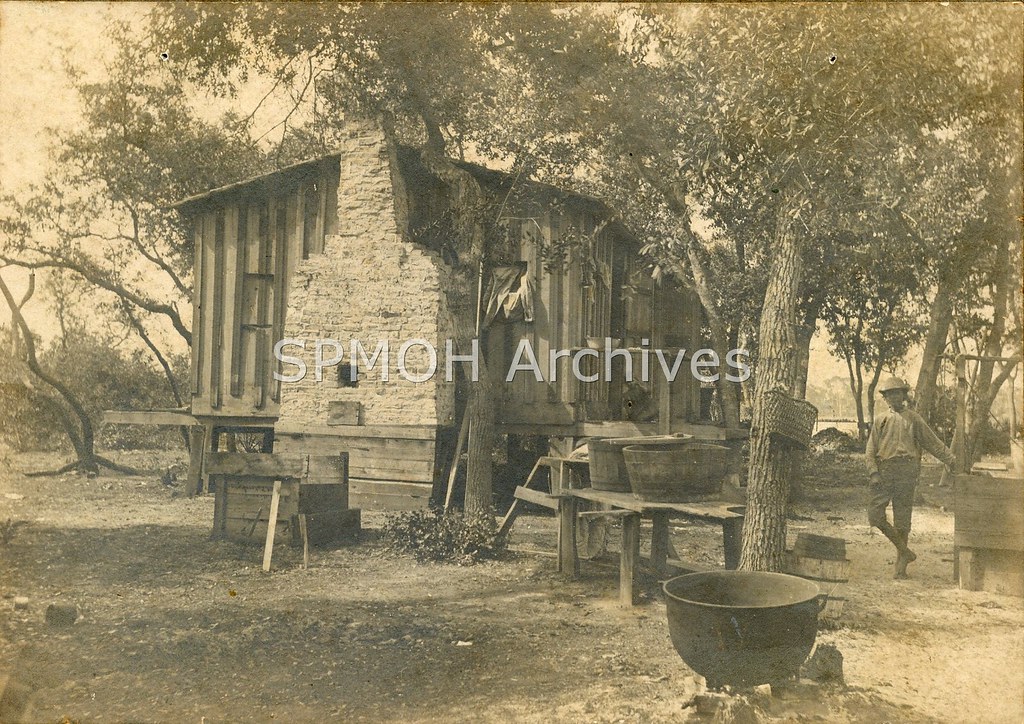 Pre-1900s
Coffee Pot Bayou — the western edge of Shore Acres — pictured around 1900, decades before Upham platted the neighborhood.
Courtesy of St. Petersburg Museum of History Archives, photo no. P00492.
 1910s-1930s
Postcard view of Coffee Pot Bayou between 1910 and 1932 — overlapping the years when Nathaniel J. Upham was platting Shore Acres on the peninsula across the water.
Courtesy of St. Petersburg Museum of History Archives, photo no. 40.9.970.
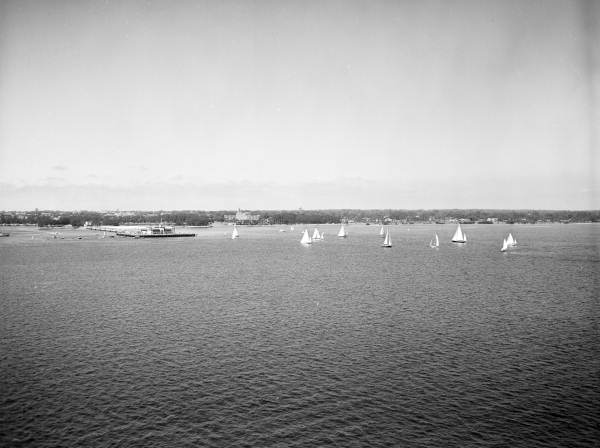 1950s
1950s1955 aerial — Shore Acres' big buildout was just beginning. The 350-home Butterfly Lake project broke ground around this period.
Courtesy of State Archives of Florida, Florida Memory. C20865.
Commute Times
Click any destination to see the mapped route with real-time traffic estimates.
Pros & Cons
The Pros
- Most accessible waterfront pricing in St. Pete proper — sub-Snell-Isle, sub-Old-Northeast
- Canal lots and direct bay frontage with deep-water access for boaters
- 12 minutes to downtown St. Pete — closer than most waterfront neighborhoods
- Strong land value — even substantially damaged homes attract buyers and rebuilders
- Newer elevated rebuilds perform dramatically better in storms and carry lower flood-insurance costs
- Active boating community with public and private launches and tons of canal access
- Brand-new $11M Shore Acres Recreation Center (2022) with 6-lane pool, gym, and programs
- Excellent zoned elementary (Shore Acres Elementary) and Mangrove Bay Golf Course at the doorstep
The Cons
- Most of the neighborhood sits in flood zone AE on land just 2-7 feet above sea level
- Hurricane Helene (Sept 2024) flooded approximately 82% of homes — many with 4+ feet of water inside
- Many homes are still in mid-rebuild as of early 2026 — visible storm damage on some streets
- FEMA 50% Substantial Improvement rule applies to most renovations on older slab homes
- Flood + wind insurance has reset upward and is now a major monthly carrying cost
- Block-by-block variation in recovery — neighbors at very different stages of rebuild
- City flood-mitigation project ($33M, breaks ground summer 2026) means construction disruption ahead
What You Need to Know
Who Should Live Here
Buyers who specifically want waterfront access at lower price points and either want a newer elevated home or are buying with eyes wide open about the rebuild path on an older slab. Boaters and fishermen who need canal access without paying Snell Isle pricing. Buyers who can absorb a five-figure annual insurance bill without flinching. Buyers who are comfortable doing real due diligence — substantial-damage letters, elevation certificates, FEMA lookback periods — instead of buying on vibes. If any of that sounds heavy, look at Crescent Lake, Disston Heights, or Allendale instead.
What to Watch For
This is the single most important due-diligence neighborhood in St. Pete. Pull the substantial-damage letter status from the city. Understand the FEMA 50% rule and the lookback period — improvements made in prior years can count toward the threshold. Get the elevation certificate. Get a real (not seller-supplied) flood and wind insurance quote before you go under contract. Inspect the seawall and dock — Helene took out a lot of both. Pull permit history to confirm any post-Helene work was permitted and inspected. If the home is being sold 'as-is, post-storm,' assume nothing about what's behind the drywall until your inspector says otherwise.
What to Expect
A neighborhood in active transition. Some streets — especially the higher-elevation interior — look much like they did pre-Helene. Others are mostly rebuilds and elevations in progress, with stilt homes going up next to original 1960s ranches. Newer modern coastal construction is replacing 1950s slabs at a meaningful pace, and the character of the neighborhood is genuinely changing. Canal lots are still the core appeal. Pricing remains more accessible than other waterfront areas — that's the whole reason buyers come here, and that's also why the rebuild math works for many sellers. Expect the city's $33M flood-mitigation project to bring construction noise and road closures starting summer 2026.
Aaron's Honest Take
Aaron & Aubrey Chand
Living in St. Pete · Excellecore Real Estate
Here's what I tell buyers who ask me about Shore Acres: this is the elephant-in-the-room neighborhood in St. Pete right now, and we're going to talk about it head-on before we look at a single house. Helene flooded roughly 82% of Shore Acres in September 2024 — over six feet of surge, the highest on record. Many homes had four feet of water inside. Milton came through two weeks later. As Aubrey and I drive clients through the neighborhood today, you can still see the recovery — gutted homes next to fresh stilt rebuilds, contractor signs in front yards, seawalls being replaced. That's the reality, and any agent who tries to walk you past it is doing you a disservice.
Now the other side. Shore Acres has always been the way buyers got into waterfront in St. Pete without paying Snell Isle prices, and that math actually got more interesting after Helene, not less. Pricing has reset on the older slab homes. Land value held up because the lots are still the lots — canals, deep-water access, twelve minutes to downtown. The newer elevated rebuilds going up across the neighborhood are an entirely different building: pile foundations, finished living space lifted ten-plus feet, impact glass, metal roofs, FEMA-compliant breakaway walls. They priced out very differently in Helene than the 1960s slab next door, and they'll insure very differently going forward. If you buy the right kind of home here, the next storm is a fundamentally different conversation.
But you have to do the homework, and there's no shortcut. Substantial-damage letter. Elevation certificate. The FEMA 50% rule and the lookback period. A real insurance quote in writing before you remove contingencies — not the seller's number from three years ago. Permit history on any work done since September 2024. Seawall and dock condition. The city's $33M flood-mitigation project starts construction summer 2026 — know which blocks are affected. None of this is a reason not to buy in Shore Acres. It's a reason not to buy in Shore Acres without an agent who'll slow you down and walk you through every line item. We've helped over 50 buyers relocate to Tampa Bay, and this is the one neighborhood where 'we'd rather lose a deal than let you buy the wrong house' isn't a slogan — it's the job.
The Buying Reality
30-90 days for non-elevated homes; elevated rebuilds and dry-during-Helene homes go in under three weeks
Elevated — more inventory than pre-Helene as some owners decided to sell rather than rebuild
Common on elevated/rebuilt homes and on direct-bay lots; rare on as-is post-storm slab homes
On elevated homes: pre-approval, insurance pre-quoted, clean inspection terms. On older homes being sold for land value: cash or rehab/construction financing, willingness to handle the 50% rule and elevation requirements yourself, and a contractor lined up before you make the offer.
Schools & Zoning
Magnet Options
Private / Independent
Pinellas County operates a controlled-choice attendance system, so zoning is one factor among several. Shore Acres Elementary draws strong reviews from neighborhood parents and has an active PTA. Many Shore Acres families pursue magnet placements at Hopkins or Lakewood for middle and high school. Northeast High has solid programs but isn't a magnet itself. Verify zoning and choice-program eligibility through the PCSB School Zone Locator before counting on any specific school.
Insurance & Maintenance Reality
Pre-War Home Considerations
Insurance in Shore Acres is its own conversation, and you need to start it before you make an offer — not after. Almost the entire neighborhood sits in flood zone AE, which means flood insurance is required by any lender. Median annual flood premiums in Shore Acres reach roughly $5,000 and climb higher on non-elevated homes after the FEMA Risk Rating 2.0 changes. Wind insurance through Citizens (often the only available carrier on a slab home this close to open water) adds another major line item. Total annual insurance — flood plus wind plus hazard — on an older slab home in Shore Acres routinely runs $8,000-$15,000, and that's before you factor in any post-Helene reassessment.
The single biggest variable is whether the home is elevated above Base Flood Elevation (BFE). An elevated rebuild with finished living space 10+ feet above grade and a properly vented enclosure below can cut flood premiums by 60-80% versus the slab home next door. That's not a small detail — over a 10-year hold, that delta can be $40,000-$80,000. It also widens your carrier options dramatically.
The FEMA 50% rule (Substantial Improvement / Substantial Damage) governs what you can do to a non-elevated home post-purchase. If the cost of any single project plus prior improvements within the lookback period exceeds 50% of the structure's market value (excluding land), you trigger a full elevation requirement. St. Petersburg currently uses a multi-year lookback, which has been a flashpoint locally — Shore Acres Civic Association has been pushing for a one-year lookback after a calamity event. Talk to a contractor experienced with FEMA-compliant work before you fall in love with a home that needs renovation. They'll tell you within ten minutes whether you can do what you want without triggering elevation.
Storm Impact: Helene & Milton
Shore Acres took the worst hit of any St. Pete neighborhood in 2024. Hurricane Helene (Sept 26-27, 2024) drove over six feet of storm surge into the neighborhood — the highest on record — flooding an estimated 82% of homes, many with four feet or more of water in finished living spaces. Hurricane Milton followed two weeks later. The combined damage triggered the FEMA Substantial Improvement / 50% rule across hundreds of properties and reshaped the neighborhood in ways that are still playing out as of early 2026. This is the elephant-in-the-room neighborhood in St. Pete real estate right now.
Hurricane Helene
Sep 2024Devastating. Six-plus feet of storm surge — highest on record for Shore Acres. Approximately 82% of homes flooded; many with 4+ feet of interior water. Saltwater inundation destroyed flooring, drywall, cabinetry, mechanicals, and personal property at scale. House fires were reported in the Tanglewood pocket. The Tampa Bay Times, Fox 13, and Bay News 9 all covered the immediate aftermath in detail. Recovery started immediately but the FEMA 50% rule has slowed down many rebuilds — homeowners are choosing between repairing within the threshold, fully elevating, or selling for land value. As of early 2026, some streets look largely restored; others still have visible damage and ongoing construction.
Hurricane Milton
Oct 2024Came through about two weeks after Helene. By the time Milton arrived, most Shore Acres homes were already gutted from Helene, so the additional surge from Milton was less catastrophic in absolute terms but compounded the damage on properties that hadn't yet been dried out. Wind damage on already-stressed roofs was the main additional insurance event. Milton is the second hit that gets less press but matters for any buyer pulling damage history.
Blocks to Watch
Connecticut Avenue NE corridor and Bayshore Boulevard NE — the lowest, most flood-prone area, which is exactly why the city's $33M flood-mitigation pump station and stormwater upgrade is going there. Tanglewood, the canal-front blocks of Bayou Grande Boulevard NE, and the Overlook section saw some of the deepest water. Higher-elevation interior streets near Mangrove Bay Golf Course fared somewhat better but were not spared. Always pull the elevation certificate and the substantial-damage letter for the specific property — block-level generalizations don't replace property-level data.
Community & Events
Shore Acres Civic Association meetings
Monthly
One of the most active neighborhood associations in St. Pete — meetings cover flood mitigation, elevation grants, the city's resiliency project, and post-Helene rebuild advocacy. SACA has been the lead community voice on FEMA 50% rule reform.
Raise Up Forum
Periodic, post-storm
Educational sessions held at the Shore Acres Recreation Center to help residents understand federal and state elevation funding (Elevate Florida, FEMA HMGP), the FEMA 50% rule, and the practical mechanics of raising a home.
Helene Anniversary Remembrance
Late September
Community gathering held by SACA on the anniversary of Helene's landfall to honor neighbors lost or displaced and mark recovery milestones. Covered by WTSP and local outlets.
Shore Acres Rec Center programming
Year-round
Yoga, Tae Kwon Do, dog obedience, sewing, youth seasonal camps, and before/after-school childcare in the new $11M facility. A real day-to-day quality-of-life anchor for the neighborhood.
What Residents Are Saying Online
Pulled from public discussion threads on City-Data Tampa Bay (pre- and post-Helene) plus published local journalism. The flooding conversation in Shore Acres long predates Helene — residents have been openly discussing tidal flooding, insurance burden, and the 'when the big one comes' calculus on these forums for years. Helene crystallized everything they were already saying. Quotes here capture both the long-running ambivalence and the specific 2024-2025 rebuild reality.
“Yes... it does. I live in Shore Acres (my entire life), and it floods whenever the tide is a few feet above normal, even if there is no rain.”
“We pay about $3600 a year, and because we're basically an island, Citizens is just about the only insurance company you can get coverage with.”
“When the big one comes, we will be under water. Period. However, so will everyone else within a few miles of the coast.”
“The homes there appear to be kept up better than anywhere else I've seen in St. Pete for the money.”
“It's like driving through a canyon of people's lives on the curb.”
“We're not rebuilding. I had no idea it would be this bad.”
“I have dozens of new connections. I was blown away by how amazing every neighbor was. Everyone was in it together.”
Further Reading & Resources
Civic & Preservation
City of St. Petersburg — Shore Acres Resiliency Infrastructure
Official project page for the $33M Shore Acres flood-mitigation project — scope, timeline, public meetings, and affected streets.
Pinellas County — Substantial Damage & Storm Permits
Official county guidance on the FEMA 50% rule, substantial-damage letters, and post-storm permitting — required reading before buying any non-elevated home in Shore Acres.
City of St. Petersburg — Floodplain Management
Floodplain rules, BFE standards, and city-specific implementation of the 50% rule. Includes elevation certificate guidance.
Shore Acres Repetitive Loss Area Analysis (2019)
City-commissioned 2019 analysis of repetitive flood loss in Shore Acres — primary-source data on which blocks flood, how often, and from what sources. Pre-Helene but the geography hasn't changed.
Elevate Florida — home elevation grant program
State program that funds elevation of repeatedly-flooded homes. Over 500 Shore Acres residents applied; roughly 100-150 will be funded.
Journalism
St Pete Catalyst — Floodlines: Shore Acres residents ponder an uncertain future
Long-form post-Helene feature with resident interviews — essential reading for any buyer considering the neighborhood.
St Pete Catalyst — Chaney proposes re-interpretation of FEMA's 50% rule
Coverage of the local political effort to reform how the FEMA 50% rule is applied in St. Pete — directly relevant to Shore Acres rebuild economics.
Tampa Bay Times — Shore Acres assesses damage after Helene
Tampa Bay Times' immediate coverage of the Helene damage in Shore Acres.
Tampa Bay Times — Build or bail? Shore Acres grapples with future
Pre-Helene Tampa Bay Times feature on the rebuild-vs-sell question that defines the neighborhood. Holds up after Helene.
Grist — This Florida neighborhood recovered from flood after flood. Will it survive Helene?
National-outlet long-form on Shore Acres' repeat-flooding cycle — useful for buyers who want the outside view.
Northeast Journal — Shore Acres, the Shortcut That Never Was, Turns 100
Local-magazine history of the neighborhood — Upham, the Gandy dredges, the Weedon Island bridge, and the post-WWII buildout.
Northeast Journal — As Shore Acres Rebuilds, a Community Learns and Grows
Feature on the post-Idalia (and ultimately post-Helene) rebuild culture — elevation, water-resistant materials, community response.
St Pete Rising — $33M Shore Acres flood mitigation project funding
Coverage of the city's biggest single-neighborhood resiliency investment, breaking ground summer 2026.
Neighborhood Association
What's Nearby
Shore Acres Recreation Center
in neighborhood
Shore Acres Pool
in neighborhood
Mangrove Bay Golf Course
0.5 mi
Weedon Island Preserve
5 mi
Sunken Gardens
3 mi
4th Street North dining corridor
1.5 mi
Downtown St. Pete waterfront
4 mi
The Pier
4.5 mi
Coffee Pot Bayou
1 mi
St. Pete Beach
12 mi
Northeast Park Shopping Center
1.2 mi
Saturday Morning Market
4 mi
Elevation & Flood Risk
4ft average elevation
FEMA Flood Zone AE (most of the neighborhood) — flood insurance required
Thinking about Shore Acres?
We've helped over 50 buyers relocate to Tampa Bay. Let's talk about whether Shore Acres is the right fit for you.
Explore more neighborhoods
View All in Relocation Guide