The Pink Streets
St. Pete's only pink-paved waterfront neighborhood
Platted 1925 (Pinellas Point Edition)
Established
George Cook / Murok Realty Corp.
Developer
First concrete-paved streets in St. Pete (tinted pink with hematite)
First-of-its-kind
City Council, September 1989 — pink streets stay
Preservation vote
1925-1928 Spanish/Tudor + 1953-58 Vision-Aire + 1950s-70s ranches
Architectural mix
Larger than north St. Pete — many over 10,000 sf
Typical lot
Neighborhood Overview
The Pink Streets sit at the southernmost tip of St. Petersburg, inside the larger Greater Pinellas Point neighborhood, and they are one of those places you actually have to drive through to understand. The streets are pink — not painted, not stained, but mixed pink at the plant in 1925 with hematite (iron oxide) so the concrete itself is the color. They were the first concrete streets in St. Petersburg. Everything before that had been brick and shell. Developer George Cook, working through his Murok Realty Corp., poured them as part of the Pinellas Point Edition along with continuous pink curbs, claiming the dye would cut glare and reduce heat absorption.
Cook's plan was bigger than what got built. He had permission to dredge 140 more acres into Tampa Bay in a skull-shaped layout of finger lots and lagoons, with an exclusive beach and casino. The 1926 land bust killed most of it. By 1930 only seventeen homes stood along the new pink streets. The neighborhood filled in slowly over the next forty years — 1920s Spanish and Mediterranean Revival next to 1950s ranches next to Glenn Q. Johnson's mid-century Vision-Aire "Birdcage" homes — which is why the Pink Streets today reads like a forty-year cross-section of Florida architecture on the same block.
What buyers actually get: panoramic views of Tampa Bay and the Sunshine Skyway, larger lots than almost anywhere in north St. Pete, a Tocobaga temple mound preserved inside the neighborhood, and a price floor that's still meaningfully below comparable waterfront in Snell Isle or Old Northeast. The trade-offs are real. You drive for most errands. The area was hit hard enough by Hurricane Helene's storm surge in 2024 that you have to underwrite waterfront blocks block-by-block. And while the neighborhood has the Greater Pinellas Point Civic Association, it does not have local historic district protection — meaning the architectural mix can keep changing. That's the deal. For the right buyer it's one of the best value plays on the water in the city.
History & Origins
Platted 1925 as the Pinellas Point Edition
George Cook (Murok Realty Corp., founded 1925 by Marguerite Cook and her son George E. Cook)
Pre-Boom / Florida Land Boom (1925-1926); built out 1925-1970
The Pink Streets begin with a 1925 marketing decision. George Cook's Murok Realty Corp. — the name a portmanteau of his mother's maiden name (Murat) and Cook — wanted the Pinellas Point Edition to feel grander than anything else on the market. Cook had been to the Lake Wales section of central Florida and noticed how the red clay roads cut glare and "blended beautifully into the landscape," as a May 1925 Tampa Morning Tribune article quoted him. He decided the new subdivision's streets would be the first concrete pavements in St. Petersburg and they would be pink. A July 12, 1925 St. Petersburg Times piece described the mix as "one part cement, two parts sand and four parts selected gravel" tinted with hematite. The pink curbs were poured continuous with the streets, and the development was platted on a curving layout with simple street names — Cook didn't like the hard-to-pronounce Spanish names popular in California developments and insisted on Blossom, Neighbor, and Home.
Then the 1926 bust hit. Cook had received city approval that October to dredge 140 additional acres into Tampa Bay in a skull-shaped configuration of finger lots, deep lagoons, an exclusive beach, and a casino. The dredging never happened. By 1930, only 17 homes had been built along the new pink streets. The neighborhood filled in slowly over the following decades — a 1925 Catherine Bell Tippetts house here, the 1926 Mediterranean Revival Argenteau Castle there, then ranches in the 1950s and 1960s, and Glenn Q. Johnson's 13 to 15 Vision-Aire "Birdcage" homes between 1953 and 1958 in the Bay Vista Park subdivision and Bayou Shores. Bay Vista Park itself, at the south end of 4th Street, was the landing for the Bee Line Ferry beginning in 1927 — the ferry that turned the 60-mile drive to Bradenton into a 7-mile boat ride and ran until the original Sunshine Skyway opened in 1954.
The defining 20th-century moment came in the 1980s. By then, the pink streets were potholed and the city debated for six years whether to repave them in standard asphalt at roughly half the cost. Pink concrete was almost double the price. Residents fought back. On September 7, 1989, the St. Petersburg City Council voted to maintain the pink streets and the hexagonal-block sidewalks. Nearly 4.5 miles of pink concrete were repaired in the early 1990s, with residents assessed the cost difference between asphalt and pink concrete. The pink streets stayed. The Pinellas Point Temple Mound — one of the few remaining Tocobaga mounds in St. Petersburg, donated to the city by Edward C. Wright in 1958 and made an official historical and archaeological landmark in 1993 — also stayed, despite mountain bike tracks and graffiti nearly destroying it before preservation efforts by USF, the Florida Archaeology Network, and the Greater Pinellas Point Civic Association rescued the site in the early 2000s. The Pink Streets is not a designated historic district, but it has the kind of resident-driven preservation history most designated neighborhoods spend decades trying to build.
Architecture & What You'll Be Buying
Predominant Styles
Typical Year Built
1925-1970, with infill new construction continuing today
Typical Size
1,400-2,400 sq ft on lots typically 9,000-15,000 sq ft (waterfront lots much larger)
Construction
The neighborhood is a forty-year architectural cross-section. A 1925 Spanish villa with coral-rock surrounds and a 1953 Birdcage with floor-to-roofline screened terraces can sit a block apart. Most ranches are concrete-block construction with terrazzo or hardwood floors and original jalousie windows. The mid-century homes — particularly Glenn Q. Johnson's 13-15 Vision-Aire houses, built 1953-58 — used insect-resistant cedar, cypress, and redwood, with elevated living floors and floor-to-roof screens designed to run 10-12 degrees cooler than outside without air conditioning. Recent Vision-Aire sales: $420,000 to nearly $1 million.
Materials & Streetscape
Pink-tinted concrete streets and curbs (continuous-pour 1925 originals + 1990s in-kind replacements). Hexagonal-block sidewalks in some sections. Stucco-over-frame and stucco-over-block on the 1920s homes; concrete block on most mid-century construction; cedar, cypress, and redwood interiors on the Birdcage homes. Coral rock fireplaces and Florida Keys coral surrounds appear in the 1925 Tippetts house and a handful of other 1920s estates.
Pockets Within the Neighborhood
The Pink Streets proper
The original 1925 Murok subdivision — roughly between 10th Street and 21st Street, just south of Pinellas Point Drive South. This is where the 1920s Spanish, Tudor, and Mediterranean Revival homes are concentrated, along with the Tippetts and Argenteau houses.
What sets it apart: The actual pink concrete streets and continuous pink curbs. The most architecturally varied blocks in the neighborhood. Larger lots, more 1920s land-boom DNA, and the bones of George Cook's original plat.
Bay Vista Park subdivision
Mid-century neighborhood inside Greater Pinellas Point along Pinellas Point Drive S and 69th Avenue S — home to most of Glenn Q. Johnson's Vision-Aire "Birdcage" houses and the 1950s-60s ranches that filled in around them. Bay Vista Park itself sits at the south end of 4th Street S and was the original Bee Line Ferry landing.
What sets it apart: The mid-century modern concentration. If you are buying a Birdcage or want walkable access to the boat ramps, kayak launch, and Skyway-view park, this is the pocket.
Bayou Shores
Waterfront pocket along Big Bayou with mid-century and modern custom homes, including a handful of additional Birdcage houses. Quiet, dead-end-feeling streets with deepwater frontage.
What sets it apart: Genuine deepwater access for sailboats and larger powerboats. More AE flood-zone exposure than the inland Pink Streets, so insurance and elevation certificates matter more here.
Notable Homes & Landmarks
Catherine Bell Tippetts House (1925)
Built 1925
Built for Catherine Bell Tippetts, who founded the St. Petersburg branch of the Florida Audubon Society in 1909 and led the campaign that named the mockingbird Florida's state bird (1927) and the orange blossom the state flower. Her work as Chair of the Conservation Division of the General Federation of Women's Clubs spread the idea of state birds and flowers nationwide. The house features coral from the Florida Keys as window and door surrounds and a coral-rock fireplace. Tippetts Park at the southern tip of 14th Street South was renamed in her honor in 2009.
Later occupied 1971-1984 by Ron and Doris Guay — stage names Ron and Joy Holiday — known as "The Cat Dancers," who practiced their act with live tigers in the backyard. Their story is the subject of the 2007 HBO documentary The Cat Dancers.
2199 Serpentine Circle S (Argenteau Castle / The Princess House)
Built Completed December 1926
Mediterranean Revival castle built to house the European royal collection of Princess Rosalie de Mercy-Argenteau ("Rose" / "The Gold Rose of Paris"), the last of one of Belgium's oldest royal lines. The contents included a 1070 parchment granting castle rights to her ancestor, Marie Antoinette lace, court gowns, autographed scores from world-class composers, and hundreds of dog portraits. Rose died mysteriously in 1925 (rumors of poisoning) before the castle was completed. It opened as a museum in December 1926 and failed within three years.
Mayor Al Lang — the man who brought spring training baseball to St. Pete and championed the Green Benches — purchased the home at auction in 1933 and threw parties with Babe Ruth in attendance. The property was condemned in the late 1960s and sold for $20,000. A full restoration was completed 2005-2007. Four bedrooms, each on a different level with balconies, and what one feature called "perhaps the best views in St. Petersburg."
1535 Manor Way S (Beauchemin House)
Built ~1928
Two-story English Tudor masonry-brick built for Joseph S. Beauchemin — a Springfield, Massachusetts architect-developer who introduced Dutch Colonial homes to Tampa Bay during the land boom. "Beauchemin Built" homes still stand in Crescent Lake, Roser Park, Grove Heights, and Allendale. Five bedrooms, six baths, 5,434 sq ft, hidden wine cellar, stained-glass windows, sunken home theater, pool, and detached garage on a 0.57-acre corner lot. Listed at $2.175M in August 2024 — bought by the seller in 2022 for $850,000.
The Beauchemins lived in the home only briefly before selling in May 1930 in what period coverage called "one of the largest [sales] made in the city."
711 Pinellas Point Drive S (Vision-Aire / Birdcage)
Built 1954
One of only 13 to 15 Vision-Aire "Birdcage" homes designed by architect Glenn Q. Johnson and built between 1953 and 1958. The Birdcage design — inspired by dwellings Johnson saw on a WWII tour in the Philippines — features an elevated living floor surrounded by floor-to-roofline screened terraces, vaulted ceilings with skylights, heavy concrete floors, and interior walls built as jalousies for cross-ventilation. All Vision-Aire homes face southeast to catch winter sun and prevailing breezes from Tampa Bay. Designed to run 10-12 degrees cooler than outside without air conditioning. 1,424 sq ft on a quarter-acre lot. Listed at $800,000 in May 2024.
749 69th Avenue S (Vision-Aire / Birdcage, Bay Vista Park subdivision)
Built 1954 (1967 addition)
Glenn Q. Johnson Birdcage with cedar paneling, vintage rosewood Cado wall system, large screened patios, heavy concrete floors, and original jalousie walls. 2,122 sq ft, two bedrooms, two baths. Sold in 2022 for $650,000 and again in 2023 for $758,000. One of the cleanest surviving examples of Johnson's mid-century Florida modernism.
Then & Now
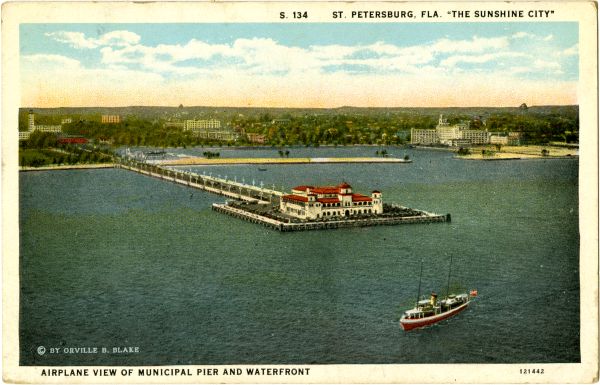 1920s
1920s1926 aerial of the St. Pete waterfront — the same era the Pink Streets were laid out and the Argenteau Castle was completed.
Florida Memory / State Archives of Florida — pc13231
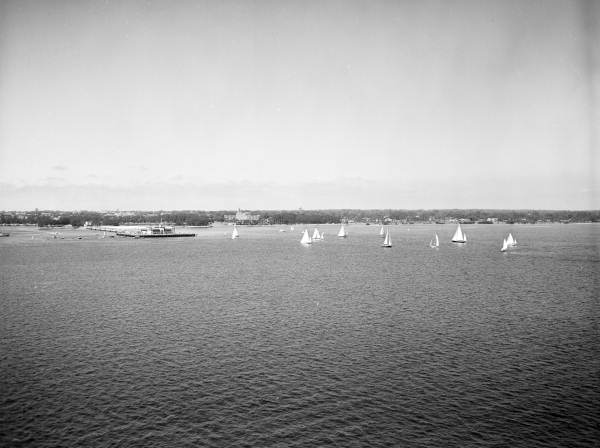 1950s
1950s1955 aerial — the Pink Streets and Bay Vista Park were filling in with mid-century ranches and Glenn Q. Johnson's Vision-Aire Birdcage homes (1953-58).
Florida Memory / State Archives of Florida — c20865
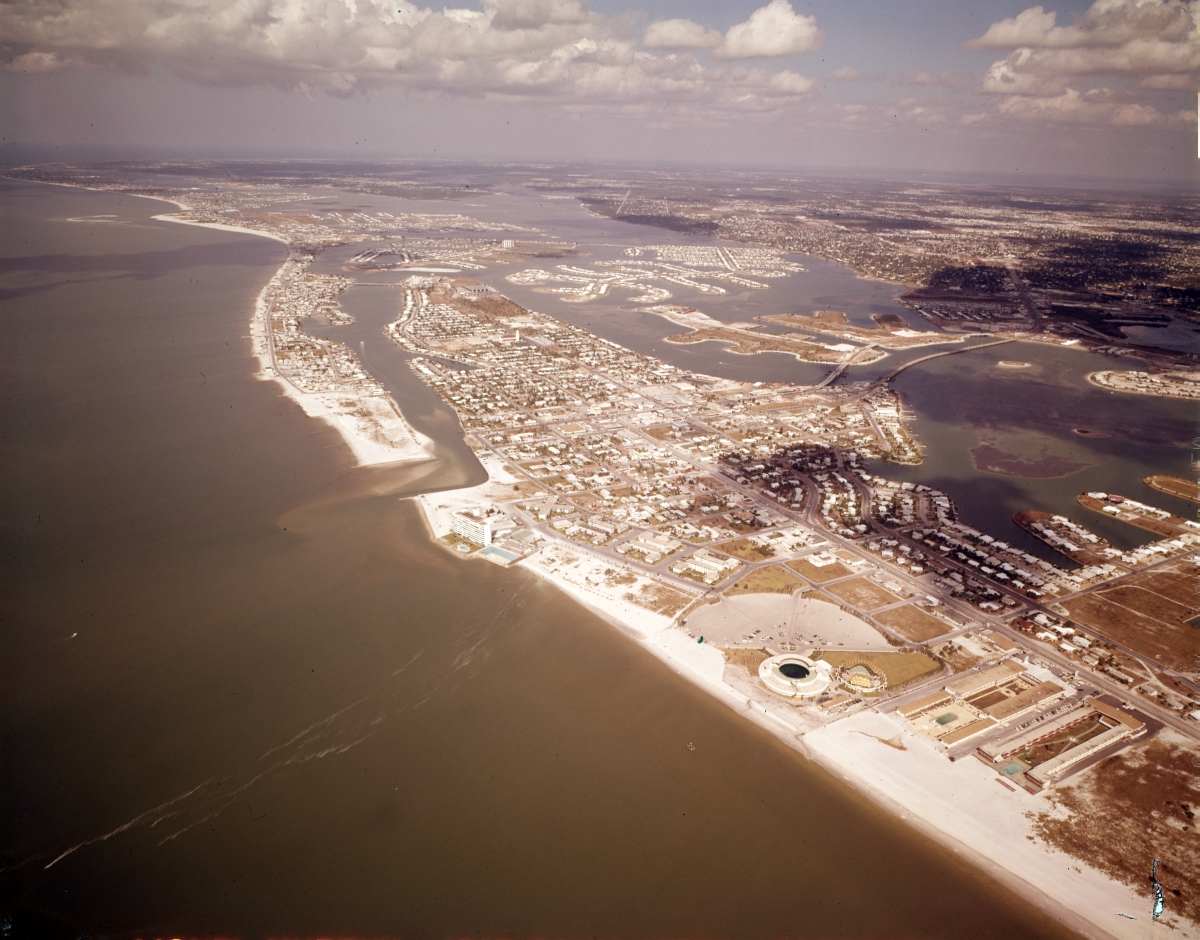 1960s
1960s1964 aerial looking north — the Sunshine Skyway is in place and Pinellas Point's mid-century build-out is well underway.
Florida Memory / State Archives of Florida — dc072619
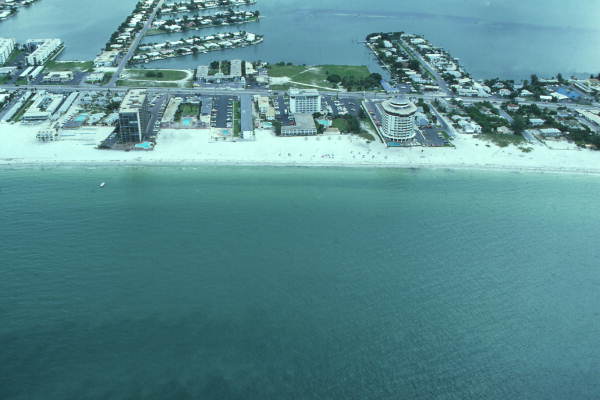 1970s
1970s1976 — by this point the Pink Streets are complete and the Greater Pinellas Point Civic Association has taken on early preservation efforts at the Tocobaga temple mound.
Florida Memory / State Archives of Florida — k024244
Commute Times
Click any destination to see the mapped route with real-time traffic estimates.
Pros & Cons
The Pros
- The pink streets themselves — literally one-of-a-kind in America, and the first concrete-paved streets in St. Pete (1925)
- Panoramic Tampa Bay and Sunshine Skyway views from many blocks; some streets dead-end at the water
- Larger lots than almost anywhere in north St. Pete — many over 10,000 sq ft, with mature oaks and tropical landscaping
- Architectural variety on the same block — 1920s Spanish next to 1953 Vision-Aire Birdcage next to a 1960s ranch
- Pinellas Point Temple Mound preserved inside the neighborhood — one of the few remaining Tocobaga sites in St. Pete
- Bay Vista Park and Lake Vista Park both inside the area — boat ramps, kayak launch, Skyway views, dog park, pool
- Genuinely diverse community with an active civic association (Greater Pinellas Point Civic Association)
- Waterfront pricing meaningfully below Snell Isle, Old Northeast, or Bayway Isles for comparable footage
The Cons
- Not a local historic district — no protection against teardowns or out-of-character infill
- Hurricane Helene's 2024 storm surge reached deep into Greater Pinellas Point — waterfront and low-lying inland blocks need block-by-block flood-zone verification
- Walk Score is low — you drive for most errands; not the walkable-to-downtown lifestyle of Old Northeast or Roser Park
- School zoning is the south-county application area — buyers using public schools typically lean on magnets rather than zoned schools
- Mid-century homes on slab need flood-zone diligence; some have not been elevated since they were built
- Pink concrete repairs are still assessed to residents — repaving is not free
- Insurance shopping is harder than people expect — older 1920s and 1950s homes need 4-point inspections, wind mitigation, and flood elevation certificates
What You Need to Know
Who Should Live Here
Buyers who want larger lots, water views, and architectural character at a meaningfully better price than north St. Pete waterfront. The Pink Streets reward the buyer who actually likes the eclectic mix — a 1925 Tudor next to a 1955 Birdcage next to a 1968 ranch — instead of wishing the whole block matched. It also rewards the buyer who likes a quieter, more residential rhythm and is fine driving a few minutes to Trader Joe's, downtown, or the beaches. Not the right fit for someone who wants to walk to coffee shops, who needs a top-rated zoned public school by default, or who is unwilling to do the homework on flood zones and insurance.
What to Watch For
Verify the specific lot's flood zone using Pinellas County's flood map service center — the inland Pink Streets are mostly Zone X, but waterfront and Big Bayou frontage runs AE, and some interior pockets sit lower than the headline elevation suggests. Pull an elevation certificate before you write an offer. For 1920s homes, get a thorough inspection of the original plumbing (cast iron, galvanized supply), electrical, and roof — coral and stucco-over-frame look beautiful and hide a lot. For Vision-Aire Birdcages, the original wood is irreplaceable and the screened terraces require ongoing maintenance — be honest about whether you'll keep up with it. Check Helene flood history block-by-block; some homes flooded interior space in 2024 and some did not.
What to Expect
A neighborhood where the pink streets actually do reduce glare in afternoon light, where Skyway views are part of multiple side streets, and where Bay Vista Park's boat ramp and kayak launch are part of the rhythm of life. Quieter than Old Northeast. More architecturally surprising than Snell Isle. Diverse — economically and demographically — in a way that buyers from north St. Pete sometimes underestimate. Driving everywhere, but a fast straight shot up 4th Street to downtown. Less foot traffic, more dog walks, more evening sky over Tampa Bay.
Aaron's Honest Take
Aaron & Aubrey Chand
Living in St. Pete · Excellecore Real Estate
Here's what I tell buyers about the Pink Streets: this is the value play on the water in St. Pete right now. You get bigger lots, real Tampa Bay views, the Sunshine Skyway out your kitchen window on some streets, and you pay meaningfully less than you would for a comparable footprint in Snell Isle or Old Northeast. The cost of admission is a slightly longer commute to downtown, a school zoning answer that pushes most buyers toward the magnets, and the homework on flood zones that any waterfront-adjacent neighborhood in this city now requires. If those things are dealbreakers, look further north. If they're not, the math is hard to argue with.
The architecture is what surprises everyone. People hear "Pink Streets" and assume one era of houses. It's a forty-year cross-section. A 1925 Catherine Bell Tippetts Spanish villa with coral-rock fireplaces, the Argenteau Castle from 1926, the Beauchemin Tudor from 1928, then a wave of 1950s and 1960s ranches, then Glenn Q. Johnson's Vision-Aire Birdcages from 1953 to 1958 — only thirteen or fifteen of those exist anywhere — and contemporary new construction filling in the gaps. You can find a buyer for any of those eras at the right price. You just have to know which one you're buying and price it accordingly. Most agents in this city don't know the difference between a Birdcage and a 1962 ranch. That's a knowledge gap you can use.
The honest cons: this is not a designated historic district. The pink streets stayed because residents won a six-year fight in the 1980s and paid the assessment for pink concrete in the 1990s, but the houses themselves don't have local district protection. That cuts both ways — it means lighter renovation rules, but it also means a teardown two doors down is legal. Helene's surge in 2024 reached deeper into Greater Pinellas Point than a lot of buyers expect, and not every block dried out the same way. Walk-everywhere buyers will be frustrated. In the past couple years, we've helped over 50 buyers relocate to Tampa Bay, and the ones who land here are usually the ones who came in wanting Old Northeast and walked away thinking the Pink Streets gave them more square footage, more water, more sky, and more character per dollar. That's the play.
The Buying Reality
~30-50 days for fairly-priced inland homes; restored historic and Birdcage homes go faster
Moderate — roughly 20 homes a year sell across the Pink Streets proper
Common on Vision-Aire Birdcages and on restored 1920s Tudors and Spanish under $1.2M
Pull elevation certificates and Helene flood history before you write. Have insurance quotes in hand for older homes and waterfront. Sellers here are sophisticated about flood diligence; making it your problem at inspection is how deals fall apart. For Birdcages, lead with appreciation for the architecture — these sellers care who moves in next.
Schools & Zoning
Magnet Options
Private / Independent
Pinellas County uses a controlled-choice / application-area system, so zoned-school answers are one input, not the whole answer. The Pink Streets sit in the south-county application area and most public-school families end up at one of the magnets (Lakewood CAT, Bay Point CAST, Bay Point Elementary Magnet) rather than purely zoned schools. Always run the specific address through the PCSB School Zone Locator at https://www.pcsb.org/zone before assuming a school assignment.
Insurance & Maintenance Reality
Pre-War Home Considerations
Insurance in the Pink Streets is a real conversation, not a checkbox — and after Helene it became more so. Carriers will require a 4-point inspection (roof, electrical, plumbing, HVAC) and a wind-mitigation report on anything older than 25-30 years. Roof age matters most: a roof over 15 years old will narrow your carrier list quickly, and over 20 years can become uninsurable through standard markets without replacement.
For 1920s homes — the Spanish villas, the Tudors, the Tippetts and Beauchemin houses — the common surprises are knob-and-tube wiring still hiding behind plaster, cast-iron drain lines at end of life, galvanized supply lines under century-old yards, and original cloth-wrapped wiring. None of these are dealbreakers. Each can add real renovation cost.
For mid-century homes (1950s ranches and the Vision-Aire Birdcages), the issues are different: slab-on-grade construction means flood-zone exposure is the bigger insurance variable. Pull an elevation certificate before you write. Helene's 2024 surge reached interior space on some blocks of Greater Pinellas Point and not on others — your insurance quote will reflect that block-level history. For waterfront and AE-zone properties, expect to need separate flood insurance, and price it before going under contract.
Storm Impact: Helene & Milton
Greater Pinellas Point — including the Pink Streets — sits on a peninsula bordered on three sides by Tampa Bay, which means storm-surge exposure is real. Hurricane Helene in September 2024 brought the first hurricane-driven surge to the Tampa Bay region in over a century. Pinellas County evacuation Zone A (which covers waterfront sections of Pinellas Point, all barrier islands, all of Tierra Verde, and parts of Gulfport) was placed under mandatory evacuation. Inland Pink Streets blocks fared better than the immediate waterfront, but no part of Greater Pinellas Point was untouched. Underwriting flood exposure block-by-block is mandatory here, not optional.
Hurricane Helene
Sep 2024Helene's surge — recorded at 5 to 8+ feet across coastal Pinellas, with localized peaks higher — flooded waterfront and low-lying inland blocks of Greater Pinellas Point. Some Pink Streets homes saw water in yards but not living spaces; others on AE-zone frontage along Big Bayou and Tampa Bay saw interior flooding. The 2024 storm reset what buyers and lenders expect for elevation certificates, flood insurance, and Helene-history disclosures in this neighborhood specifically.
Hurricane Milton
Oct 2024Hurricane Milton arrived two weeks after Helene with strong winds and heavy rain (parts of St. Pete saw 18+ inches of rain and 101 mph gusts) but spared Pinellas the catastrophic surge. For the Pink Streets, Milton was primarily a wind and rain event — additional roof damage on already-stressed roofs, downed trees, fence loss — rather than a second surge.
Blocks to Watch
Waterfront blocks along Tampa Bay and Big Bayou (AE flood zone), the lowest-lying interior streets in Bay Vista Park subdivision, and any home without a recent elevation certificate. The bluffs and elevated interior blocks of the Pink Streets proper performed better, but ask for the specific address's Helene history before you write.
Community & Events
Greater Pinellas Point Civic Association meetings
Quarterly (general membership), 2026
The neighborhood's civic association — promotes inclusiveness, runs preservation efforts (including the Pinellas Point Temple Mound), and is the primary channel for issues affecting the pink streets, the parks, and infill development.
Pinellas Point Temple Mound preservation programming
Ongoing
Walking trails and interpretive signage at the preserved Tocobaga ceremonial mound — restored after a 2000s preservation push by USF, the Florida Archaeology Network, and the Greater Pinellas Point Civic Association.
Bay Vista Park boat ramps & kayak launch
Daily, year-round
4.3 acres of waterfront on the southern shores of St. Petersburg with two boat ramps, a kayak launch, playground, and Sunshine Skyway views. The site was the 1927-1954 landing for the Bee Line Ferry.
Lake Vista Park & Recreation Center
Daily, year-round
Recreation center, pool, skate park, athletic fields, dog park, and recreation trails on 62nd Avenue South — the main community-program hub for Greater Pinellas Point.
What Residents Are Saying Online
Resident sentiment for the Pink Streets / Greater Pinellas Point clusters around four themes: the genuine peace and quiet of the neighborhood, real demographic and architectural diversity, easy 4th Street access to downtown St. Pete, and waterfront/park access most buyers underestimate. The honest cons that come up: it's not a walking neighborhood for shopping or dining, and it sits south of Central, which carries a perception barrier some buyers (and agents) bring to the conversation. After Helene, flood-zone awareness has stepped up sharply for waterfront-adjacent blocks.
“I'm close to everything and yet surrounded by peace and quiet. My neighbors are friendly and the highway connects me to all of Saint Petersburg.”
“Diverse community with convenient shopping. Good schools with low crime rate.”
“Quiet streets, lots of diversity, big yards, several parks including waterfront playground, easy access to the highway, two big grocery stores nearby, close to magnet schools, not in a flood zone.”
“The Greater Pinellas Point neighborhood is a very diverse neighborhood and the neighbors are very helpful and look out for one another.”
“For a neighborhood in the south side it has the lowest crime rate and highest safety measures, and the public schools in Greater Pinellas Point are above average.”
Further Reading & Resources
Civic & Preservation
Pinellas County — Tocobaga Temple Mound
Official county page on the Pinellas Point Temple Mound — one of the few remaining Tocobaga ceremonial mounds in St. Petersburg.
Bay Vista Park (City of St. Petersburg)
Official parks page — 4.3 acres waterfront, two boat ramps, kayak launch, Skyway views. Original 1927-1954 Bee Line Ferry landing.
Lake Vista Park & Recreation Center
Official parks page — recreation center, pool, skate park, athletic fields, dog park, and trails on 62nd Ave S.
Pinellas County Flood Map Service Center
Official county flood map portal — pull the flood zone for any specific Pink Streets address before writing an offer.
Journalism
St. Pete Catalyst — A walk along the Pink Streets reveals a secret garden and a great St. Pete lady (Roy Peter Clark, 2020)
Long-form Roy Peter Clark feature on Catherine Bell Tippetts, her Pink Streets home, and the Florida state-bird campaign.
St. Pete Catalyst — Places This Week: Pink Streets home hits the market (Aug 2024)
Listing feature on the Beauchemin House (1535 Manor Way S, ~1928 English Tudor), with history and current pricing.
St. Pete Catalyst — Places This Week: A Pinellas Point Birdcage home (May 2024)
Detailed feature on a Glenn Q. Johnson Vision-Aire Birdcage at 711 Pinellas Point Drive S, including design philosophy and current pricing.
Creative Loafing — A rare midcentury 'Bird Cage' home in St. Pete is back on the market (Jan 2023)
Profile of a Bay Vista Park Birdcage at 749 69th Ave S — Glenn Q. Johnson architecture, cedar paneling, vintage Cado wall system.
Creative Loafing — A rare midcentury Bird Cage house is on the market in St. Pete (Nov 2024)
Feature on the Hugh Hill Birdcage at 736 69th Ave S — 1954, 4BR, 2,311 sq ft, 1 of only 15 Vision-Aire homes.
Creative Loafing — The historic Beauchemin house in St. Pete's Pink Streets district is now for sale
Photo feature and history on the Beauchemin House — one of the most distinctive 1920s Pink Streets homes.
The Gabber Newspaper — The Pink Streets of St. Petersburg
Detailed local-newspaper feature on Murok Realty Corp., George Cook, the 1925 concrete pour, the Bee Line Ferry, the Cat Dancers, and the 1989 City Council preservation vote.
Schools
Pinellas County Schools — School Zone Locator
Address-by-address zoning lookup. The Pink Streets sit in the south-county application area; verify your specific address.
Pinellas County Schools — Application Areas
Official PCSB page on the controlled-choice application-area system; explains how zoned vs. magnet school placement actually works.
Cultural
Pinellas Point Mound — Wikipedia
Background on the temple mound's history, construction, and 1958 donation by Edward C. Wright.
Pinellas Point Temple Mound — Clio
Historical entry on the mound, the surrounding Indian Mound Park, and Tocobaga occupation 900-1700 AD.
Tocobaga Temple Mound Historical Marker (HMdb)
Historical marker text and photos for the Tocobaga mound at Pinellas Point.
Hive Architects — Birdcage House, St. Petersburg, Florida
Architectural firm profile of a restored Glenn Q. Johnson Birdcage — design specs, southeast orientation, jalousie walls, cross-ventilation strategy.
AIA Tampa Bay — Bird Cage House
AIA Tampa Bay feature on Johnson's Vision-Aire homes — 13 Birdcages built 1954-58, design influence from WWII Philippine dwellings, Pinellas Point and Bay Vista locations.
What's Nearby
Bay Vista Park
in district
Lake Vista Park & Recreation Center
in district
Pinellas Point Temple Mound (Indian Mound Park)
in district
Catherine Bell Tippetts Park
in district
Maximo Park
1.5 mi
Mullet's Fish Camp
2 mi
Sunshine Skyway Bridge & Fishing Pier
3 mi
Fort De Soto Park
8 mi
Downtown St. Pete waterfront / The Pier
6 mi
St. Pete Beach (Pass-a-Grille)
9 mi
Tropicana Field / Historic Gas Plant District
5 mi
Skyway Marina District
1.5 mi
Elevation & Flood Risk
18ft average elevation
FEMA Flood Zone X (most of the inland Pink Streets), AE near Tampa Bay and Big Bayou frontage — flood insurance required
Thinking about The Pink Streets?
We've helped over 50 buyers relocate to Tampa Bay. Let's talk about whether The Pink Streets is the right fit for you.
Explore more neighborhoods
View All in Relocation Guide