Historic Uptown
St. Pete's first streetcar suburb, built around Mirror Lake
1898-1953 (heart 1906-1930)
Era of Development
Round Lake Historic District (2003)
National Register
Mirror Lake — Dec 2024 (89% owner support)
Local Historic District
~160 acres, 1,000+ contributing buildings
District Size
10-15 minutes
Walk to Downtown
~40 ft (one of the highest plateaus in the city)
Elevation
Neighborhood Overview
Historic Uptown is the catch-all name for the oldest residential neighborhood north of downtown St. Pete — a network of brick streets, century-old bungalows, and small apartment courts wrapped around two distinct lakes. Mirror Lake sits on the southern edge, fronted by the 1915 Carnegie Library, the St. Petersburg Shuffleboard Club, the old St. Pete High School, and the Coliseum. Round Lake sits a few blocks north, the quieter of the two, with its own National Register Historic District protecting roughly 1,000 historic buildings around the lake itself. Together they make up what locals call Historic Uptown, and what Realtors and the city sometimes call Round Lake / Uptown depending on the listing.
This was St. Petersburg's first streetcar suburb. When the rest of the city north of First Avenue was still pasture and orange groves, Historic Uptown was already being platted, built, and walked. The 1898 Rawls House at 734 Grove St N — a two-story I-House farmhouse, the form of the classic American homestead — is widely considered the oldest surviving single-family home in the city. Around it, between roughly 1906 and 1930, the neighborhood filled in with Craftsman bungalows (200+ of them in the Round Lake district alone), Frame Vernacular cottages, Mission and Mediterranean Revivals, Art Moderne apartment buildings (the 1935 Alberta Apartments at Round Lake are a National Register reference example), and the rare Florida sighting of a Prairie or Tudor.
It has always been a working neighborhood. During St. Pete's promotion as the country's 'health city' in the 1920s, residents capitalized by adding boarding houses, mother-in-law cottages, and garage apartments to their lots — the reason a quarter of St. Pete's housing stock has accessory units, with the heaviest concentration right here. Through the mid-20th century the area declined; over 100 homes from elsewhere downtown were physically moved into the Round Lake / Kenwood area during the Depression to escape teardown. Today the lakes are clean, the bungalows are getting restored, and December 2024 brought the city's newest local historic district to Mirror Lake. The trade-off: the housing stock is older than nearly anywhere else in the city, and the southern edge along First Avenue is now seeing 20+ story towers approved on its boundary.
History & Origins
Earliest platting late 1890s; the surrounding plats filled in 1906-1930
Multiple developers — C. Perry Snell built the Shell-Dash Cottage on Mirror Lake (1910) as a model home for his Lakeview subdivision
Pre-Boom and Boom (1898-1930), with later infill through 1953
Historic Uptown predates almost everything else residential in St. Petersburg. H.A. Weir acquired 40 acres around what was then called Reservoir Lake in 1876, and the lake briefly carried his name. The city's original 1888 plat included about two-thirds of the lake; in 1910 the City Council made the surrounding land a public park, and in 1915 environmentalist Katherine Bell Tippetts — founder of the St. Petersburg Audubon Society — successfully petitioned to rename it Mirror Lake. By then the Carnegie Library had broken ground on the eastern shore, the St. Pete Lawn Bowling Club had been organized (1915 — the oldest in Florida and tenth-oldest in the country), and the neighborhood north and west of the lake was filling in with the wood-frame and Craftsman houses that still define it.
The Round Lake half of the neighborhood, slightly north and west, was platted on a natural sinkhole that the city tried unsuccessfully to fill. The plateau there sits about 40 feet above sea level — roughly 15 feet higher than the rest of the city's grid — which made it desirable for the small apartment courts and boarding houses that went up alongside the single-family bungalows. By the 1920s peak, the neighborhood had over 200 Craftsman bungalows, dozens of Frame Vernacular and Mediterranean Revival homes, and a tourist economy built around boarding houses and mother-in-law cottages catering to St. Pete's promotion as the nation's 'health city.' During the Depression, when downtown lots were being cleared for new construction, more than 100 homes from elsewhere in the city were physically moved into the Round Lake and Kenwood areas — slid onto I-beams, jacked up, transported, and reset on new piers. Many of those relocated bungalows are still here.
The neighborhood declined through the mid-20th century. The Mirror Lake banks saw stretches of homelessness and crime. The Coliseum kept hosting big bands and graduations, but the surrounding bungalows lost residents to the suburbs. Then came the comeback: Round Lake / Historic Uptown was added to the National Register in 2003 (NRHP #03000824), recognizing the variety of early 20th-century residential architecture and the close ties to St. Pete's tourist past. In December 2024, after a years-long effort led by Preserve the 'Burg and a citizen-initiated balloting process that drew 89% support from district property owners, Mirror Lake itself became the city's newest local historic district — the first new local district since 2021. The local protection covers properties within 200 feet of the lake and triggers Certificate of Appropriateness review on exterior changes. The Round Lake portion remains National Register only, which is honorary for residential property but unlocks the federal 20% rehab credit on income-producing buildings.
Architecture & What You'll Be Buying
Predominant Styles
Typical Year Built
1898-1953 (most concentrated 1906-1930)
Typical Size
900-2,400 sq ft on small lots (typical 50x100), with frequent garage apartments and accessory cottages adding 400-800 sq ft
Construction
The earliest homes (Rawls House, the 1910 Shell-Dash Cottage) are wood-frame on pier foundations — that's why so many homes from this era could be physically moved during the Depression. The Boom-era homes are mostly Craftsman bungalows with deep front porches, original heart-pine floors, and exposed rafter tails. Mirror Lake's south and east sides have a cluster of Mediterranean Revival apartment buildings and small mid-rise condos (the LaFayette Apartments, 701 Mirror Lake — formerly St. Pete High School — and others). Round Lake has the city's reference Art Moderne examples: the 1935 Alberta Apartments and the apartment house photographed in the Florida Memory survey are the textbook entries.
Materials & Streetscape
Predominantly wood frame with clapboard or shingle siding. Mediterranean and Mission examples are stucco over hollow tile. Many of the original brick streets (especially in the Round Lake plat) survive under or alongside asphalt overlay; preservation guidelines now call for keeping the brick visible where exposed. The lakes themselves are central architectural features — Mirror Lake's recreation complex and the round 'sinkhole lake' at Round Lake Park drive the orientation of the surrounding streets.
Pockets Within the Neighborhood
Mirror Lake (the local historic district)
The 21-acre district designated December 2024 — properties within 200 feet of the lake itself. Contains the Carnegie Library, the Shuffleboard Club, the Lawn Bowling Club, the Coliseum, the old St. Pete High School / 701 Mirror Lake Condominiums, Mirror Lake Christian Church / Lyceum, Tomlinson Adult Learning Center, the LaFayette Apartments, and a ring of small Mediterranean Revival apartment buildings.
What sets it apart: This is the only part of the neighborhood that triggers a Certificate of Appropriateness review on exterior work. The local protection here is brand new and meaningful — it's why the Red Apple Group's planned 23-story tower on the corner of 5th Street and 3rd Avenue North got noticed before the boundary was finalized, and why the Sunshine Center was specifically excluded from the district to keep redevelopment options open.
Round Lake (the National Register district)
The 160-acre residential plat north and west of Mirror Lake, centered on Round Lake Park itself — a small round lake formed from a sinkhole that the city tried and failed to fill. Most of the bungalows, the Frame Vernacular cottages, the 1935 Alberta Apartments, and the brick streets are here. National Register only — no Certificate of Appropriateness obligation on exterior changes.
What sets it apart: The plateau here sits about 40 feet above sea level, which is roughly 15 feet higher than most of the rest of St. Pete. That's why the area survived storm surge in Helene and Milton with no measurable surge impact. The downside: most of the housing stock is wood frame on pier foundations, which means the inspection and insurance conversation matters.
The Rawls House corner / Grove St N
A small cluster of pre-1910 wood-frame homes along Grove Street, anchored by the 1898 Rawls House — the oldest surviving home in the city. Nearby blocks include early 1900s vernacular cottages and the original streetcar suburb fabric.
What sets it apart: This is the deepest history layer in the neighborhood — older than Old Northeast, older than Roser Park, older than virtually anything else still standing in St. Pete. The houses here are simpler than the Boom-era bungalows on the rest of the plat: pier foundations, narrow plans, no ornament.
Notable Homes & Landmarks
734 Grove St N (Rawls House)
Built 1898
Widely cited as the oldest surviving single-family home in St. Petersburg and the last remaining I-House in the city. Two stories tall, one room deep, central hall running front-to-back — the form of the classic American farmhouse, traceable through Appalachia back to rural England. No ornament, no barrel tile, no stucco; just a working house from before St. Pete had any idea what it wanted to be. Locally designated as a historic landmark and listed inside the Round Lake National Register district. Last publicly marketed in 2021 at $615K (1,202 sq ft, 3 bed / 2 bath).
Built by William L. Rawls for himself in 1898, four years before St. Petersburg was even officially incorporated as a city.
250 Mirror Lake Dr N
Built 1936
Lakefront mansion built of Georgia granite with a glazed tile roof, hollow-tile and stone-veneer walls, a silica-rock fireplace, and bronze hardware throughout. 15 rooms, 8 bedrooms. Construction cost: $18,000 — a remarkable number for a Depression-era St. Pete build.
Built by Allendale Terrace developer Cade B. Allen for Mrs. Ena Simpson Jackson, who relocated from Piedmont, SC in 1927. Her husband William, owner of Home Service Ice Co., died suddenly in 1934. Two years later Ena commissioned this house and operated it as an income property with rented rooms. She lived there until her death in October 1958; her will directed the proceeds to benefit Hobson Memorial Baptist Church.
701 Mirror Lake Dr N (Old St. Petersburg High School)
Built 1919
Mission Revival, originally the third home of St. Petersburg High School. Operated as the city's only high school from 1919 until the 'million-dollar' 5th Ave N campus opened in December 1926. Then served as Mirror Lake Junior High, then an adult education center, until conversion to 70 condominiums in 1991. The words 'St. Petersburg High School' are still engraved on the building. Seven grand arched windows on the main facade, each capped with a coat-of-arms-like medallion, and richly finished columns flanking the entrance.
Generations of St. Pete's most prominent families — the children who walked through Mirror Lake's halls between 1919 and 1925 would be over 100 today.
Tomlinson Adult Learning Center (Mirror Lake Dr)
Built 1924
Originally built as a junior high school in Mediterranean Revival style with two large owl statues atop the main entrance columns. In 1935 it was renamed for Edwin H. Tomlinson, St. Petersburg's greatest early benefactor — the same Tomlinson who built the Roser Park house at 702 8th Ave S. Tomlinson's beneficence in St. Pete also included the Manual Training School, a 2,500-seat gymnasium and auditorium (no longer standing), St. Peter's Episcopal Cathedral, and a contribution toward the city's first hospital. Today the building serves 680+ adult education students.
Alberta Apartments (Round Lake Historic District)
Built 1935
One of the National Register reference examples of Art Moderne residential architecture in St. Petersburg. The streamlined horizontal lines, flat roof, glass-block features, and corner windows are the textbook entries cited in the district's nomination paperwork. The other apartment house photographed in the same 1993 Florida Memory survey sits a few doors down — together they document the small-apartment-and-courtyard pattern that defined Round Lake during the tourist economy years.
Then & Now
 1900
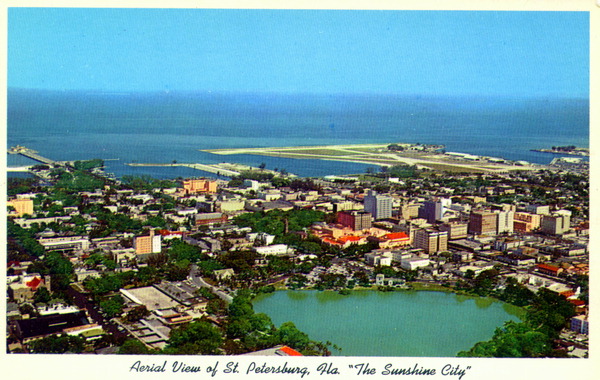
1900Aerial view of St. Petersburg with Mirror Lake in the foreground, c. 1900 — the lake (then called Reservoir Lake) was already the center of the city's earliest residential growth.
Florida Memory / State Archives of Florida — PC3768
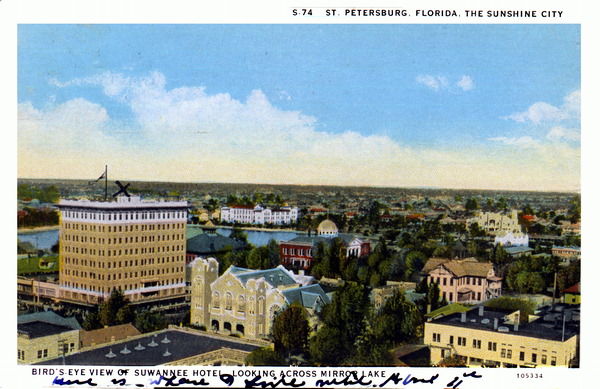
1933Bird's-eye view of the Suwannee Hotel looking across Mirror Lake, c. 1933 — the hotel anchored Mirror Lake's south side during the city's tourist-economy peak.
Florida Memory / State Archives of Florida — PC3773
 1940
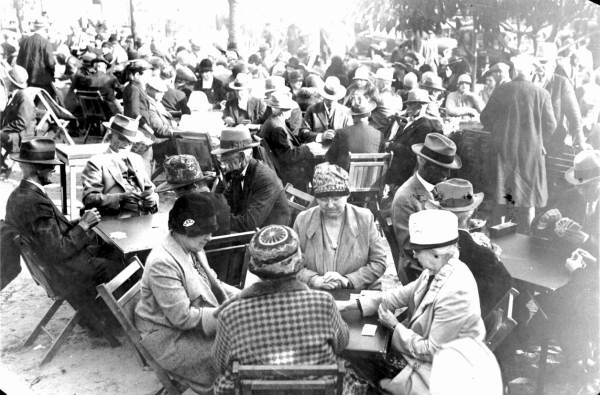
1940Card tournament at Mirror Lake Park, c. 1940 — Mirror Lake's recreation complex hosted the Lawn Bowling Club, Shuffleboard Club, Chess Club, and Bridge Club, all of which are still active today.
Florida Memory / State Archives of Florida — N040118
 1959
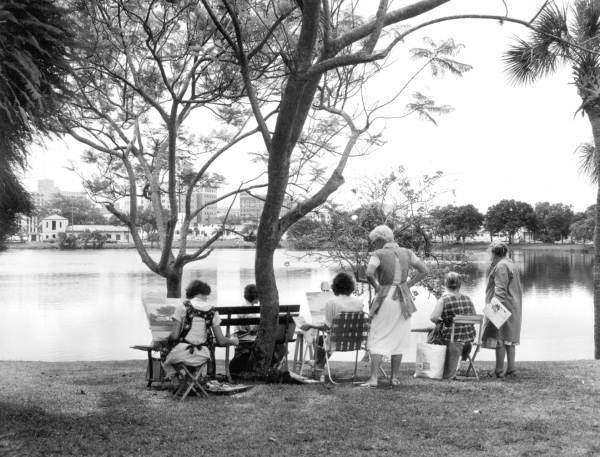
1959Art class on the shore of Mirror Lake, 1959 — the lake has been a public park since 1910 and a working civic gathering space ever since.
Florida Memory / State Archives of Florida — C029992
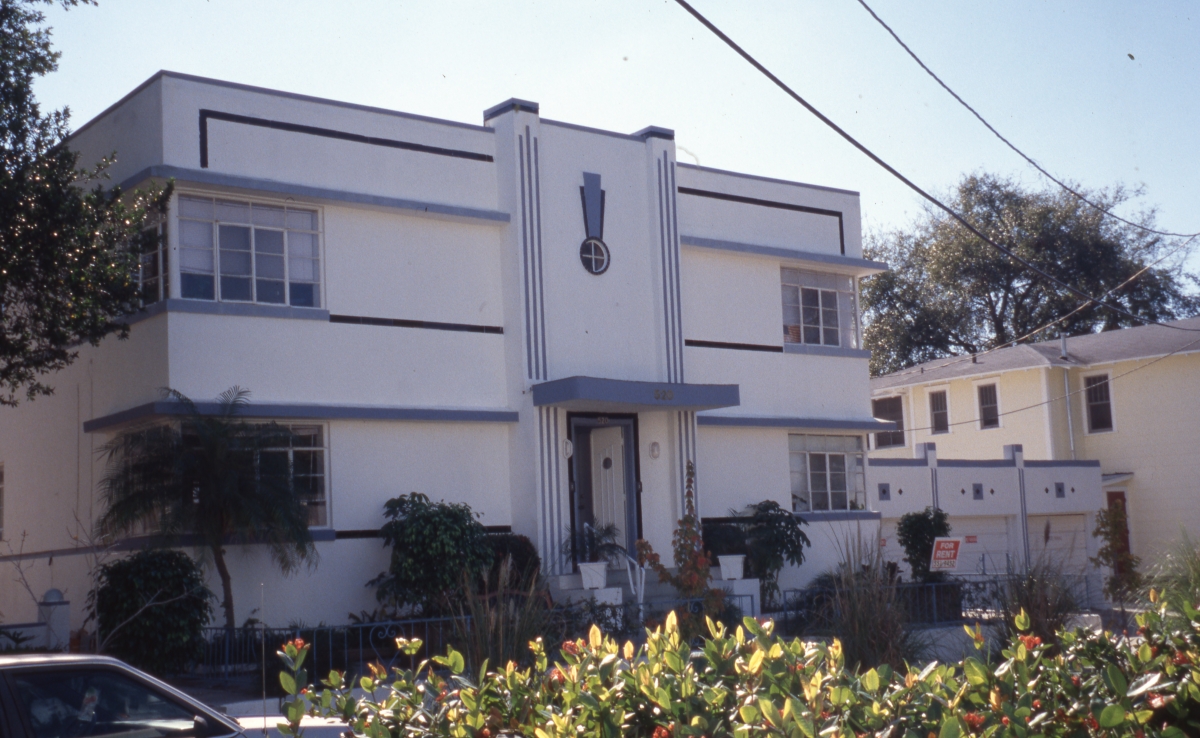 1935
1935Alberta Apartments (1935) in the Round Lake Historic District — one of the National Register reference examples of Art Moderne residential architecture in St. Pete.
Florida Memory / State Archives of Florida — MSF-PI5274-001
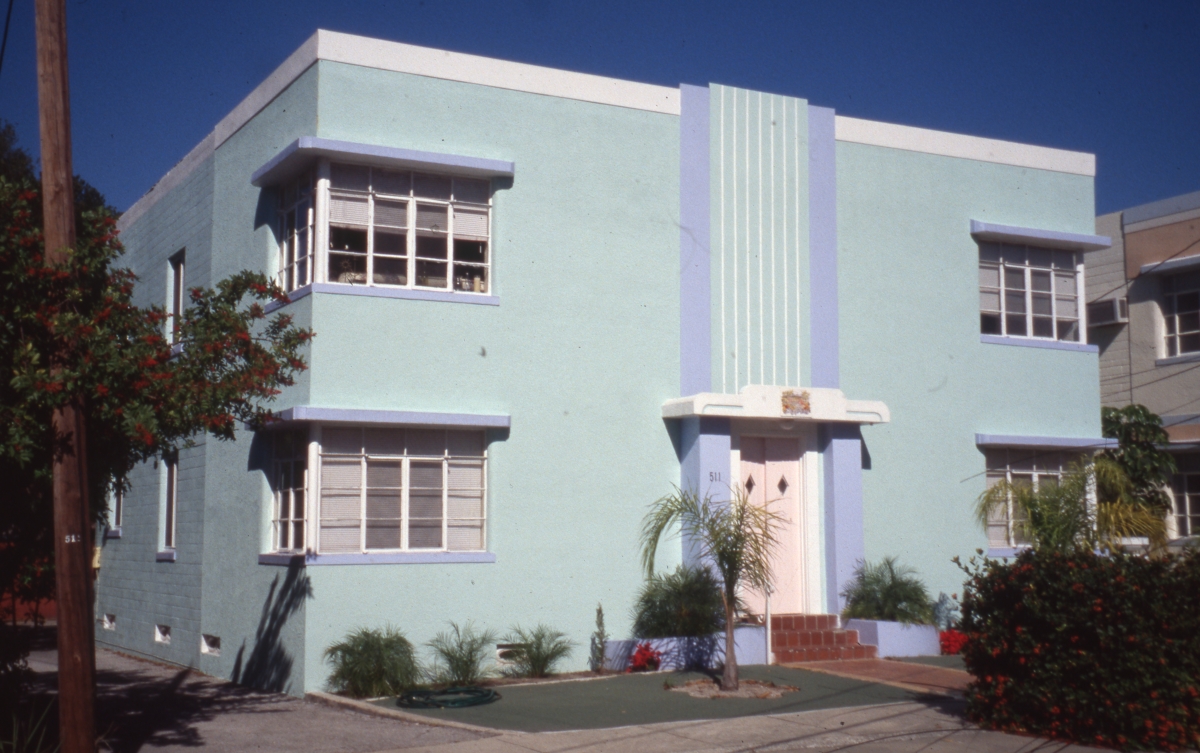 1935
1935Round Lake apartment house, c. 1935 — small-apartment courts like these were a defining feature of the neighborhood during the tourist-economy years.
Florida Memory / State Archives of Florida — MSF-PI5275-001
Commute Times
Click any destination to see the mapped route with real-time traffic estimates.
Pros & Cons
The Pros
- Walk Score 84 — one of the city's most walkable neighborhoods, with downtown, Central Avenue, and the EDGE District all reachable on foot
- The plateau elevation (~40 ft) put the neighborhood above the surge line during Helene and Milton — Mirror Lake itself stayed dry while Shore Acres and Old Northeast flooded
- Most of the district sits in flood zone X, which keeps insurance costs significantly lower than waterfront St. Pete
- Two distinct historic district designations: National Register (Round Lake, 2003) plus the new Mirror Lake local district (December 2024)
- Homes inside the Mirror Lake local district qualify for the city's 10-year ad valorem tax exemption on approved historic renovations
- Income-producing properties (rentals, true STR operations) inside either district qualify for the federal 20% Historic Rehabilitation Tax Credit
- Architectural variety is real — Craftsman bungalows, Frame Vernacular, Mediterranean Revival, Mission, Art Moderne, plus the 1898 I-House. Few St. Pete neighborhoods offer this range.
- Active neighborhood association (historicuptown.com) and an engaged Mirror Lake preservation crowd through Preserve the 'Burg
The Cons
- The southern edge along 1st Ave N is being aggressively developed — a 23-story tower at 5th Street and 3rd Ave N is approved across from the Carnegie Library, just outside the Mirror Lake historic district boundary
- Most of the housing stock is 95+ years old and wood-frame on pier foundations — inspections need to look for knob-and-tube wiring, cast-iron drains, galvanized supply lines, and termite history
- Insurance on pre-war wood-frame homes runs higher and requires 4-point and wind-mitigation inspections; roof age becomes a deciding factor over 15 years
- Vacancy rate is unusually high (~22% per NeighborhoodScout) because so much of the stock is small studios, garage apartments, and tourist-era boarding houses now operating as long-term rentals
- Yards are small — many lots are 50x100 with the bungalow taking most of the buildable footprint, and accessory cottages eating the rest
- The 1st Ave N corridor and the southern Mirror Lake edge can feel commercial and busy, especially with the new tower construction underway
- Properties in the Mirror Lake local district will need a Certificate of Appropriateness for any meaningful exterior work — that's a feature for long-term value but a constraint for flippers
What You Need to Know
Who Should Live Here
Buyers who want walkable urban living without paying Old Northeast or Snell Isle prices — and who actually want a historic home, not the look of one. Historic Uptown rewards the buyer who's planning to live in their bungalow for ten or twenty years and is willing to do the systems work along the way. It also works well for buyers focused on the income-property side: a primary house plus a permitted garage apartment is a common configuration here, and the federal 20% rehab credit applies to those rental units inside the National Register district. Less ideal for someone who wants new construction, modern open plans, big yards, or a low-maintenance build.
What to Watch For
Verify which district your specific lot sits in. Mirror Lake (local + National Register) means Certificate of Appropriateness review on exterior changes — that's the strongest protection, but also the most rules. Round Lake (National Register only) is honorary — no review obligation, but also no city tax-exemption eligibility for renovations. Check whether the home has been moved (over 100 homes in this area were relocated during the Depression — moved homes can have foundation issues that aren't obvious). Get the wood-frame inspection done thoroughly: wiring, plumbing, drain stack condition, termite history, and roof age. Pull the permit history before you write an offer — unpermitted accessory units and converted garage apartments are common here and become your problem at closing. Insurance quotes should come before you go under contract, not after.
What to Expect
A walkable neighborhood that feels different than four blocks away on Central — narrow brick streets, mature oaks, and front porches that get used. The lakes drive the rhythm: Mirror Lake at sunrise with the joggers and the shuffleboard club opening up; Round Lake quieter, with bird-watchers and dog walkers on the loop trail. Coffee at Flatbread & Butter on Round Lake. Friday nights at the Shuffleboard Club, which has rebounded to 1,200+ members and is genuinely one of the most popular weekly events in the city. Walking distance to the EDGE District, the Saturday Morning Market, and downtown St. Pete proper. Young professionals and creatives, retirees who walk everywhere, and a heavy mix of long-term renters in the small apartment courts. Active redevelopment along the 1st Ave N edge — you'll see cranes from your front porch.
Aaron's Honest Take
Aaron & Aubrey Chand
Living in St. Pete · Excellecore Real Estate
Here's what I tell buyers who ask about Historic Uptown: this is the neighborhood where you can still buy a real St. Pete bungalow under $600K. Old Northeast is past a million for anything renovated. Kenwood is following it. Roser Park has almost no inventory. Historic Uptown still has 1920s Craftsman bungalows on brick streets, a five-minute walk to downtown, with median sale prices around $520K-$580K depending on how you draw the boundary. That's not a forever number — the December 2024 Mirror Lake designation, the 23-story tower going up at the southern edge, and the steady appreciation in the Round Lake plat are all pulling values up.
The honest cons. Most of the housing stock is older than your grandparents. Wood frame, pier foundations, knob-and-tube hiding behind plaster in homes that haven't been updated since the '70s. The 1st Ave N corridor along Mirror Lake is being redeveloped aggressively right now, which is great for walkable amenities and not great if you wanted a quiet block on the southern edge. Yards are small. And inside the new Mirror Lake local district, you're going to need a Certificate of Appropriateness for any exterior work — which protects your neighbor from putting up a stucco box next door, but means your replacement windows go through review.
The hurricane piece is what people miss. This neighborhood sits on a plateau — about 40 feet above sea level on the Round Lake side, well above the FEMA floodplain. Helene took Shore Acres, Snell Isle, and chunks of Old Northeast. Mirror Lake stayed dry. Most of the district is flood zone X, which keeps insurance manageable on homes that already need higher 4-point premiums. If you're a buyer choosing between a $700K renovated bungalow in Historic Uptown and a $700K renovated bungalow on the water in Shore Acres, the math right now strongly favors elevation. We've helped over 50 buyers relocate to Tampa Bay in the past couple years, and the post-Helene flight to higher ground is the single biggest pattern we're tracking.
The Buying Reality
~23-30 days for fairly-priced homes; renovated bungalows under $650K often go in two weeks
Moderate — typical district has 8-15 active single-family listings plus condos and small apartment buildings
Common on renovated bungalows under $650K and on Mirror Lake-adjacent condos under $400K
Get pre-approved, line up insurance quotes before going under contract, run the 4-point and wind-mitigation inspections quickly, and don't ask for repair credits on cosmetic items. Verify which historic district your lot sits in (or doesn't) before negotiating — it changes both your renovation rules and your tax-incentive eligibility. If the listing is inside the Mirror Lake local district, build review timelines into any planned exterior work.
Schools & Zoning
Magnet Options
Private / Independent
Pinellas County operates a controlled-choice attendance system, so zoning is one factor among several. St. Petersburg High is the closest 9-12 in the public system and is the zoned high school for most of Historic Uptown. Hopkins Middle hosts the Center for Communications magnet program, which several Historic Uptown families use as their middle-school path. For buyers prioritizing magnet placement, look at Lakewood's Center for Advanced Technologies and the SPC Collegiate High School — both pull from across the city and aren't tied to neighborhood zoning.
Insurance & Maintenance Reality
Pre-War Home Considerations
Insurance for a Historic Uptown wood-frame home is its own conversation — start it before you make an offer. Carriers will require a 4-point inspection (roof, electrical, plumbing, HVAC) and a wind-mitigation report. Roof age matters most: anything over 15 years on a wood-frame home will narrow your carrier options sharply, and over 20 years can become uninsurable through standard markets.
The most common surprises in this neighborhood: knob-and-tube wiring still hiding behind plaster walls in unrenovated bungalows, cast-iron drain lines reaching the end of their service life, original cloth-wrapped supply lines, galvanized water mains under century-old yards, and termite history on homes that have been moved at some point in the last hundred years. Each can add $5K-$30K to a renovation budget.
The upside: most of the district sits in flood zone X, which means flood insurance is optional rather than required. That's a meaningful difference from Shore Acres or coastal Old Northeast, where AE-zone flood premiums alone can run $3K-$8K per year. For homes inside the Mirror Lake local district, the 10-year ad valorem tax exemption on approved historic renovations can offset thousands per year on a meaningful renovation. For income-producing properties (long-term rentals, true STR businesses) anywhere in the National Register district, the federal 20% Historic Rehabilitation Tax Credit applies. Talk to a contractor experienced with historic St. Pete homes before you fall in love with one — they'll tell you what's hiding behind the plaster.
Storm Impact: Helene & Milton
Historic Uptown came through Helene and Milton significantly better than nearly any other historic St. Pete neighborhood. The plateau elevation (about 40 feet above sea level on the Round Lake side, ~25 feet around Mirror Lake) put the entire district above the surge line during Helene's record September 2024 storm surge, and Milton's October 2024 wind/rain track did not produce surge in this area. Wind damage was the primary insurance event: tree limbs down, scattered roof loss on already-stressed older roofs, and some shingle damage. Power was out for several days in much of the district after Milton. The cleanup took weeks but the homes themselves were largely untouched.
Hurricane Helene
Sep 2024No measurable storm surge in Historic Uptown during Helene. Mirror Lake itself stayed within its banks. The Coliseum, Shuffleboard Club, Carnegie Library, and Tomlinson Adult Learning Center were all reported undamaged from flooding. Compared to Shore Acres, Snell Isle, Old Northeast east of Beach Drive, and the Pink Streets — all of which saw widespread interior flooding — Historic Uptown homes were dry.
Hurricane Milton
Oct 2024Milton produced 18+ inches of rain at Albert Whitted Airport (a few miles south) and 100+ mph wind gusts in St. Pete. Historic Uptown saw the wind, not the rain emergency: a few trees down, some roof damage on older shingle roofs, scattered fence loss. The 1st Ave N construction crane that fell at 400 Central was several blocks south of the district and didn't affect any Historic Uptown property. No widespread surge.
Blocks to Watch
The lowest-elevation block in the district sits around the southern edge of Mirror Lake (5th Ave N near 4th St N), which is closer to the bay grade. That stretch is mostly commercial / institutional (the library, the high school condos, the Coliseum). Verify the elevation certificate on any property south of 5th Ave N before assuming flood zone X. The plateau is real on the Round Lake side; the Mirror Lake side has more variation.
Tax & Preservation Incentives
Historic District Status
Mirror Lake became St. Petersburg's 11th locally-designated historic district on December 12, 2024 (Ordinance 135-HL), with 89% of district property owners voting in support. The local district covers properties within 200 feet of Mirror Lake and is the city's first new local historic district since 2021. Round Lake / Historic Uptown north and west of the lake is National Register only (listed September 29, 2003 — NRHP #03000824) and is not locally designated.
10-Year Ad Valorem Exemption
Properties inside the Mirror Lake local historic district qualify for St. Petersburg's 10-year ad valorem tax exemption on the increase in taxes attributable to approved historic renovations, capped at $100,000 per single-family residence. On a $200K renovation, this can save $3,000-$5,000 per year for a decade. Properties in the Round Lake National Register district that are not inside the Mirror Lake local district do NOT qualify for this exemption — local designation is required. The renovation must be reviewed and approved by the city's preservation staff before work begins.
Federal 20% Rehab Tax Credit
Income-producing historic properties anywhere in the Round Lake / Historic Uptown National Register district qualify for the federal 20% Historic Rehabilitation Tax Credit on certified rehabilitation expenditures. This applies to long-term rentals, properly registered short-term rental businesses, and mixed-use buildings — including the small apartment courts and garage apartments common in this neighborhood. Owner-occupied primary residences do not qualify. The credit is taken against federal income tax liability and can be carried forward.
If you're buying inside the Mirror Lake local district (within 200 ft of the lake), exterior changes — including paint colors, replacement windows, demolitions, and additions — require a Certificate of Appropriateness from the city. Most COAs are approved at staff level without a public hearing, but the review can add weeks to a project. Both incentives require pre-approval before construction. Talk to the City of St. Petersburg's preservation planning staff before pulling permits.
Community & Events
St. Petersburg Shuffleboard Club Friday Nights
Friday evenings, year-round (free and open to the public)
The world's first organized shuffleboard club, founded in 1924 — once the world's largest with 5,000 members at its 1944 peak, now rebounded to 1,200+ members. Friday Night Shuffle is one of the most popular regular events in St. Pete, drawing players of every age and skill level to the original courts on Mirror Lake. Free instruction, BYOB.
Historic Mirror Lake Walking Tour (Preserve the 'Burg)
Periodic — typically multiple Saturdays per year
Walking tour of the newly designated Mirror Lake Local Historic District led by Preserve the 'Burg volunteers. Covers the 1915 Carnegie Library, the 1924 Shuffleboard Club, the 1919 old St. Pete High School (now 701 Mirror Lake Condos), the Tomlinson Adult Learning Center, and the surrounding historic apartment buildings.
Historic Uptown Neighborhood Association Meetings
Monthly
Active neighborhood association covering the Round Lake / Uptown / South Crescent area. Meetings cover land-use issues, historic preservation, neighborhood events, and the ongoing south-edge development pressure along 1st Ave N.
Round Lake Park Walking Loop
Daily, year-round
Self-organized morning and evening loops around the small sinkhole-fed Round Lake — one of the quieter daily community rituals in the neighborhood. Bird-watching, dog walking, and stroller laps.
Saturday Morning Market
October-May, Saturdays at Al Lang Stadium (summer location: Williams Park)
One of the largest weekly markets in the Southeast, a 10-15 minute walk from most of Historic Uptown. Local produce, food vendors, music, and crafts.
What Residents Are Saying Online
Pulled from Trulia, Niche, and St Pete walkability sources. Residents consistently call out three things: real walkability to downtown and Central Avenue, the brick streets and bungalow architecture (the 'little village' feel four blocks off Central), and the pace of revitalization with a heavy mix of young professionals moving in. Honest cons mentioned include rental prices climbing, narrow streets with parking pressure, small yards, and historical reputation issues that have largely faded but still show up in older reviews. The neighborhood association is repeatedly described as 'very active' — that matches what we see on the ground.
“I love it here. The brick streets are narrow, so it's like a little village. Totally a different vibe from 4 blocks away on central ave but walking distance to everything... Anyone who says it not great here has either been priced out or wouldn't be happy anywhere. Is it perfect? No, but try and buy a house here. There's almost nothing for sale.”
“Urban neighborhood going through a revival. Very walkable with dense population of historic bungalows. A lot of young professionals are moving here due to the close proximity to downtown as we're the first neighborhood north of it. Lots of people walking their dogs and riding their bikes. Very active neighborhood association.”
“Very dog friendly and walkable neighborhood. Lots of young professionals are moving to the area. We have Round Lake and St Anthony's Park to walk your dogs!”
“Crescent lake, downtown festivities, yard sales, fruit trees, brick roads, wind, jasmine, swimming, Happy days.”
“This is the most important historic designation I will have as a city council member because of the historic significance of this area. If you get 89% of the vote… that's a mandate.”
“Not a lot of room for kids to play in most areas, most homes have very small yards for play. There are a couple of parks in the area.”
Further Reading & Resources
Civic & Preservation
City of St. Petersburg — Historic Preservation Program
Official city .gov page for the historic preservation program — design guidelines, Certificate of Appropriateness process, and the local register including the Mirror Lake district.
City of St. Pete — Property Owner Tax Incentives
10-year ad valorem tax exemption program for qualifying renovations inside the Mirror Lake local historic district.
City of St. Petersburg — Community Planning & Preservation Commission
The body that reviews Certificates of Appropriateness for the Mirror Lake local historic district.
National Register of Historic Places — Round Lake Historic District
Official federal listing page for the Round Lake / Historic Uptown National Register District (NRIS #03000824), listed September 29, 2003. Covers ~1,000 contributing buildings.
National Register Nomination Form — Round Lake Historic District (PDF)
Full nomination paperwork describing the district's architectural styles, period of significance (1900-1974), boundaries (5th Ave N, 9th St N, 13th Ave N, 4th St N), and the plateau elevation that distinguishes it from the rest of St. Pete.
Preserve the 'Burg
Local preservation nonprofit. Spearheaded the citizen-initiated Mirror Lake Local Historic District application, which won 89% owner support and was approved December 2024.
Preserve the 'Burg — Local Historic District Designation FAQ
Comparison of National Register vs. local district protection — useful before buying in the Round Lake portion of the neighborhood (NR only) versus the Mirror Lake portion (local + NR).
Journalism
St Pete Catalyst — Mirror Lake receives historic designation
December 2024 coverage of the Mirror Lake local historic district approval — the city's first new local district since 2021.
St Pete Catalyst — A win for historic preservation is a win for St. Pete
Editorial on the Mirror Lake designation — explains the COA process, the development incentives, and the neighborhood-compatible development framing.
St Pete Rising — Mirror Lake one step closer to historic district
November 2024 coverage of the citizen-led balloting process — 77 of 142 tax parcels supported designation, just over the 72-parcel threshold required to file.
St Pete Rising — It's official: Mirror Lake is now a historic district
Coverage of the December 12, 2024 City Council 5-2 vote approving the Mirror Lake Local Historic District.
Tampa Bay Business Journal — Mirror Lake legal battle
Coverage of the procedural legal challenge to the Mirror Lake designation — the developer of the planned 23-story tower at 5th & 3rd N filed a constitutional challenge to the citizen-balloting process.
Tampa Bay Times — Why 'St. Petersburg High School' is engraved on a Mirror Lake condo
Long-form on the 1919 high school building at 701 Mirror Lake — the city's only high school until 1953, now 70 condominiums.
Northeast Journal — Mirror Lake: Beauty & History
Detailed history of Mirror Lake, the Carnegie Library, the Lawn Bowling Club (1915), the Shuffleboard Club (1924), the Coliseum, and the surrounding architectural landmarks.
Green Bench Monthly — A Walk Around Mirror Lake
Walking-tour-style feature covering each major Mirror Lake landmark in sequence — including the Tomlinson Adult Learning Center, the Mirror Lake Christian Church / Lyceum, and the 1920s house Cade B. Allen built that now houses Weidner Law.
Creative Loafing — Rawls House for sale (oldest home in St. Pete)
2021 feature on 734 Grove St N — the 1898 Rawls House, the last surviving I-House in the city and one of its oldest homes.
Neighborhood Association
Historic Uptown Neighborhood Association
The official neighborhood association for Historic Uptown / Round Lake — events, association news, and resources for residents.
St. Petersburg Council of Neighborhood Associations (CONA)
Citywide directory of St. Petersburg neighborhood associations, including Historic Uptown.
Cultural
Mirror Lake Library — National Register listing
1915 Beaux-Arts Carnegie library, one of ten Carnegie libraries built in Florida. Listed on the National Register June 13, 1986. Designed by Henry D. Whitfield.
St. Petersburg Shuffleboard Club
1924 — the first organized shuffleboard club in the United States and once the world's largest. Free public Friday Night Shuffle is the neighborhood's signature regular event.
What's Nearby
Mirror Lake Park
in district
Round Lake Park
in district
St. Petersburg Shuffleboard Club
in district
The Coliseum (1924)
in district
Mirror Lake Community Library (1915 Carnegie)
in district
Tomlinson Adult Learning Center (1924)
in district
Flatbread & Butter (Round Lake coffee/pizza)
in district
Crescent Lake Park
0.5 mi
EDGE District (Central Ave west of MLK)
0.4 mi
Saturday Morning Market (Al Lang Stadium)
0.8 mi
St. Pete Pier
1.0 mi
Trader Joe's (4th St N)
0.7 mi
Elevation & Flood Risk
40ft average elevation
FEMA Flood Zone X (most of district — the neighborhood sits on a plateau ~40 ft above sea level, well above the FEMA floodplain) — flood insurance required
Thinking about Historic Uptown?
We've helped over 50 buyers relocate to Tampa Bay. Let's talk about whether Historic Uptown is the right fit for you.
Explore more neighborhoods
View All in Relocation Guide