Historic Roser Park
St. Pete's First Historic District
Platted 1911
Established
1987 (St. Pete's first)
Local Historic District
1998
National Register
27 acres, ~146 buildings
District Size
15 minutes
Walk to Downtown
20-30 ft (highest in city)
Elevation
Neighborhood Overview
Historic Roser Park is St. Petersburg's first locally-designated historic district — and the only neighborhood in the city where the streets actually rise and fall. Charles Martin Roser, the Ohio candy manufacturer credited with the Fig Newton recipe, platted these 27 acres in 1911 along the bluffs of Booker Creek. The result is a neighborhood that doesn't look or feel like the rest of flat St. Pete: brick streets curve over genuine hills, retaining walls of rusticated concrete block hold up front yards, and the creek itself threads through the middle of the district before emptying into Bayboro Harbor.
Designation came in July 1987, making Roser Park the original local historic district before Old Northeast, Granada Terrace, or any other St. Pete neighborhood was protected. The district was expanded in 2018 to include the 800 block of 10th Ave S, and added to the National Register in 1998. The period of significance runs 1910 through 1926 — the heart of St. Pete's pre-bust building boom — which means most homes here are now over a century old.
Roser Park sits a 15-minute walk from downtown St. Pete and the Innovation District around Bayboro Harbor. That walkability — combined with one of the highest elevations in the city, real architectural variety, and the genuine rarity of being the city's first historic district — has made it one of St. Pete's quietly strongest appreciating neighborhoods. The trade-off is that inventory is tight and most homes need careful inspection: a 1910s wood-frame bungalow on a hill is charming, but it's also a hundred-year-old structure with all the maintenance that implies.
History & Origins
Platted 1911
Charles Martin Roser
Pre-Boom (1910-1926)
Charles Martin Roser arrived in St. Petersburg from Ohio in 1910 and bought just over ten acres along Booker Creek the following year. Roser had made his fortune in baking — he is popularly credited with developing the Fig Newton recipe — and he platted the neighborhood as an exclusive residential enclave for the city's emerging professional class. The streets were laid out to follow the natural contours of the land rather than fight them, which is why Roser Park has curves and grades that don't exist anywhere else in St. Pete.
The neighborhood grew through the 1910s and 1920s alongside the broader development of Bayboro Harbor, designated around 1910 as St. Pete's deep-water commercial port. Doctors, lawyers, businessmen, and civic leaders built homes here because of the elevation, the proximity to downtown, and the prestige of Roser's plat. By 1926, when the Florida land bust hit, most of the district's significant homes were already standing — which is why Roser Park's period of significance ends that year.
The neighborhood declined through the mid-20th century as suburban St. Pete grew north and west, but began a slow comeback in the 1970s. In July 1987, Roser Park became St. Petersburg's first locally-designated historic district — predating Granada Terrace's 1988 designation and every Old Northeast and Kenwood sub-district. The National Register listing followed in 1998. A 2018 expansion added the 800 block of 10th Ave S to the local district. Today Roser Park's combination of historic protection, hilly topography, walkability to downtown, and architectural integrity make it one of the rarest neighborhoods in Florida — let alone in St. Pete.
Architecture & What You'll Be Buying
Predominant Styles
Typical Year Built
1910-1926 (period of significance)
Typical Size
1,400-2,800 sq ft on narrow lots (50-55 ft wide, 100-210 ft deep)
Construction
One to three stories, predominantly wood frame with clapboard siding. Original front setbacks of 20 feet are preserved by historic district rules. Many homes still have original wood floors, plaster walls, fireplaces, and screened porches. Two-thirds of homes have not been substantially renovated, which is both an opportunity and a maintenance reality.
Materials & Streetscape
Roser Park is the only neighborhood in St. Pete with substantial use of rusticated concrete block retaining walls — a textured, hand-cast block with a rough stone-like face that holds up the front yards on the hilly streets. The streets themselves are mostly original brick with granite curbstones. Booker Creek runs through the middle of the district, lined in places with original stone walls.
Notable Homes & Landmarks
702 8th Ave S
Built ~1920s
Built for Edwin H. Tomlinson, an early St. Pete pioneer and philanthropist (the Tomlinson Adult Learning Center on Mirror Lake bears his name). The original specs included 10 rooms, two baths, a sleeping porch, sun parlor, screened porch, steam heat, and a garage on a 75x100 corner lot — furnished in mahogany and Haviland China. In 1923 it was valued at $25,000 (about $480K today). Later occupied by the family of Dr. Charles D. Farriss starting in 1945; his daughter Alice White went on to become Realtor of the Year in 1972.
Converted to the Ronald McDonald House from 1978 to 1980, serving families with children at All Children's Hospital — one of the first such houses in Florida.
832 8th Ave S
Built 1924
Described in period documents as 'one of the nicest homes in Roser Park.' Five bedrooms, two baths, a capacity garage, on a 50x100 lot — built for $25,000. John Harold Sommers built the home for his bride Rheba Crawford. Sommers was an ad writer for the St. Pete Times who launched 'Tourist News Magazine' in 1920.
Rheba Crawford Sommers earned the title 'Angel of Broadway' in 1922 after New York police arrested her for causing a traffic jam with her street preaching. She was a Salvation Army Captain who led tent revivals in St. Pete before leaving the marriage in 1928 for a California ministry.
735 8th Ave S
Built 1920
Four bedrooms, two baths, finished in 'fine bleach mahogany' woodwork with a working fireplace. Built for John Hubbard Mather (a Civil War veteran and retired Chicago jewelry-supply executive) and his wife Clara. They paid for the home outright in 1922.
When John died in 1927, his entire $50,000 estate — about $880,000 in today's dollars — passed to their housekeeper Emma Pearson, who had been with the family since 1909. Emma lived in the home until 1945 and lived to age 106, passing in 1994.
745 8th Ave S
Built 1922
Built for Dr. Thaddeus Hall Green, an Emory-trained physician and 'one of only a few doctors in the city' when he arrived in St. Pete. Dr. Green opened Doctors Hospital at 1485 4th Ave N in 1940 — a 24-bed facility that became one of the city's important medical institutions before the post-war hospital boom.
Then & Now
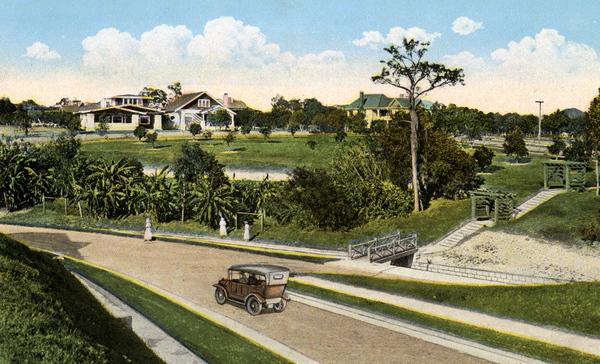
c. 1900Postcard view of Roser Park, c. 1900 — when the Booker Creek bluffs were still being shaped into the neighborhood we know today.
Courtesy of State Archives of Florida, Florida Memory
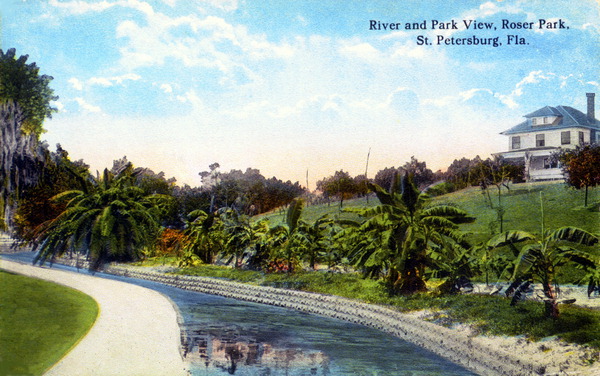 c. 1900
River and park view in Roser Park, looking along Booker Creek.
Courtesy of State Archives of Florida, Florida Memory
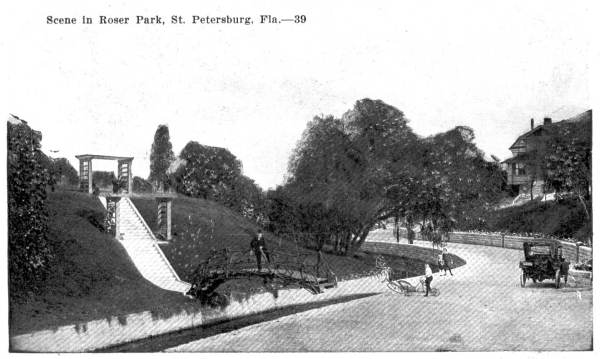 c. 1910
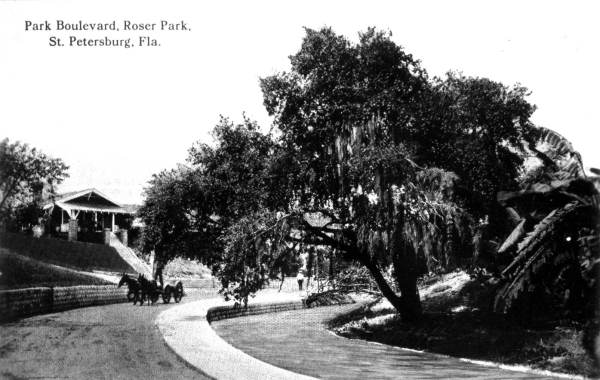
Streetscape, c. 1910 — the brick-paved drive curving through the bluffs above the creek.
Courtesy of State Archives of Florida, Florida Memory
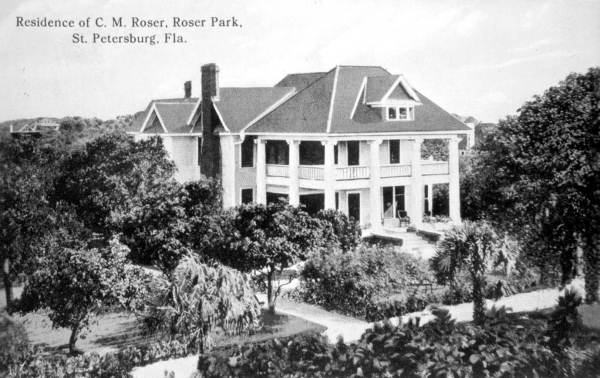 c. 1915
Charles M. Roser's own residence in Roser Park, c. 1915.
Courtesy of State Archives of Florida, Florida Memory
 c. 1915
Roser Park Drive curving along the bluffs, c. 1915.
Courtesy of State Archives of Florida, Florida Memory
 1971
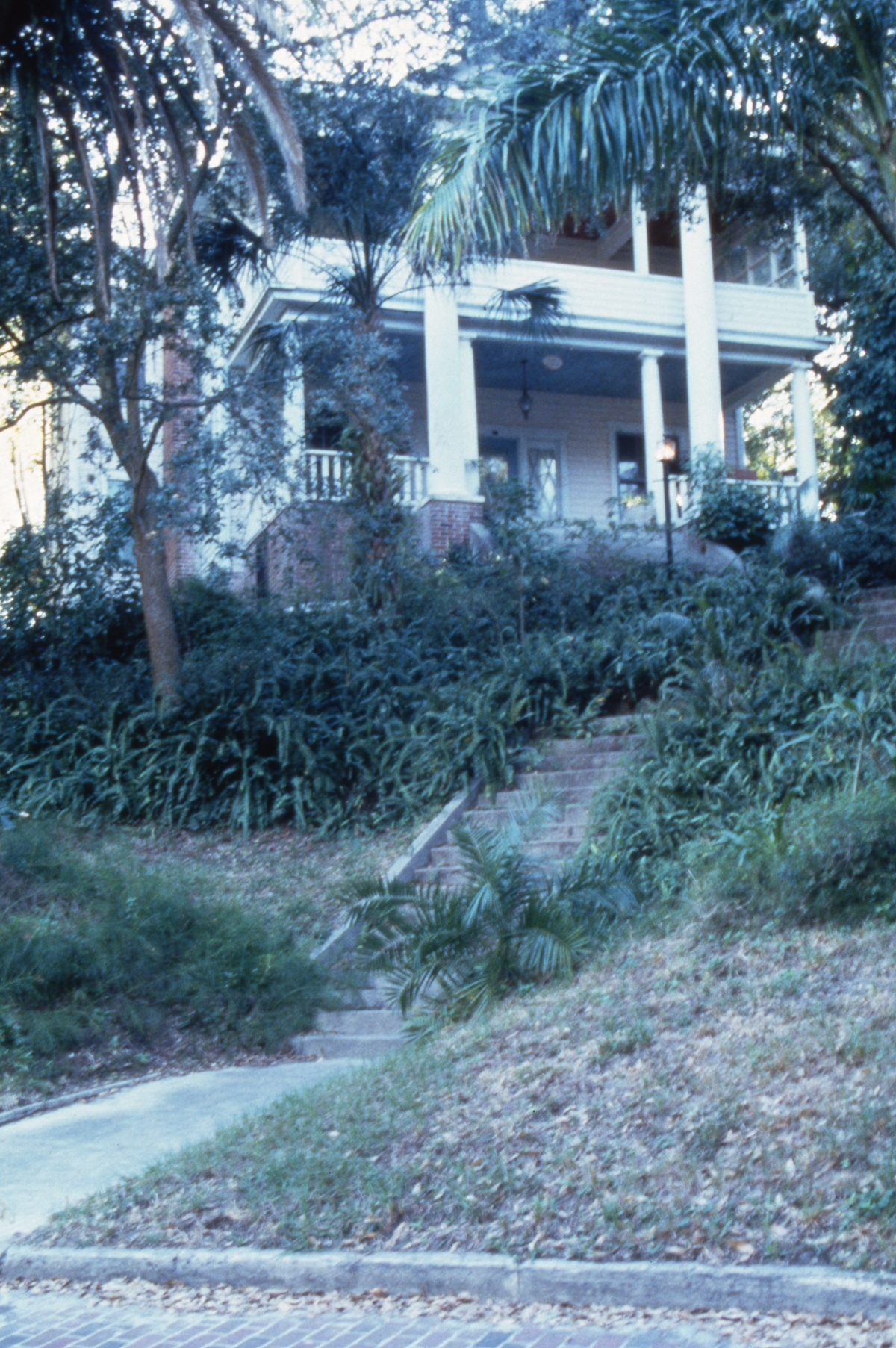
1971Survey photographs of the Roser Park Historic District, 1971 — documentation that helped support the 1987 local designation and 1998 National Register listing.
Courtesy of State Archives of Florida, Florida Memory
Commute Times
Click any destination to see the mapped route with real-time traffic estimates.
Pros & Cons
The Pros
- St. Pete's first and most-protected historic district — strongest neighborhood character in the city
- Genuinely hilly streets — the only neighborhood in St. Pete with real elevation change
- 15-minute walk to downtown St. Pete restaurants, the Pier, and waterfront
- Most of district sits in flood zone X (high ground around the bluffs)
- Eligible for 10-year ad valorem tax exemption on approved historic renovations
- Eligible for federal 20% Historic Rehabilitation Tax Credit on income-producing historic homes
- Historic districts in St. Pete have appreciated 119% over 14 years vs. 85% citywide
- Booker Creek and Roser Park itself give the neighborhood unusual natural texture for an urban area
The Cons
- Inventory turns slowly — homes here often don't come up for years at a time
- Most homes are 100+ years old and require careful inspection (foundation, wiring, plumbing)
- Booker Creek edge of district has AE flood zone exposure
- Historic district rules limit exterior changes — replacement windows, additions, paint colors all require approval
- Insurance on pre-war wood-frame homes runs higher than newer builds and requires 4-point inspections
- No major grocery within walking distance — you'll drive for most errands
What You Need to Know
Who Should Live Here
Buyers who genuinely value historic character and are willing to pay the price of admission — both in dollars and in maintenance commitment. Roser Park is for the buyer who wants a 1920s craftsman with original heart-pine floors, a hilly walk to downtown, and a neighborhood with rules that protect what they bought. Not the right fit for someone who wants modern, low-maintenance, or new construction.
What to Watch For
Verify the specific lot's flood zone — the western and southern edges of the district near Booker Creek are AE. Get a thorough inspection of the foundation (rusticated block can crack), the electrical (knob-and-tube is still hiding in some unrenovated homes), the plumbing (cast iron and lead are common), and the roof. Check the seller's permit history with the city — historic district rules mean unpermitted exterior changes can become your problem at closing. Insurance quotes should come before, not after, you go under contract.
What to Expect
A neighborhood where front porches are used, neighbors know each other, and the architecture review board takes its job seriously. Brick streets with granite curbs, mature oaks, and retaining walls that have been holding up front yards for a century. Walk-throughs of Roser Park itself (the actual park along Booker Creek), morning runs that are uncharacteristically hilly for Florida, and a five-minute drive to the Pier. Homes that need work, but the kind of work that's worth doing.
Aaron's Honest Take
Aaron & Aubrey Chand
Living in St. Pete · Excellecore Real Estate
Here's what I tell buyers who ask me about Roser Park: this is the neighborhood you buy when you actually want a historic home, not the idea of one. Old Northeast and Snell Isle get most of the historic-home attention in St. Pete, but Roser Park got the designation first — 1987 — and the protections here are real. If you're going to spend $700K on a 1920s bungalow, you want the city to back you up when your neighbor wants to tear theirs down and put up a stucco box. In Roser Park, they can't.
The hills are the other thing. People don't realize how flat the rest of St. Pete is until they walk Roser Park. There's actual elevation here — twenty to thirty feet of bluff above Booker Creek — and it changes how the neighborhood feels in ways you can't photograph. It also changes flood exposure: most of the district sits in flood zone X, which is unusual for a historic St. Pete neighborhood. Helene didn't take Roser Park the way it took Shore Acres.
The honest cons: the inventory is brutal. Some streets see one sale a year. Most homes need work — not catastrophic work, but the kind of structural and systems work a 100-year-old home needs every couple of decades. Insurance is a real conversation, not an afterthought. And you have to want to live in a neighborhood that has rules, because the historic district has them and they get enforced. If those things sound like dealbreakers, look at Crescent Heights or North Kenwood instead. If they sound like features, Roser Park is one of the best long-term holds in the city.
The Buying Reality
~27 days for fairly-priced homes; well-renovated homes go in under two weeks
Tight — typical district has 2-5 active listings
Common on renovated bungalows under $750K
Get pre-approved, line up insurance quotes before you go under contract, be flexible on cosmetics, and don't ask for repair credits on cosmetic items — sellers in protected historic districts walk from those buyers.
Schools & Zoning
Magnet Options
Private / Independent
Pinellas County operates a controlled-choice attendance system, so zoning is one factor among several. Magnet placements are competitive but don't depend on neighborhood. Most Roser Park families using public schools end up at one of the magnets rather than the zoned schools.
Insurance & Maintenance Reality
Pre-War Home Considerations
Insurance for a pre-war Roser Park home is its own conversation — start it before you make an offer. Carriers will require a 4-point inspection (roof, electrical, plumbing, HVAC) and a wind-mitigation report. Roof age matters most: anything over 15 years on a wood-frame home will narrow your carrier options sharply, and over 20 years can become uninsurable through standard markets.
The most common surprises in Roser Park: knob-and-tube wiring still hiding behind plaster walls in unrenovated homes, cast-iron drain lines reaching the end of their service life, original cloth-wrapped supply lines, and active galvanized water mains under century-old yards. None of these are dealbreakers, but each can add $5K-$30K to a renovation budget.
The upside: because of the historic district, the federal 20% rehab credit, and the city's 10-year ad valorem exemption on approved improvements, the math on a meaningful renovation is significantly better in Roser Park than in a non-designated neighborhood. Talk to a contractor experienced with historic homes before you fall in love with one — they'll tell you what's hiding behind the plaster.
Storm Impact: Helene & Milton
Roser Park came through Helene and Milton significantly better than most other historic St. Pete neighborhoods. The combination of elevation (most of the district sits 20-30 feet above sea level along the Booker Creek bluffs) and distance from open water meant minimal storm-surge flooding. The areas that did flood were predictable: lots adjacent to Booker Creek itself.
Hurricane Helene
Sep 2024Limited surge impact for the bulk of the district. The 800 block along Booker Creek saw water in yards but generally not in finished living spaces. Compared to Shore Acres, Snell Isle, or Old Northeast — all of which had widespread interior flooding — Roser Park homes were largely dry. Wind damage was typical: downed limbs, some roof damage on older homes, scattered fence loss.
Hurricane Milton
Oct 2024Came through inland from the south two weeks after Helene; primary damage was wind-driven rain and a handful of trees down. No widespread surge given Milton's track. Roof damage on already-stressed roofs was the main insurance event.
Blocks to Watch
Lots immediately adjacent to Booker Creek (south side of 8th Ave S, east end of 10th Ave S) sit lower than the bluffs and have AE flood zone designation. Verify the specific elevation certificate before purchasing on these blocks.
Tax & Preservation Incentives
Historic District Status
Roser Park has been a locally-designated historic district since July 1987 — the first in St. Petersburg. The local designation provides the strongest protections (architectural review for exterior changes) and qualifies properties for the city's tax incentive program. Period of significance: 1910-1926.
10-Year Ad Valorem Exemption
St. Petersburg offers a 10-year exemption from the increase in ad valorem taxes attributable to approved historic renovations, capped at $100,000 per single-family residence. On a $200K renovation, this can save $3,000-$5,000 per year for a decade. The renovation must be reviewed and approved by the city's preservation staff before work begins.
Federal 20% Rehab Tax Credit
Income-producing historic homes (full-time rentals, short-term rentals operating as a business, mixed-use) qualify for the federal 20% Historic Rehabilitation Tax Credit on certified rehabilitation expenditures. Owner-occupied primary residences do not qualify, but homes used as long-term rentals or true STR operations do. The credit is taken against federal income tax liability and can be carried forward.
Both incentives require pre-approval before construction. Talk to the City of St. Petersburg's preservation planning staff before pulling permits — projects done out-of-process are not eligible retroactively.
Community & Events
Historic Roser Park Tour of Homes
Annual
The neighborhood's signature event, organized by the Historic Roser Park Neighborhood Association. Self-guided tour through the most architecturally significant homes — including porch concerts in recent years.
Roser Park Outdoor Museum
Self-guided, year-round
28 placards installed throughout the district by the Neighborhood Association tell the story of the area's homes, its developers, and the city's first historic district designation.
Roser Park Neighborhood Association meetings
Monthly
Active neighborhood association — among the most engaged in St. Pete. Meetings are how you hear about CPPC review of nearby renovations and any zoning changes that affect the district.
Saturday Morning Market
October-May, Saturdays
Held at Al Lang Stadium (with a summer location at Williams Park) — one of the largest weekly markets in the Southeast and a 15-minute walk from the heart of Roser Park.
What Residents Are Saying Online
Pulled from public discussion threads on City-Data Tampa Bay. Residents consistently call out three things: the genuine hills (rare in St. Pete), walkability to downtown along Booker Creek, and a 'south of Central' perception barrier that keeps some buyers away. Honest cons mentioned include surrounding-area safety variation and the visual/character contrast between the bluff homes and other parts of the district.
“Downtown is just over a mile — not a tough walk at all, along the creek and within the only hills in St. Pete.”
“It's one of the neighborhoods closest to Tropicana Field — we walk to games several times per year.”
“HRP is a gem, but is located south of Central so many people refuse to even look at it, often on the advice of realtors.”
“The only neighborhood I have seen that has hills here in St. Petersburg... The beautiful rolling hills overlooking Booker Creek.”
“Roser Park itself is a safe area but the surrounding areas may be questionable.”
“To me, the only nice area of Roser Park is along the creek where the big houses on the bluffs are found.”
Further Reading & Resources
Civic & Preservation
City of St. Petersburg — Historic Preservation Program
Official city .gov page for the historic preservation program — design guidelines, Certificate of Appropriateness process, local register.
City of St. Pete — Property Owner Tax Incentives
10-year ad valorem tax exemption program for qualifying historic-district renovations.
City of St. Petersburg — Community Planning & Preservation Commission
The body that reviews historic-district renovations and Certificates of Appropriateness in St. Pete (functions as the Architectural Review Commission).
National Park Service — Historic Preservation Tax Incentives
Federal program for the 20% Historic Rehabilitation Tax Credit on income-producing certified historic structures.
NPS — 20% Tax Credit Basics
Plain-English overview of how the federal 20% rehab credit works — eligibility, certification process, paperwork.
National Register of Historic Places — Roser Park Listing
Official federal listing page (NRIS ID 98000295), listed April 1, 1998.
Preserve the 'Burg
Local historic preservation nonprofit founded by Peter Belmont — the organization that fought for Roser Park's listing.
Preserve the 'Burg — Historic Preservation in St. Pete
Comprehensive overview of preservation in St. Petersburg, including Roser Park's role as the first local district.
Florida Trust for Historic Preservation
Statewide preservation partner of the National Trust — advocacy, easements, and statewide historic-property resources.
Journalism
St Pete Catalyst — Roser Park Tour of Homes & Porch Concerts
Local feature on the neighborhood's annual Tour of Homes and porch-concert tradition.
St Pete Catalyst — Founding Fathers (Charles M. Roser profile)
Profile of Charles Martin Roser — the Fig Newton fortune, Mound Park Hospital, and the hotels he built in St. Pete.
Creative Loafing — The Hills Are Alive in Historic Roser Park
Long-form cultural feature on the neighborhood's quirks — the hills, the creek, and what makes Roser Park feel different.
Creative Loafing — An Original Roser Park Home For Sale
Architectural feature on a Roser-era home — useful context on what 'original' construction looks like.
Creative Loafing — The Roser Park Mini Lights Legend
Long-form on the neighborhood's most famous urban legend — the mysterious 'mini lights' along Booker Creek.
Tampa Bay Times — A Historic Roser Park Home Turns 100
Newspaper feature on a centenary home in the district.
Tampa Bay Times Archive — Roser Park Earns a Spot in History (1998)
Original Tampa Bay Times coverage of the National Register listing — primary-source quality.
Tampa Bay Times — Booker Creek Trail Debate
Coverage of the proposed trail through the district — useful for understanding neighborhood politics.
Neighborhood Association
Historic Roser Park Neighborhood Association
The neighborhood's official association — events, history, the outdoor museum, tour of homes, and how to get involved.
Historic Roser Park — Neighborhood History
Detailed history page from the neighborhood association, including Charles Martin Roser's biography.
What's Nearby
Roser Park (the park)
in district
Booker Creek Trail
in district
Bayboro Harbor / Innovation District
0.5 mi
USF St. Petersburg
0.5 mi
Downtown St. Pete waterfront
1 mi
The Pier
1.2 mi
Tampa Bay Watch Discovery Center (at the Pier)
1.2 mi
Saturday Morning Market
1 mi
Al Lang Stadium / Tampa Bay Rowdies
0.9 mi
Elevation & Flood Risk
25ft average elevation
FEMA Flood Zone X (most of district), AE near Booker Creek — flood insurance required
Thinking about Historic Roser Park?
We've helped over 50 buyers relocate to Tampa Bay. Let's talk about whether Historic Roser Park is the right fit for you.
Explore more neighborhoods
View All in Relocation Guide