Greater Pinellas Point
St. Pete's Southern Peninsula — Pink Streets, Bird Cages, and a Tocobaga Temple Mound
1925 — Murok Realty (Marguerite & George Cook)
First Platted
~17,977 (Niche)
Population
AE near coast, X further inland
Flood Zone
5-25 ft (varies sharply by block)
Elevation
~4.5 miles of pink-tinted concrete, restored 1990s
Pink Streets
1920s Mediterranean, 1950s mid-century, ranch, contemporary infill
Construction Mix
Neighborhood Overview
Greater Pinellas Point is the southernmost neighborhood in St. Pete — a peninsula sticking into Tampa Bay, bordered by I-275 on the west, 4th Street on the east, and 54th Avenue South on the north. From the southern tip you can look out and see the Gulf of Mexico flow under the Skyway Bridge into Tampa Bay. It's the kind of neighborhood locals know about and out-of-state buyers usually don't, partly because it's tucked-away by design — you don't drive through Pinellas Point to get anywhere else, you only end up here if you meant to. About 17,000 people live across the broader district, which contains four distinct sub-areas: the iconic Pink Streets at the southern bluff, Bahama Shores along the Bay, Bay Vista Park around the southern tip, and Bayou Shores east of the airport approach.
The architecture here is the most genuinely eclectic in St. Pete. The 1920s boom dropped a handful of Mediterranean Revival mansions along the southern bluff, including the Argenteau Castle and the Catherine Bell Tippetts house. The Great Depression froze development for two decades. Postwar growth filled in the rest — block ranches, Florida modern, and one of the rarest residential typologies in the country: Glenn Q. Johnson's Vision-Aire 'Bird Cage' houses, of which only 13 to 15 were ever built (clustered along 69th Ave S and Pinellas Point Drive between 1953 and 1958). Bahama Shores east of 4th Street S, roughly 54th through 62nd, still reads as a mid-century museum from the street: pastels, jalousies, decorative concrete-block screen walls, the whole vocabulary intact.
Pricing varies dramatically by block — a 1950s 3-bed, 2-bath block home off the bay might trade in the $350K-$500K range, while waterfront on the Pink Streets bluff or Bahama Shores can run well into seven figures. The flood-zone story is the most important conversation: blocks one or two streets apart can sit in completely different FEMA zones, and Hurricane Helene's storm surge in September 2024 made the difference catastrophically real. Western shoreline homes flooded badly. Higher-elevation pockets a few hundred feet inland stayed dry. This is a neighborhood where pulling the actual flood map for the actual address — not generalizing — is the difference between a smart purchase and an expensive lesson.
History & Origins
First platted 1925 (Murok Realty)
Marguerite Cook & George E. Cook (Murok Realty Corp.)
1925 boom plat → 1940s-50s buildout → 1990s pink-streets restoration
The story of Pinellas Point starts long before St. Pete did. The Tocobaga lived on this peninsula for at least a thousand years, and the Pinellas Point Temple Mound — visible today inside Indian Mound Park at 1800 Mound Park Place S — was the ceremonial center of one of their villages. The site is associated with the legend of Princess Hirrihigua, whose intercession to spare a Spanish explorer's life predates the John Smith / Pocahontas story by 50 to 70 years and was documented in four contemporary accounts. Spanish explorer Pánfilo de Narváez landed in this area in 1528. The mound stood roughly 17 feet tall on a 49-by-154-foot base before settlers in 1929 scraped one side away to build adjacent lots; what remains is still the most intact Tocobaga temple mound in the city, and it sits casually between two houses on a quiet street.
European settlement of the peninsula came late. David and Marguerite Cook bought waterfront acreage in 1906 with money from the Cook publishing fortune in Elgin, Illinois, but left it largely untouched for nearly twenty years. Marguerite and her son George E. Cook formed the Murok Realty Corporation in 1925 — the same year Pinellas Point was annexed into the city — and announced an ambitious plan: 140 additional acres of dredge-and-fill, deep lagoons, finger lots, an exclusive beach and casino, and a layout that the original plat shows as roughly skull-shaped. They also did something nobody else in Florida had done: they tinted the concrete streets pink, using hematite (iron oxide), claiming it would reduce glare and heat absorption and 'blend beautifully into the landscape.' These were the first concrete-paved streets in Pinellas County. The original pour was continuous, including pink curbs.
The 1926 land bust hit before the dredge-and-fill could happen. Murok went bankrupt; only about 17 homes stood on the Pink Streets by 1930. Edward C. Wright bought roughly 500 of the remaining lots in 1940 and held them quietly for decades — donating the Indian Mound site to the City of St. Petersburg in December 1958, which preserved it from the development that destroyed most other St. Pete shell mounds. Real growth didn't return until Rutenberg Homes bought the Wright holdings and launched a 1973 'Pinellas Point' campaign celebrating the 'winding pink streets and beautiful pines and palms.' By the mid-1980s the original 1925 concrete had failed; pink concrete cost almost double asphalt to replace, and the city wanted to pave it black. A six-year preservation battle ended September 7, 1989, when City Council voted to keep the streets pink. Residents on the affected blocks were assessed the difference. About 4.5 miles of pink concrete were restored in the early 1990s, and the City of St. Petersburg now maintains them as a designated historic feature.
Architecture & What You'll Be Buying
Predominant Styles
Typical Year Built
Mix: 1925-1930 along original Pink Streets bluff; 1950s-1970s buildout dominates
Typical Size
1,400-2,400 sq ft on larger-than-typical lots (75-100 ft wide, often 120-200 ft deep)
Construction
The 1920s homes are hollow-tile and stucco with red barrel-tile roofs, often with coral-rock fireplaces and Florida Keys coral around windows and doors. The 1950s-60s wave is concrete block with low-pitched roofs, jalousie windows, terrazzo floors, attached carports, and screened rear patios. Glenn Q. Johnson's Bird Cage / Vision-Aire homes (clustered along 69th Ave S and Pinellas Point Drive) have inverted floor plans — bedrooms downstairs where it's cool, living spaces upstairs where breezes move — wrapped in floor-to-roofline screened terraces, with jalousie interior walls so air passes through rooms, not just around them. Johnson's contemporary measurements documented 10-12 degrees cooler interiors than outside air, without air conditioning.
Materials & Streetscape
Pink concrete streets along the Pink Streets sub-district (4.5 miles, restored 1990s). Coral rock fireplaces and Florida Keys coral surrounds in the highest-end 1920s homes. Cuban tile floors, terrazzo, and jalousie glass throughout the mid-century stock. Mature live oaks, sabal palms, and pines line most blocks. Decorative concrete-block screen walls with cutout patterns are still common in Bahama Shores and the Pink Streets.
Pockets Within the Neighborhood
The Pink Streets
The signature sub-district — roughly 4.5 miles of pink-tinted concrete streets between 10th Street and 21st Street, just south of Pinellas Point Drive. Curving roads, big mature shade trees, and a mix that runs from 1920s Mediterranean to mid-century to custom new construction.
What sets it apart: There is genuinely nothing else like this in the country — the first concrete streets in Pinellas County, tinted pink in 1925, fought for and restored in the 1990s. Homes on the Pink Streets carry a recognizable premium because the streets themselves are the amenity. Some streets dead-end on bluffs overlooking Tampa Bay and the Skyway.
Bahama Shores
Waterfront and near-waterfront pocket along Tampa Bay east of 4th Street S, roughly 54th to 62nd. Mediterranean Revival concentration with a strong 1950s-60s mid-century overlay. Median around $640K with significant range.
What sets it apart: Best-preserved mid-century streetscape in the broader district — the pastels, jalousies, terrazzo, and decorative concrete-block screen walls still read intact from block to block. Waterfront here flooded badly during Helene; inland blocks fared much better.
Bay Vista Park
The southern tip around Pinellas Point Drive and 4th Street S — site of the original Beeline Ferry landing (1926, connected St. Pete to Bradenton, turned a 60-mile drive into a 7-mile boat ride). Now home to Bay Vista Park (recreation center, playground, waterfront), Tippetts Park, and most of Glenn Q. Johnson's Vision-Aire / Bird Cage cluster.
What sets it apart: The architectural heart of mid-century Pinellas Point. If you're hunting a Vision-Aire, you're hunting here. Direct Skyway Bridge views from many lots.
Bayou Shores
Quieter pocket along the eastern edge near the bayou and inland from the bay. More 1950s-1970s ranch with scattered Bird Cage / Vision-Aire homes and contemporary infill.
What sets it apart: Generally higher elevation than Bahama Shores or Bay Vista Park, with less direct waterfront. Better fared during Helene than the western shoreline. Tends to price below the Pink Streets per square foot.
Notable Homes & Landmarks
2199 Serpentine Circle (Argenteau Castle)
Built 1926
Mediterranean Revival 'castle' built to house the treasures of Princess Rosalie de Mercy-Argenteau, last member of one of Belgium's oldest royal lines. The princess died mysteriously in 1925 (rumors of poisoning) before the home was completed. Belgium sued to reclaim the contents — and lost. Opened as a museum in December 1926; failed within three years. Mayor Al Lang bought it at auction in 1933 and threw parties there with Babe Ruth as a guest. Condemned by the late 1960s, sold for $20,000, fully restored 2005-2007.
Princess Rosalie de Mercy-Argenteau (original); Mayor Al Lang (1933-?); private restoration completed 2007.
7300 14th Street S (Catherine Bell Tippetts House)
Built 1925
Built by Catherine Bell Tippetts, the Audubon Society leader who in 1927 successfully lobbied the Florida Legislature to designate the mockingbird the state bird and the orange blossom the state flower — and whose campaigns led to other states following suit. Coral rock fireplace, Florida Keys coral surrounds at windows and doors. Later owned by 'The Cat Dancers' Ron and Joy Holiday — performers who practiced choreography with live tigers in the backyard, the subject of HBO's 2007 documentary 'The Cat Dancers.' Tippetts Park at the foot of 14th Street S was renamed in her honor in 2009.
Katherine Bell Tippetts (original); Ron and Joy Holiday ('The Cat Dancers').
749 69th Ave S (Vision-Aire / Bird Cage)
Built 1954
Architect Glenn Q. Johnson's signature work — 2,122 sq ft, two bedrooms, two baths. Every longitudinal wall is wrapped in a floor-to-roofline screened terrace, so the house reads from the street as a box inside a cage. Living room, kitchen, and breezeway sit upstairs where breezes move; bedrooms tuck into the cooler lower level. Long stretches of interior walls are jalousie — horizontal glass louvers you can crank open so air passes through rooms. Original rosewood wall system intact. Listed at $650K in recent years. Re-windowed Vision-Aires with the screened cage stripped out are 'worth the lot' — the architecture is the value.
Designed by Glenn Q. Johnson (1909-1999), Armour Institute of Technology-trained modernist, partnered with developer George Ely. One of only 13-15 Vision-Aires ever built (1953-1958).
Bahama Shores — east of 4th Street S, 54th to 62nd
Built 1925-1960s
Design guidelines list this concentration under both Mediterranean Revival (1920s tile-roof homes) and Mid-Century. A handful of well-preserved blocks still read as a mid-century museum from the street: pastel exteriors, original jalousies, terrazzo floors, decorative concrete-block screen walls, attached carports, screened rear patios. The waterfront edge along Tampa Bay holds larger Mediterranean and contemporary homes; the Edgar Ferdon-designed 1926 home is one of the surviving 1920s anchors of the sub-district.
1800 Mound Park Place S (Pinellas Point Temple Mound)
Built Pre-1500 AD
Not a home — but the most important historic site in the neighborhood. Tocobaga temple mound, originally roughly 17 feet tall on a 49-by-154-foot base. Mapped in 1880 showing its full extent and a southern access ramp; partially destroyed in 1929 to construct an adjacent lot. Site of the Princess Hirrihigua legend (a Pocahontas-style intervention documented 50-70 years before John Smith's account). Donated to the City of St. Petersburg by Edward C. Wright in 1958, designated an official historical and archaeological landmark in 1993. Fenced and preserved between two houses on a quiet street.
Then & Now
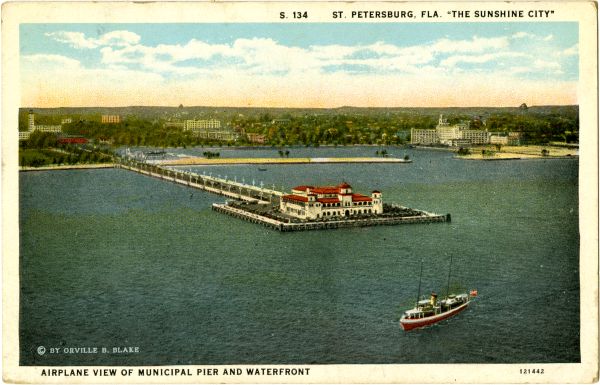 1925-1929
Aerial of the St. Pete waterfront from 1926, the same year Murok Realty was pouring the original pink concrete on Pinellas Point.
Courtesy of State Archives of Florida, Florida Memory — PC13231
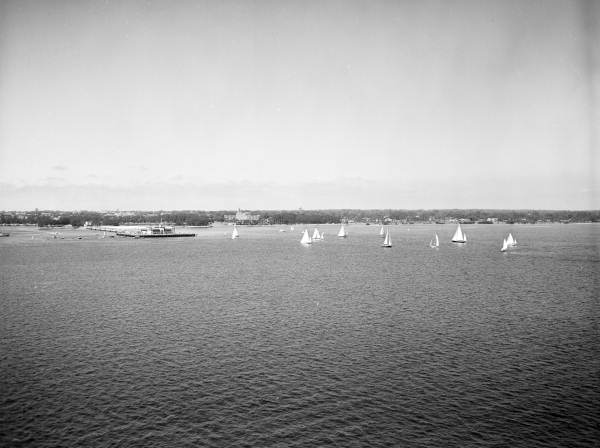 1950s
1950s1955 aerial of the St. Petersburg-Havana Yacht Race start. This is the same decade Glenn Q. Johnson was finishing his Vision-Aire 'Bird Cage' homes along 69th Ave S.
Courtesy of State Archives of Florida, Florida Memory — C20865
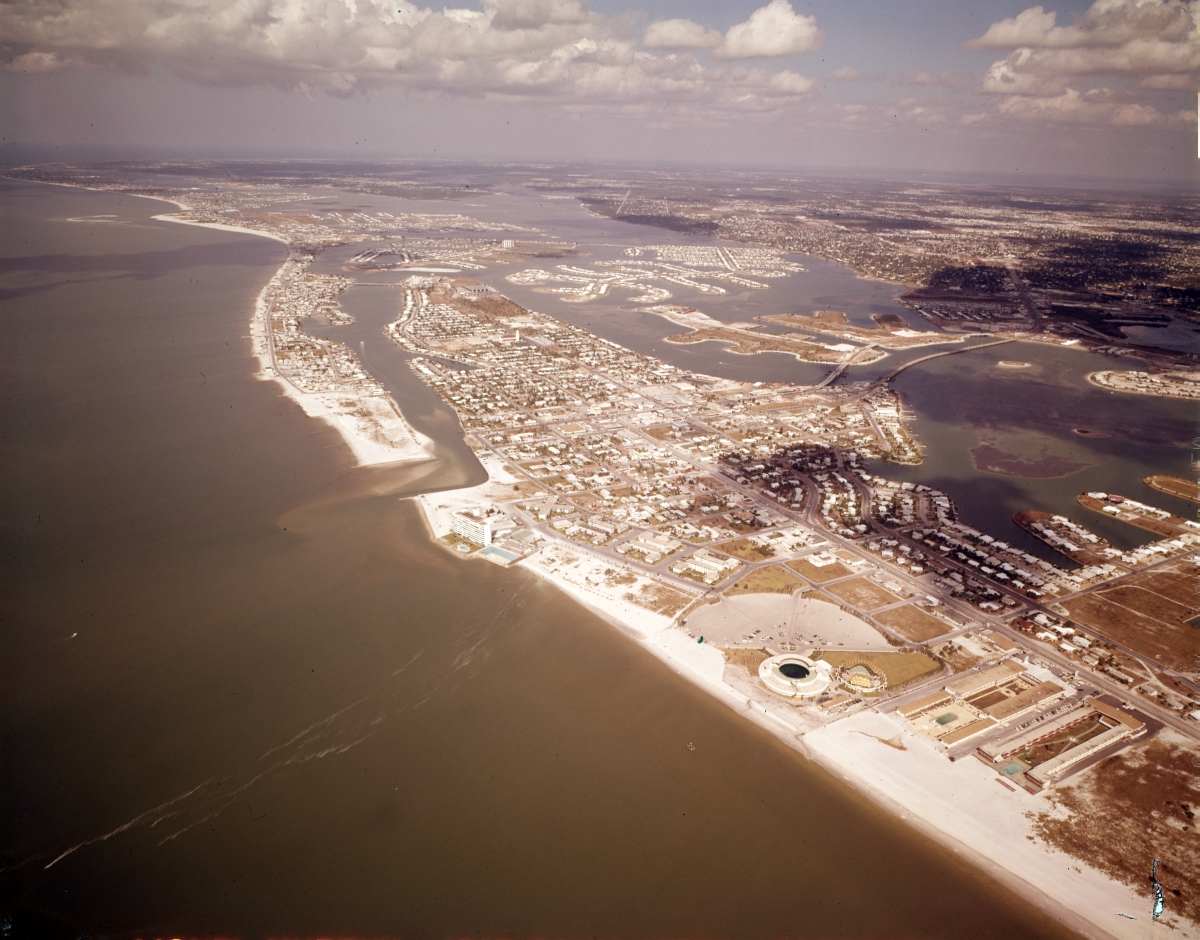 1960s
1960sAerial of the Pinellas peninsula circa 1964, looking north — the southern tip in the foreground is the Greater Pinellas Point neighborhood.
Courtesy of State Archives of Florida, Florida Memory — DC072619
Commute Times
Click any destination to see the mapped route with real-time traffic estimates.
Pros & Cons
The Pros
- One of the more affordable entry points into St. Pete proper — 1950s block ranches on big lots still trade in the mid-$300s to mid-$500s in inland pockets
- Pink Streets — the only pink-concrete neighborhood in America, a genuine one-of-one architectural feature
- Greatest architectural variety in St. Pete: 1920s Mediterranean, 1950s mid-century, ranch, Glenn Q. Johnson Bird Cages, contemporary new construction
- Tampa Bay views and direct Sunshine Skyway sightlines from many lots — boat access via Maximo and Bay Vista ramps
- Big lots and mature canopy uncommon at the price point — quiet streets, low traffic, tucked-away feel
- Eight parks totaling 140+ acres of green space inside the broader district, including Tippetts Park, Bay Vista Park, Maximo Park, and Lake Vista
- Pinellas Point Temple Mound — one of only a handful of intact Tocobaga temple mounds in the city, walking distance from much of the Pink Streets
- Active neighborhood civic association (GPP Civic Association) and a CONA-member voice in city affairs
The Cons
- Block-by-block flood-zone variation — verify every address on the FEMA map before you make an offer
- Hurricane Helene devastated the western shoreline (Bahama Shores, Pink Streets bluff); inland blocks largely stayed dry — the line is real and recent
- Walk Score is low (~30) — you're driving for groceries, dining, and most errands
- Limited dining and shopping inside the neighborhood proper — Mullet's Fish Camp, The Chattaway, Tiki Docks, and Skyway Marina District are the main nearby options
- Less name recognition with relocation buyers than Old Northeast or Snell Isle, which can make resale narrative work harder
- Insurance is meaningfully higher near the coast — 4-point and wind-mit reports are required, and roof age becomes a major underwriting factor
- Zoned public schools rate below St. Pete's strongest neighborhood schools — most engaged buyers either lottery into magnets or apply to Bay Vista Fundamental
What You Need to Know
Who Should Live Here
Buyers who want value, space, water views, and architectural variety — and who are willing to drive for most amenities. A strong fit for boaters (nine boat ramps inside the broader district), for buyers chasing a specific architectural style (1920s Mediterranean on the bluff, mid-century in Bahama Shores, a Vision-Aire if you can find one), and for anyone who'd rather have a 1950s block house on a big lot in a quiet pocket than a small bungalow on a busy walkable street. Not the right fit for someone who wants to walk to dinner, ride a bike to the Pier, or live inside the downtown energy.
What to Watch For
The flood-zone line is the most important conversation in this neighborhood. Some streets are AE; others are X just one or two blocks away. Get the FEMA flood map for the specific address, the elevation certificate, and a real insurance quote — before you make an offer, not after. Helene flooded waterfront pockets that had never seen water before. Verify roof age, get a 4-point inspection, and look at wind-mitigation features carefully — insurance carriers are tightening on roofs older than 15 years near the coast. If you're buying a Glenn Q. Johnson Vision-Aire, pull permit history and confirm the screened cage and original jalousie walls are intact — a 're-windowed' Bird Cage with the cage stripped out is worth the lot, not the architecture. Check the actual specific block: Pink Streets streetscape varies, and not every road in the broader district is pink.
What to Expect
A peninsula that doesn't look or feel like the rest of flat, gridded St. Pete. Curving pink streets in the iconic core. 1920s Mediterranean tile roofs next to 1950s pastel ranches next to occasional Vision-Aire bird cages. Big mature live oaks, eight parks, nine boat ramps, panoramic Tampa Bay and Skyway Bridge views from the southern bluff. A genuinely diverse community — Niche grades the diversity an A. Quiet streets, low traffic, neighbors who know each other. Twelve minutes to downtown, ten to St. Pete Beach if you sneak around I-275 traffic. A neighborhood that rewards homework — flood-zone, roof, insurance — and punishes generalization.
Aaron's Honest Take
Aaron & Aubrey Chand
Living in St. Pete · Excellecore Real Estate
When buyers ask me about Pinellas Point, the first thing I tell them is that you can't generalize. There is no single answer about flood zone, no single answer about price, no single answer about character. It's the most internally varied neighborhood in St. Pete. The Pink Streets are one place. Bahama Shores is a different place. The Bird Cage cluster on 69th Ave S is a third place. And the inland blocks east of 4th Street are a fourth. Each one has its own flood profile, its own architecture, its own price band. So when someone says 'I'm looking in Pinellas Point,' I push back: which part? Because the difference between an AE waterfront lot on Bahama Shores and an X-zone block house in Bayou Shores is the difference between two very different purchases.
The honest read on Helene: this neighborhood took a real hit on the western shoreline, and I don't want to soften that. Sea Gull Drive, parts of the Pink Streets bluff, and chunks of Bahama Shores saw water they'd never seen in fifty years of ownership. Some of those homes have been demolished. Other lots a few hundred feet inland — same neighborhood name, same zip code — never saw a drop. If you're considering this area in 2026, you need to know which side of the line a specific address sits on, and you need the elevation certificate in hand before you make an offer. That's not pessimism, it's just the new reality of buying in any peninsula neighborhood in St. Pete.
Here's why Pinellas Point still belongs on a serious shortlist. The architecture is genuinely irreplaceable in some pockets — there's nothing else in the country like the Pink Streets, and a Glenn Q. Johnson Vision-Aire is statistically rarer than a Kiehnel & Elliott Mediterranean on Snell Isle, at a third of the price. The lots are bigger than almost anywhere else in the city at this price tier. The boat access is real. The Tampa Bay and Skyway views from the southern bluff are some of the best in St. Pete. You drive everywhere, sure — but you're twelve minutes from downtown and a Saturday morning at the Pier, and you're tucked away from the traffic everyone else fights. If those trade-offs sound like features instead of dealbreakers, this is a neighborhood worth taking seriously. Bring the flood map and a sharp inspector and you can find real value here.
The Buying Reality
~30-45 days for fairly-priced homes; well-renovated waterfront and Pink Streets homes move faster
Moderate — broader district typically has 30-50 active listings across all price tiers; specific micro-pockets (Pink Streets, Vision-Aire homes) are tight
Common on renovated mid-century homes under $600K and on any documented Vision-Aire / Bird Cage listing
Get pre-approved, get the FEMA flood map and elevation certificate for the specific address, line up insurance quotes before you go under contract, and bring an inspector who knows pre-1970 Florida block construction and understands wind-mitigation. Don't try to negotiate cosmetic credits on Vision-Aires — sellers walk from buyers who don't understand what the architecture is.
Schools & Zoning
Magnet Options
Private / Independent
Pinellas County operates a controlled-choice student assignment system, so zoned schools are one factor among several. Bay Vista Fundamental Elementary is a popular alternative inside the neighborhood for buyers who don't want to use Bay Point Elementary; placement is by lottery. Magnet placements at Bay Point Middle (CAST) and Lakewood High (CAT) are competitive but countywide — not dependent on zoning. Most engaged Pinellas Point buyers end up at Bay Vista Fundamental, a magnet, or a private school rather than the zoned schools.
Insurance & Maintenance Reality
Pre-War Home Considerations
Insurance in Pinellas Point is its own conversation, and the conversation is different on every block. Carriers will require a 4-point inspection (roof, electrical, plumbing, HVAC) and a wind-mitigation report. Roof age is the single biggest factor — anything over 15 years on a coastal block will narrow your carrier options sharply, and over 20 years can become uninsurable through standard markets near the bay.
Flood insurance is where the variance gets dramatic. Waterfront homes in AE zones (Bahama Shores eastern shoreline, Pink Streets bluff lots, anywhere directly on Tampa Bay) require flood policies and the premiums reflect post-Helene reality. Inland blocks in zone X may not require flood insurance at all, though we still recommend optional coverage. Get the elevation certificate. Get a real quote with the specific address and current building specs — generic quotes for 'Pinellas Point' are useless because the neighborhood is too varied.
The pre-war Mediterranean homes (Pink Streets, Bahama Shores) carry the same maintenance reality as any 100-year-old house: foundation, original wiring, cast-iron drain lines, galvanized supply lines. The 1950s block homes are generally easier to insure as long as the roof is current and the systems have been updated. Vision-Aire / Bird Cage homes are a special case — their original cypress and cedar construction holds up well, but carriers may need explanation of the screened terraces and inverted floor plans during underwriting.
Storm Impact: Helene & Milton
Helene and Milton hit Pinellas Point unevenly. The western shoreline (Bahama Shores edge, Pink Streets bluff lots, anywhere directly facing Tampa Bay) saw real surge damage during Helene — homes that had stood dry for fifty years took several feet of water. Inland blocks just a few hundred feet up — same neighborhood, same zip — largely stayed dry. The line between flooded and dry blocks is razor-thin and follows the FEMA AE/X boundary closely.
Hurricane Helene
Sep 2024September 26, 2024. Catastrophic storm surge along the bay-facing edges of the neighborhood. Sea Gull Drive, the eastern Bahama Shores coast, and parts of the Pink Streets bluff saw 3-6 feet of water inside homes. A Tampa Bay Times feature documented one Pink Streets resident's 50-year home demolished after Helene flooding. Inland Pinellas Point blocks in zone X reported no surge damage. Wind damage was typical citywide — downed trees, scattered roof loss, fence damage.
Hurricane Milton
Oct 2024October 9, 2024. Milton's track passed south of Tampa Bay, sparing the neighborhood from a second surge event. Damage was wind-driven rain, downed trees, and a thousand-year rainfall event that filled some street drainage to near-curb. Roy Peter Clark wrote in St Pete Catalyst about watching the water on his Greater Pinellas Point street creep halfway up his driveway during Milton's peak — a level he'd never seen in 46 years of living there.
Blocks to Watch
Sea Gull Drive and adjacent Pasadena-side cul-de-sacs took heavy Helene damage. Bahama Shores east of 4th Street S along the bay-facing blocks (roughly 54th-62nd Avenues South) saw significant surge. Pink Streets lots that drop to the bayfront on Armistead Drive and Demens Drive flooded; lots a block inland generally did not. Get the elevation certificate for any address west of about 8th Street or directly on the bay before making an offer.
Community & Events
Greater Pinellas Point Civic Association meetings
Monthly
Active neighborhood civic association — CONA member, the principal voice for Pinellas Point at City Hall. Coordinates with city on flood-resilience funding, infrastructure (including Pink Streets maintenance), and zoning issues affecting the broader district.
Bay Vista Park Recreation Center programming
Year-round
Recreation center at the southern tip of 4th Street S — playground, sports facilities, neighborhood pool, fishing pier, and waterfront access. Hosts the GPP civic association's bi-annual neighborhood picnics and seasonal kid programming.
Pink Streets Halloween & holiday traditions
October / December
Resident-noted: many Pink Streets homes decorate heavily for Halloween, and trick-or-treating is a draw from outside the neighborhood. December holiday lighting on the curving pink streets is a long-running local custom mentioned across Trulia and Niche reviews.
Pinellas Point Indian Mound interpretive visits
Year-round, daylight hours
Indian Mound Park at 1800 Mound Park Place S — Tocobaga temple mound with a 1960 historical marker installed by the Princess Hirrihigua Chapter of the Daughters of the American Revolution. The City of St. Pete and USF have produced 3D and virtual reconstructions of the mound's original 1880-survey extent.
What Residents Are Saying Online
Public sentiment on Pinellas Point pulls from three consistent themes across Niche, Trulia, City-Data, and StreetAdvisor: residents love the diversity, the parks, and the genuine 'tucked-away Florida' feel, but consistently flag two limitations — the zoned public schools and the lack of in-neighborhood dining. The Pink Streets specifically draw enthusiasm even from skeptics. A 50-year resident's Tampa Bay Times feature about losing her seashell-pink home to Helene captures the post-2024 tension: the neighborhood is genuinely beloved, and parts of it are now also genuinely vulnerable.
“Great neighborhood for families. Quiet streets, lots of diversity, big yards, several parks including waterfront playground, easy access to the highway, two big grocery stores nearby, close to magnet schools, not in a flood zone.”
“I love it here. The streets are pink, many trees, the roads are winding. My favorite neighborhood in St. Pete.”
“There are some families in the pink streets. The zoned schools are terribly rated, but the fundamental school today is very highly rated.”
“We live in evacuation zone D, about 15 feet above sea level, and have never seen, in almost a half-century, water rise over our curb onto our lawn... We saw no water at all through Helene, persuading us that we were immune from the storm surge that flooded out so many of our friends and neighbors. We were naïve. Who could have imagined a thousand-year rainfall during Milton?”
“Though there is definitely room for improvement Pinellas Point is a great neighborhood. I'd like to see a Trader Joe's or Whole Foods caliber grocery store added on 62nd where Sweetbay once was. I'd love to see the neighborhood schools improve. I'd love to have more restaurant/bar/nightlife options.”
“I've lived here for 17 years and love it. The people are friendly and hard working. It's a nice area all around.”
Further Reading & Resources
Civic & Preservation
Coalition of Neighborhood Associations (CONA) — Member Directory
Citywide neighborhood association coalition. GPP Civic Association is an active CONA member.
City of St. Petersburg — Parks & Recreation
Bay Vista Park, Maximo Park, Lake Vista Park, Tippetts Park, Pinellas Point (Indian Mound) Park — all city-maintained.
Preserve the 'Burg
Citywide historic preservation nonprofit — relevant for any 1920s Mediterranean homes in Bahama Shores and the Pink Streets that may merit local landmark designation.
Journalism
The Gabber — The Pink Streets of St. Petersburg
Definitive primary-source-rich article on the 1925 Cook family / Murok Realty plat, the original 1925 ads quoted in the Tampa Morning Tribune and St. Petersburg Times, and the 1989 City Council preservation vote.
Green Bench Monthly — Pinellas Point Pink Streets
Comprehensive history of the Cook family's 1906 land purchase, the 1925 Murok plat, the Bayou Castle and Tippetts House, and the 1990s pink-concrete restoration.
Tampa Bay Times — Neighborhood Profile: The Pink Streets
Long-form neighborhood profile from a 30+ year resident's perspective, with values, character, and resident voice.
St Pete Catalyst — A walk along the Pink Streets reveals a secret garden and a great St. Pete lady
Roy Peter Clark on the Pink Streets, Pinellas Point Park, and Catherine Bell Tippetts — and on what life as a far-south-side resident actually looks like.
St Pete Catalyst — Roy Peter Clark: Surviving those Hurricane Blues
Primary-source resident account of Helene and Milton's impact on Greater Pinellas Point — the storm-surge naivete, the Milton thousand-year rainfall, the post-storm landscape.
Tampa Bay Times — She spent 50 years in a perfect pink house — then came Hurricane Helene
Long-form feature documenting one Pink Streets-adjacent resident's 50-year home demolished after Helene — the most honest available account of post-storm reality on the Pinellas peninsula's western shoreline.
WUSF — Pinellas County residents focus on recovery after Hurricane Milton
Countywide post-Milton coverage providing context for the storm's specific track and damage pattern on the Pinellas peninsula.
Tampa Bay Times — Mariners Pointe sale (2014)
Coverage of a long-standing rental complex on Pinellas Point Drive S — useful context on the multi-family edge of the broader district and the GPP Civic Association's neighborhood-watch involvement.
Tampa Bay Times — Time ran out for Pinellas residents who didn't evacuate for Helene
Reconstruction of Helene's surge timeline across Pinellas County — the citywide context for the Pinellas Point shoreline experience.
Neighborhood Association
Schools
Cultural
Pinellas Point Mound — Wikipedia
Reference summary of the Tocobaga temple mound, its 1958 donation to the city, the 1960 DAR historical marker, and the 2014 USF terrestrial laser-scanning reconstruction.
Diamond Legacy America — Pinellas Point Mound feature
Long-form feature on the temple mound, including dimensions, the Princess Hirrihigua legend, and the mound's preservation context.
Northeast Journal — St. Petersburg's Native American Indian Mounds
Citywide context on St. Pete's surviving Tocobaga mounds (Pinellas Point, Abercrombie, Jungle Prada, Maximo) including the Juan Ortiz / Hirrihigua story.
What's Nearby
Pinellas Point Temple Mound (Indian Mound Park)
in district
Bay Vista Park & Recreation Center
in district
Katherine B. Tippetts Park
in district
Maximo Park & Boat Ramp
1.0 mi
Lake Vista Park & Recreation Center
in district
Lakewood Estates Golf Course
1.5 mi
Skyway Fishing Pier State Park
3 mi
Mullet's Fish Camp
1.5 mi
The Chattaway
2.5 mi
Tiki Docks Skyway Bar & Grill
1 mi
Skyway Marina District
1 mi
Fort De Soto Park
10 mi
St. Pete Beach
8 mi
Elevation & Flood Risk
12ft average elevation
FEMA Flood Zone AE near coast, X further inland (varies block-by-block) — flood insurance required
Thinking about Greater Pinellas Point?
We've helped over 50 buyers relocate to Tampa Bay. Let's talk about whether Greater Pinellas Point is the right fit for you.
Explore more neighborhoods
View All in Relocation Guide