Downtown St. Pete
Waterfront Skyline, Walk-Everywhere Living
92 — most walkable area in Tampa Bay
Walk Score
X for most blocks; AE along the waterfront
Flood Zone
5-15 ft (waterfront blocks lower)
Elevation
Downtown St. Petersburg Historic District (2004)
National Register District
Concrete high-rise condos + adapted historic buildings
Construction
26-acre St. Pete Pier (reopened July 2020, $92M)
Anchor Amenity
Neighborhood Overview
Downtown St. Pete is the most walkable square mile in Tampa Bay. The 26-acre St. Pete Pier — rebuilt in 2020 for $92 million — anchors the east edge. The Salvador Dalí Museum, the Museum of Fine Arts, the James Museum of Western & Wildlife Art, and the Florida Holocaust Museum are all inside the same fifteen-minute walk. Beach Drive's restaurants, the Saturday Morning Market at Al Lang Stadium, the Sundial plaza, the new high-rise towers, and the historic Vinoy Hotel all sit in the same dense grid bounded roughly by Central Avenue, the waterfront, 4th Street North, and 4th Street South. Walk Score for the core blocks is 92.
Living downtown is a fundamentally different real estate product than the historic neighborhoods. The inventory is overwhelmingly condo and townhome — concrete high-rise construction, HOA dues that include amenities and reserves, and building-by-building variation in flood resilience. The newer towers (Saltaire, ONE St. Petersburg, Bliss, ONE Beach Drive, the 46-story 400 Central that started move-ins in late 2025) are built with flood-resistant lower floors and amenity decks elevated above grade. Older waterfront buildings have varying experiences and need much closer diligence on reserves, special assessment history, and flood policy structure.
If your priority is lock-and-leave urban living, walk-everywhere convenience, and waterfront views without the maintenance burden of a single-family home, downtown is the answer in St. Pete. The honest carrying-cost math has to be priced in: a $700K condo with $1,200/mo HOA, building-paid wind, and a unit-owner flood policy is a different reality than a $700K bungalow inland. The good news is that the structure of downtown — concrete high-rise on a National Register block of adapted historic buildings, with a real cultural anchor in the Pier — is one of the few urban-Florida products that has held its appreciation through every cycle since the towers started rising in the mid-2000s.
History & Origins
Platted 1888 as part of original St. Petersburg
John C. Williams (founder) and Peter Demens (railroad)
1888-present (Downtown National Register District designated 2004)
Downtown St. Pete is the original St. Petersburg. John C. Williams platted the city in 1888 around what is now Williams Park; Peter Demens brought the Orange Belt Railway to the bayfront the same year and named the new town after his Russian birthplace. The Detroit Hotel — the city's first — opened on Central Avenue in 1888 and still stands one block off the water as adapted-reuse condos. Through the 1890s and early 1900s downtown grew along Central Avenue and around Williams Park as a walking, streetcar, and tourist district. A railroad pier extended into the bay from the foot of 2nd Avenue NE; an open-air post office (still operating today, the only one of its kind in the U.S.) opened in 1917 on 4th Street.
The 1920s land boom built downtown's first skyline. The Vinoy Park Hotel opened New Year's Eve 1925 — built by Aymer Vinoy Laughner with his father Perry Orville Laughner of Roser Park, designed by Henry Taylor (who also did the Flora Wylie House on 14th Avenue NE). The Florida Power Building, the Snell Arcade (Perry Snell's downtown commercial address at 4th and Central, completed 1929), the Kress Building, the Florida Arcade, and the Suwannee Hotel on Mirror Lake all date from the 1922-1929 boom. The Million Dollar Pier — a Mediterranean-Revival amusement pier — opened 1926 and became the city's signature postcard image. The 1926 land bust and the Depression froze new construction; downtown coasted on its tourist economy and the famous green benches that lined Central Avenue.
The Inverted Pyramid replaced the Million Dollar Pier in 1973 and stood for forty years before being closed in 2013 and demolished in 2015. The current 26-acre St. Pete Pier opened July 6, 2020, in the middle of the COVID pandemic, after seven years of design, debate, and construction at a cost of $92 million. In parallel, the residential skyline went vertical. ONE St. Petersburg (41 stories) finished in 2018; Saltaire (35 stories) topped out in 2023; 400 Central (46 stories, the tallest residential tower on Florida's Gulf Coast at 515 feet) issued its first temporary certificate of occupancy in December 2025. The Tropicana Field site — the 86-acre Historic Gas Plant District just west of the high-rise core — has four shortlisted master-plan proposals on Mayor Welch's desk in 2026 and will reshape downtown's western edge for the next two decades. The Downtown St. Petersburg Historic District was added to the National Register in 2004; the Mirror Lake neighborhood (an inland pocket of downtown around 8th-4th Streets and 1st-5th Avenues North) became the city's eleventh local historic district in December 2024.
Architecture & What You'll Be Buying
Predominant Styles
Typical Year Built
Two distinct eras — 1920s historic shell or 1995-2025 high-rise. Almost no inventory between those periods.
Typical Size
Condos 700-2,500 sq ft (one-bedroom to three-bedroom); penthouses 3,000-7,000+; the rare adapted historic SFR runs 2,000-4,000
Construction
New towers are post-tensioned concrete with impact-rated glazing, elevated lobby and amenity decks, and parking garages typically wrapped above flood elevation. Older mid-rises (1970s-1990s) vary widely in flood resilience — get the building's elevation certificate, the reserve study, and the post-Helene assessment history before writing an offer. Adapted historic buildings (Snell Arcade, Detroit Hotel, the Florencia, the Princess Martha) trade architectural character for older mechanical systems and tighter floor plates.
Materials & Streetscape
Concrete and steel high-rise dominates. The historic shell — the Snell Arcade's terra-cotta and bronze Mediterranean Revival, the Vinoy's Mediterranean ochre stucco, the Kress Building's polychrome terra-cotta, the Suwannee Hotel's cast-stone classicism — gives downtown its texture. The Veillard House at 262 4th Avenue North is the rarest survivor: an 1901 Queen Anne / bungalow blend designed by Henry H. DuPont (the same architect who did the Don CeSar), relocated from 450 4th Avenue North in 1979 to avoid demolition and listed on the National Register in 1982.
Pockets Within the Neighborhood
Beach Drive corridor
The waterfront restaurant strip from roughly 4th Avenue NE to 1st Avenue NE — the Vinoy on one end, Parkshore Plaza and the Florencia in the middle, the Pier at the south end.
What sets it apart: This is the postcard. Highest condo prices, tightest inventory, walk-out-the-lobby access to the bayfront park. AE flood zone for the lowest floors of older buildings.
Central Ave corridor
The east-west commercial spine from the bayfront to about 6th Street, lined with adapted historic buildings, restaurants, galleries, the Sundial plaza, and the Saturday Morning Market site at Al Lang Stadium.
What sets it apart: Lofts and adapted historic units rather than waterfront towers. More texture, more nightlife, more nights you don't need a car. Strong Friday and Saturday foot traffic.
Mirror Lake / Uptown edge
The inland pocket around Mirror Lake, the Mirror Lake Library, and the Coliseum — became the city's eleventh local historic district in December 2024.
What sets it apart: Almost entirely contributing-historic buildings (early 1900s bungalows, 1920s apartment buildings, the Suwannee Hotel) rather than new construction. Local-district designation now applies — exterior changes require a Certificate of Appropriateness. Lower price point than the waterfront blocks.
EDGE / Tropicana Field side
The blocks west of 4th Street, transitioning toward the 86-acre Historic Gas Plant District / Tropicana Field redevelopment site.
What sets it apart: Smaller-scale adaptive reuse, breweries, the Trader Joe's-anchored mixed-use blocks, and the single biggest urban-redevelopment story in Florida — the Gas Plant District master plan, with four shortlisted proposals on the mayor's desk in mid-2026.
Notable Homes & Landmarks
262 4th Ave N — The Veillard House
Built 1901
St. Pete's most architecturally significant downtown survivor. A Queen Anne / Bungalow blend designed by Henry H. DuPont — the same architect who started (and was famously fired from) the Don CeSar on St. Pete Beach. 3,040 square feet on a slate roof with original stained glass and a Bungalow-style front porch. Relocated to 262 4th Avenue North in 1979 to avoid demolition; listed on the National Register of Historic Places in 1982. Currently configured as office use.
Built for Ralph Veillard, a French-born St. Pete merchant and city councilman who arrived from France in 1900, ran the city's largest general store by 1908, served on the Board of Trade, and pushed the original waterfront-beautification campaign that became today's bayfront park system. Died 1931.
501 5th Ave NE — The Vinoy
Built 1925
Built by Aymer Vinoy Laughner (and his father Perry Orville Laughner of Roser Park) for $3.5 million, designed by Henry Taylor. Opened New Year's Eve 1925 as the social anchor of the 1920s tourist economy. Closed and decaying through the 1970s and 1980s, restored 1992, restored again 2022 under Marriott as the Vinoy Resort & Golf Club. The single most photographed building in downtown St. Pete and a National Register landmark.
Marriott (current); previously Renaissance, Stouffer, original Laughner family ownership. The Vinoy Residences condo tower that opened next door in 2024 trades on the same brand.
405 Central Ave — Snell Arcade
Built 1929
Perry Snell's downtown commercial monument at 4th and Central — completed in 1929 just as the Florida boom collapsed. Mediterranean Revival with bronze, terra-cotta, and a two-story arcade interior. Snell built it as the architectural showpiece of his downtown holdings. Adapted to residential lofts in 2003 (one of St. Pete's earliest historic-loft conversions), still operating as condos today.
Originally Perry Snell. Adapted reuse to lofts 2003 by Hayward Properties.
215 Central Ave — Detroit Hotel
Built 1888
St. Petersburg's first hotel, built the year the city was platted by John C. Williams. Named for Detroit, Michigan, where Williams lived before founding St. Pete. Operated as a hotel for over a century, restored 2003 as condos at the western edge of the downtown core. The oldest commercial structure in continuous use in the city.
Originally John C. Williams. Adapted to condos 2003.
100 1st Ave N — ONE St. Petersburg
Built 2018
The 41-story tower that re-launched downtown's modern high-rise era. Developed by Kolter Urban; 253 condos plus the 200-room Hyatt Place. At completion it was the tallest building in St. Pete and the project that proved the post-2008 demand for downtown waterfront luxury. Helene and Milton (2024) gave the tower its first major storm test; the building's elevated lobby and amenity floors performed as designed.
Developer Kolter Urban; condo association governs.
Then & Now
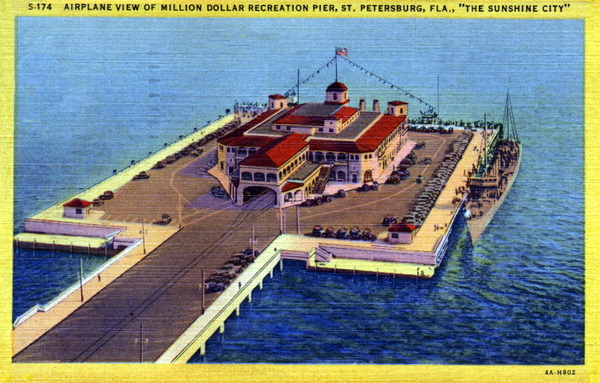 1934
1934The Mediterranean-Revival Million Dollar Pier opened in 1926 and stood until it was replaced by the Inverted Pyramid in 1973.
Florida Memory / State Archives of Florida — pc3929
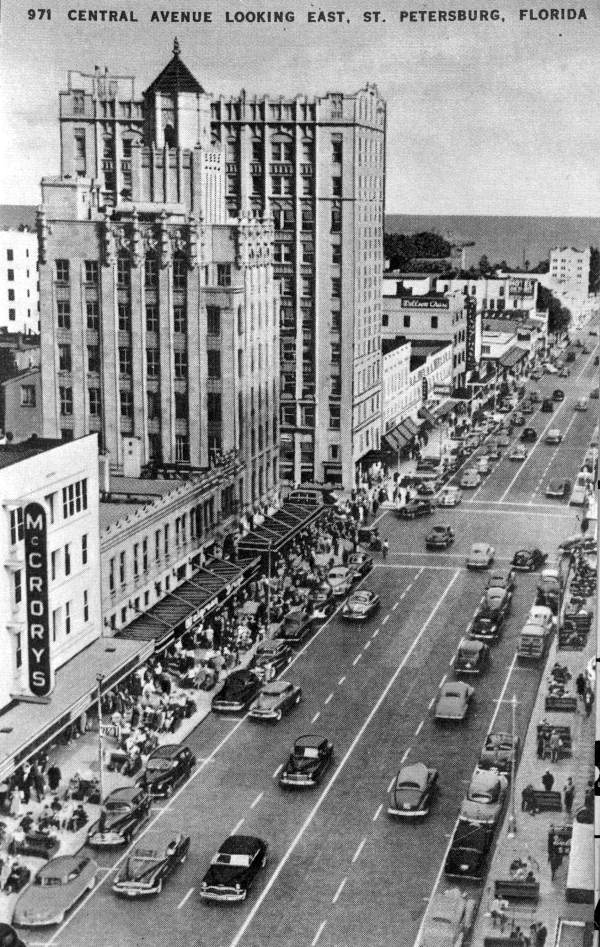
1940Perry Snell completed the Snell Arcade at 4th and Central in 1929 — Mediterranean Revival commercial monument, adapted to lofts in 2003.
Florida Memory / State Archives of Florida — n048458
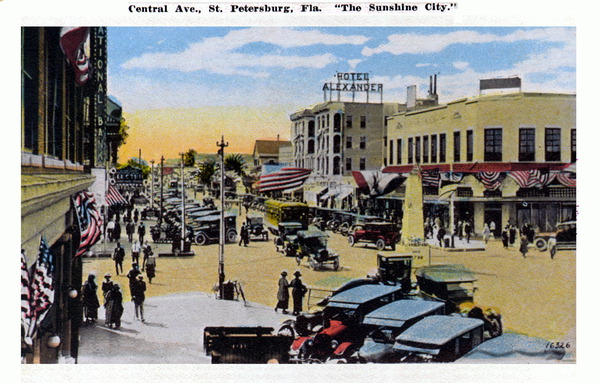 1900
1900Central Avenue at the turn of the century — the spine of downtown long before the towers arrived.
Florida Memory / State Archives of Florida — pc4126
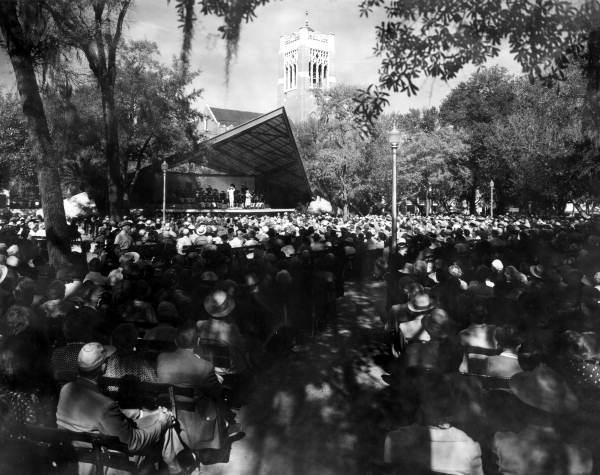 1920
1920Williams Park has anchored downtown's social life since John Williams platted the city around it in 1888.
Florida Memory / State Archives of Florida — rc19754
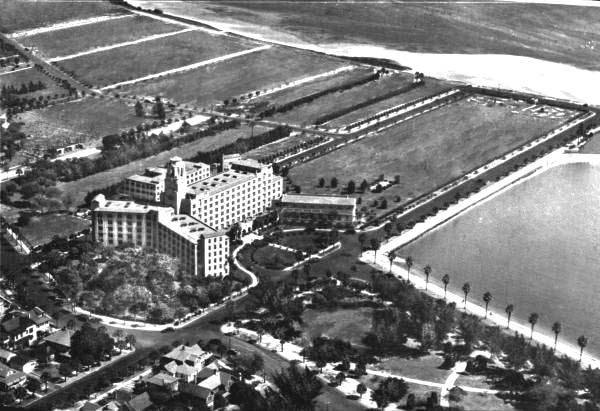 1920
1920The Vinoy Park Hotel anchored downtown's bayfront from 1925 forward — restored 1992 and again in 2022 as the Vinoy Resort & Golf Club.
Florida Memory / State Archives of Florida — pha201
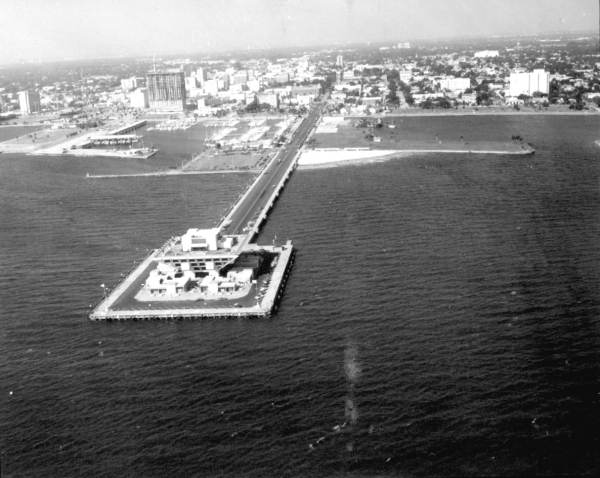 1973
1973The Inverted Pyramid replaced the Million Dollar Pier in 1973 and stood for forty years before being demolished in 2015 to make way for the current Pier.
Florida Memory / State Archives of Florida — c680822
Commute Times
Click any destination to see the mapped route with real-time traffic estimates.
Pros & Cons
The Pros
- Walk Score 92 — the most walkable area in Tampa Bay
- Pier, four major museums, the Vinoy, Beach Drive restaurants, and Saturday Morning Market all inside a 15-minute walk
- Concrete high-rise construction in the new towers — better hurricane performance than wood-frame and elevated lobby/amenity floors
- Lock-and-leave lifestyle — ideal for second homes, downsizers, and anyone who genuinely doesn't want yard maintenance
- Strong rental and resale market for well-located buildings in the Beach Drive corridor and along Central Ave
- 30 minutes to Tampa, 20 to St. Pete Beach, 27 to TPA — central to everything in the metro
- Genuine cultural density — the Dalí, MFA, James Museum, Florida Holocaust Museum, Mahaffey Theater, and the Pier's Tampa Bay Watch Discovery Center are all on foot
- National Register Downtown Historic District (2004) plus the new Mirror Lake Local Historic District (2024) — preservation framework is in place
The Cons
- Most inventory is condo or townhome — single-family options inside the downtown core are extremely limited
- HOA dues are real — $700/mo on the low end, $1,500-$2,500+ in the Beach Drive luxury towers; verify reserves and special-assessment history
- Waterfront tower flood-zone status varies building-by-building — older mid-rises along the bayfront need much closer diligence than the new towers
- Special assessments hit some buildings after Helene reshaped reserves and triggered insurance restructuring
- Construction noise during ongoing high-rise development — 400 Central, the Vinoy Residences, and the upcoming Waldorf Astoria tower are still active sites in 2026
- Limited yard / outdoor space — what you have is the building's amenity deck, the Pier, and Vinoy Park
- Parking is real — meters all day Saturday, garage spots typically conveyed with luxury units but extra in older buildings
What You Need to Know
Who Should Live Here
Buyers who genuinely value walkability over square footage. Second-home and lock-and-leave buyers who fly in for the season. Empty-nesters downsizing from suburban single-family. Professionals who want urban density without giving up Florida sun. Anyone for whom the choice between a yard and the Pier-on-foot is an obvious one in favor of the Pier. Not the right fit for buyers who want a backyard, who want quiet at midnight, or who specifically want a single-family home — that buyer should be looking at Old Northeast, Crescent Lake, or Historic Kenwood instead.
What to Watch For
HOA financials are the diligence. Pull the reserve study, the most recent reserve-funding analysis, and the special-assessment history — especially anything dated October 2024 or later, which will show how the building came through Helene and Milton. Verify the building's specific flood zone and elevation certificate (it varies by tower and by floor). Look at the building's master insurance policy and the carrier's exposure to Citizens vs. private — that affects future assessments. For older mid-rises (pre-2000), get the milestone inspection report Florida now requires for buildings over 30 years old. The new towers (post-2015) generally have stronger reserves and better flood resilience; the older waterfront buildings need much closer scrutiny on every line item.
What to Expect
Mostly concrete high-rise condos with amenity decks, fitness centers, pools, valet or self-park garages, and 24-hour staffing in the luxury towers. Some adapted historic buildings (Snell Arcade lofts, Detroit Hotel condos, the Princess Martha) for buyers who want character over a brand-new finish. New construction continuing along Central Avenue, Beach Drive, and the western edge near the Tropicana Field redevelopment site. A neighborhood where you genuinely don't need a car for daily life — groceries (Publix and Trader Joe's are walkable), restaurants, museums, the Pier, and the market are all on foot. Expect noise, expect tourists on weekends, and expect the kind of urban density that is rare anywhere else in Florida.
Aaron's Honest Take
Aaron & Aubrey Chand
Living in St. Pete · Excellecore Real Estate
Here's what I tell buyers who ask me about downtown: this is the only neighborhood in Tampa Bay where you can genuinely live without a car. The Pier, the Dalí, the MFA, four other museums, the Vinoy, Beach Drive, the Saturday Morning Market, the Mahaffey, and Trader Joe's are all inside a 15-minute walk of any of the towers. Walk Score is 92. That number doesn't lie. If you've ever wanted the urban-condo lifestyle and you've also wanted Florida sun, this is the address. The rest of Tampa Bay is suburbs and beaches; downtown St. Pete is the city.
The honest cons: you're buying a condo, almost always. Single-family homes inside the actual downtown grid are rare and they're not cheap. HOA dues run $700-$2,500 a month depending on the building, and that math has to be priced in alongside the unit-owner flood policy and the building-paid wind insurance. The old waterfront mid-rises are a different conversation than the new towers — Saltaire, ONE St. Petersburg, the new 400 Central — which were engineered with elevated lobbies and impact-rated glazing and came through Helene and Milton with the kind of building-level performance you want. The 1970s and 1980s waterfront buildings need a real reserve study and a real special-assessment-history conversation before you write an offer.
The opportunity I'd flag: the Tropicana Field redevelopment is the biggest urban-real-estate story in the state right now. The mayor narrowed the Gas Plant District master plan to four proposals and is selecting in 2026; the chosen plan reshapes 86 acres on the west edge of downtown for the next twenty years. Anyone buying within walking distance of that site — the EDGE District, the Central Ave corridor west of 4th Street, the Mirror Lake blocks — is essentially front-running an entire new neighborhood being built next door. We've helped over 50 buyers relocate to Tampa Bay in the past couple years, and the buyers who pay attention to where the city is putting its biggest bet usually do well.
The Buying Reality
~47 days for fairly-priced condos; new-construction units in 400 Central and Vinoy Residences moving through closings on developer timelines
Healthy — typically 150-200 active condo listings across the downtown core at any time
Common on well-priced 1-bedroom and 2-bedroom units in the newer towers and on the rare downtown-proper SFR; less common at the $2M+ luxury level where inventory has loosened
Get HOA financials and reserve study from your agent before you write. Line up a unit-owner flood quote in parallel with your loan application — flood is unit-owner responsibility in most Florida condos. Be specific about parking (deeded vs. assigned vs. valet) and pet policy in your offer. Don't ask for cosmetic credits in a tight building; sellers walk.
Schools & Zoning
Magnet Options
Private / Independent
Pinellas County operates a controlled-choice attendance system, so zoning is one input among several. Verify your specific address with the PCSB School Zone Locator (https://www.pcsb.org/zone) before you write — downtown's odd block geometry means two units in the same building can occasionally fall in different zones for the same grade level. Most downtown buyers with school-age children either go private (Shorecrest is closest) or apply into one of the magnets. St. Pete High is the zoned high school for most of the downtown core and remains one of the strongest IB programs in Florida.
Insurance & Maintenance Reality
Pre-War Home Considerations
Downtown insurance is a building-level conversation as much as a unit-level one. The condo association carries the master policy on the structure, the common areas, and (in most buildings) the wind exposure. The unit owner carries an HO-6 "walls-in" policy plus a separate flood policy on the contents and the unit itself. Get all three numbers — master premium / your share via HOA, HO-6, flood — before you assume you can afford the carrying costs.
The new towers (Saltaire, ONE St. Petersburg, ONE Beach Drive, 400 Central, Vinoy Residences) are concrete construction with impact-rated glazing and elevated mechanical systems — they get the strongest wind-mit credits and the cleanest flood-elevation certificates. Older mid-rises (1970s-1990s) are where the diligence matters most: cast-iron risers, original windows, and elevation certificates that show ground-floor units below base flood elevation can all show up in your HO-6 quote and the building's master renewal.
Post-Helene reality check: Florida now requires a milestone inspection on residential condo buildings 30+ years old, and the resulting reserve-funding obligations have triggered special assessments at a number of downtown buildings. Always pull the most recent reserve study, the milestone inspection report (where applicable), and the assessment history for the last 36 months before writing an offer. The buildings that got out ahead of those obligations are now the most stable; the buildings that deferred them are working through the math.
Storm Impact: Helene & Milton
Downtown's elevation (5-15 feet, with most of the inland blocks closer to 10-15) and concrete high-rise construction meant the new towers performed well structurally. The damage story was concentrated at the waterfront edge — older mid-rises with ground-floor units, and the Beach Drive blocks where storm surge from Helene pushed water onto the sidewalk and into a small number of lobby and garage levels. Milton followed two weeks later with wind-driven rain rather than surge.
Hurricane Helene
Sep 2024September 26-27, 2024. Storm surge pushed water onto Bayshore Drive and into the lowest levels of older waterfront buildings. The new luxury towers (ONE St. Petersburg, Saltaire, ONE Beach Drive) were designed with elevated lobbies and amenity decks above base flood and performed as engineered. Older mid-rises (pre-2000) on the waterfront saw garage flooding, mechanical-room damage, and in some cases ground-floor unit damage. Inland downtown blocks (Mirror Lake, the Central Ave corridor west of Beach Drive) generally stayed dry. The Pier itself reopened within days; structural damage was minimal.
Hurricane Milton
Oct 2024October 9, 2024 — came across from the south two weeks after Helene. Wind-driven rain and a construction crane failure at the 400 Central tower that carved into the top three floors of the office building across 1st Avenue (the most-photographed downtown damage of the storm). Surge was minimal given Milton's track. Wind damage was typical of a major hurricane: roof flashings, fence loss, scaffolding damage on active construction sites.
Blocks to Watch
The waterfront edge between Bayshore Drive NE and 1st Street SE is the highest-exposure zone — verify elevation certificates and master-policy flood coverage carefully. Inland blocks west of 1st Street and north of 5th Avenue North generally sit on higher ground and stayed mostly dry through both storms.
Tax & Preservation Incentives
Historic District Status
The Mirror Lake Local Historic District (designated December 12, 2024 — the city's eleventh local district) covers the inland pocket bounded roughly by 8th Street, 4th Street, 1st Avenue North, and 5th Avenue North. Properties inside that boundary now require a Certificate of Appropriateness (COA) from the Community Planning and Preservation Commission for any exterior change. The rest of the downtown core is inside the Downtown St. Petersburg National Register District (2004), which is recognition only — no COA obligation, but eligibility for the federal 20% rehab credit on income-producing certified historic structures.
10-Year Ad Valorem Exemption
Properties inside the Mirror Lake Local Historic District (and the Veillard House and other contributing structures inside the National Register district that opt into local landmark status) are eligible for St. Petersburg's 10-year ad valorem tax exemption on the increased assessed value attributable to approved historic renovations. Cap is $100,000 per single-family residence; commercial is uncapped. Pre-approval through preservation planning staff is required.
Federal 20% Rehab Tax Credit
Income-producing certified historic structures inside the Downtown National Register District qualify for the federal 20% Historic Rehabilitation Tax Credit on certified rehabilitation expenditures. This is the more relevant incentive for downtown — Snell Arcade, the Detroit Hotel, the Princess Martha, the Suwannee Hotel and similar adapted-reuse projects have all used some version of this credit. Owner-occupied primary residences do not qualify; long-term rentals and true STR-as-business operations do.
The combination of 2004 National Register designation (covering most of the historic downtown core) and 2024 Mirror Lake local designation now gives downtown a real preservation framework. For buyers of an adapted historic loft (Snell Arcade, Detroit Hotel) or a contributing structure inside the Mirror Lake district, the tax math on a meaningful renovation is materially better than at a non-designated address. Confirm specific eligibility with the city's preservation staff before pulling permits.
Community & Events
Saturday Morning Market
Saturdays — October-May at Al Lang Stadium, June-August at Williams Park
The largest farmers market in the southeastern U.S. with 170+ vendors across 135 spaces — produce, prepared food from 15+ cuisines, seafood, baked goods, local artists, and live music. A downtown institution since 2002.
First Friday on Central
First Friday of each month
Central Avenue closes between 2nd and 3rd Streets for an outdoor block party with live music, food trucks, and bar specials. The longest-running downtown street event.
St. Pete DNA general meetings
Monthly
The Downtown Neighborhood Association — advocacy, social, and informational programming for downtown residents. Meetings are how you hear about pending zoning changes, new high-rise applications, and the Tropicana Field redevelopment process.
St. Pete Pier programming
Year-round
The 26-acre Pier hosts ongoing programming including the Tampa Bay Watch Discovery Center marine-conservation events, the sailing-program lessons, the wet classroom, restaurants, the Pier Teaching Garden, and seasonal concerts and festivals at the lawn.
Localtopia
February (annual)
Keep St. Pete Local's annual celebration of local independent businesses — held at Williams Park, drawing 30,000+ attendees. The largest single-day gathering of independent businesses in Florida.
What Residents Are Saying Online
Pulled from public discussion threads on City-Data Tampa Bay (the active r/StPetersburgFL threads on downtown were not returning verbatim quotes through search at the time of compilation). Residents consistently call out three things: the genuinely walkable lifestyle (walk to work, walk to restaurants, walk to the Pier), the revitalization arc (the contrast between the old downtown and what it has become over the last 15-20 years), and the trade-off that the beaches require a 20-minute drive — which the downtown crowd treats as a feature, not a bug.
“I walked everywhere, even to work. I walked to The Pier, downtown restaurants, North Shore Park, you name it.”
“Living downtown was great! You can walk to a movie!”
“Being young, if you enjoy going out and having a few drinks from time to time, I would think it would be nice to be able to meet friends for an evening out and then walk home without the worry of a DUI or worse: car accident.”
“I love downtown St.Pete and St.Pete Beach, it is amazing what they have done to revitalize the area over the last three - four years.”
“Downtown is going to offer far more for everyday living and you'll find beachside most activities are going to require trips inland to accomplish.”
“Live close to downtown — beaches are easy to get to, and believe me it gets old fast if you are living out there and not close to shops and fun etc.”
Further Reading & Resources
Civic & Preservation
City of St. Petersburg — Historic Preservation Program
Official city .gov page for the historic preservation program — design guidelines, Certificate of Appropriateness process, and the local register that now includes Mirror Lake.
City of St. Petersburg — Mirror Lake Local Historic District
The official city page for the Mirror Lake LHD designated December 2024 — boundary map, COA process, and FAQ.
City of St. Petersburg — Historic Gas Plant District Redevelopment
The official city portal for the 86-acre Tropicana Field redevelopment process — shortlisted proposals, public input timeline, and master-plan documents.
Preserve the 'Burg — Historic Mirror Lake Neighborhood
Local preservation nonprofit's project page on the Mirror Lake designation effort — context for buyers in that pocket.
National Register — Downtown St. Petersburg Historic District
Federal listing for the 2004 National Register designation covering most of the downtown core.
Journalism
St Pete Catalyst — The Veillard House feature
Long-form profile of the 1901 Veillard House — Henry DuPont's downtown survivor, relocated 1979, on the National Register since 1982.
Creative Loafing — The Veillard House for sale
Slideshow feature on St. Pete's most architecturally significant downtown survivor.
St Pete Rising — Mirror Lake historic designation
Coverage of the December 2024 City Council vote making Mirror Lake the eleventh local historic district.
St Pete Rising — Tropicana Field redevelopment
Comprehensive coverage of the 86-acre Gas Plant District master-plan process — proposals, timeline, and public meetings.
Business Observer — St. Pete Pier reopens
Long-form on the seven-year, $92 million Pier rebuild that anchors downtown's east edge.
St Pete Catalyst — 400 Central crane damage
The Hurricane Milton crane-failure story at the 46-story 400 Central — useful context for buyers diligencing newer construction.
Tampa Bay Times — Before-and-after aerials of Helene
Aerial imagery showing Helene's storm-surge footprint across the Tampa Bay waterfront, including downtown St. Pete.
Neighborhood Association
Cultural
The St. Pete Pier — Official Site
Official site for the 26-acre Pier district — programming, tenants, the Discovery Center, the wet classroom, and the master plan.
Tampa Bay Watch Discovery Center
The marine conservation and education anchor at the Pier — touch tanks, estuary habitat, sailing programs, family programming.
The Salvador Dalí Museum
World's largest collection of Dalí outside Spain — Yann Weymouth's 2011 building is itself a downtown landmark.
Museum of Fine Arts St. Petersburg
The MFA — downtown's encyclopedic art museum on Beach Drive.
The James Museum of Western & Wildlife Art
Western and wildlife art on Central Avenue — opened 2018 as a major downtown museum addition.
The Florida Holocaust Museum
One of the three largest Holocaust museums in the U.S., located on 5th Street downtown.
Saturday Morning Market
Largest farmers market in the southeastern U.S. — 170+ vendors at Al Lang Stadium October-May, Williams Park June-August.
Mahaffey Theater
The 2,000-seat performing arts venue at the south end of downtown — Florida Orchestra, Broadway tours, and major concerts.
What's Nearby
St. Pete Pier
0.3 mi
Tampa Bay Watch Discovery Center
0.3 mi
The Salvador Dalí Museum
0.5 mi
Museum of Fine Arts
0.4 mi
The James Museum of Western & Wildlife Art
0.3 mi
Florida Holocaust Museum
0.3 mi
Beach Drive restaurants
0.2 mi
Vinoy Park
0.4 mi
Saturday Morning Market
0.3 mi
Mahaffey Theater
0.5 mi
Al Lang Stadium / Tampa Bay Rowdies
0.4 mi
Williams Park
0.2 mi
Mirror Lake
0.5 mi
St. Pete Beach
9 mi
Elevation & Flood Risk
8ft average elevation
FEMA Flood Zone X (most of district), AE near the waterfront and the Beach Drive blocks — flood insurance required
Thinking about Downtown St. Pete?
We've helped over 50 buyers relocate to Tampa Bay. Let's talk about whether Downtown St. Pete is the right fit for you.
Read more about Downtown St. Pete

Explore more neighborhoods
View All in Relocation Guide