Coffee Pot Bayou
St. Pete's iconic waterfront walking neighborhood
By 1882 (pre-Snell)
Bayou Named On Maps
David Griner, ~1880s
First Documented Cabin
600 acres starting 1911
Snell Acquisition
2 miles (part of North Bay Trail)
Walking Path
13+ species nesting in bayou
Bird Island Rookery
$2M-$8M+ on Coffee Pot Blvd
Waterfront Range
Neighborhood Overview
Coffee Pot Bayou is the waterfront edge of St. Pete's Old Northeast — the curving inlet of Tampa Bay that gives the city's most iconic walking path its name. The bayou itself is a finger of brackish water that bends north from the bay along North Shore Drive and Coffee Pot Boulevard, ending around 30th Avenue N. Brick streets, mature oaks, 1920s estates, and a wide concrete sidewalk that hugs the water for two miles define the experience here. On a Saturday morning you'll see strollers, runners, cyclists, dog walkers, and small clusters of people stopped at 23rd Ave NE looking for manatees in the water below.
The neighborhood is technically an overlap of three things: the National Register North Shore Historic District, the Granada Terrace local historic district along its southern flank, and the bayou-front blocks of Old Northeast that stretch up toward Coffee Pot Park. Architecturally it's a deeper bench than most St. Pete neighborhoods — 1920s Mediterranean Revival estates on Brightwaters and Coffee Pot Blvd, Spanish Colonial and Tudor pockets in Granada Terrace, Craftsman bungalows on inland streets, mid-century homes from the 1940s-1960s sprinkled throughout, and a small number of contemporary new builds where waterfront teardowns have happened. Floor plans range from 1,400 sq ft inland bungalows to 6,200 sq ft bayou estates.
Pricing reflects that range. Inland blocks east of 4th Street that share the Old Northeast feel without direct water access trade in the $700K-$1.4M band. Coffee Pot Boulevard, Brightwaters Boulevard, and Eden Isle Drive — the three streets where most homes have direct bayou access, deep-water docks, and yacht mooring — run $2M to $8M-plus. The neighborhood's location matters as much as the architecture: a 10-minute walk to downtown St. Pete restaurants and the Pier, a 5-minute drive to Snell Isle, a quick connection to I-275, and one of the densest concentrations of waterfront historic homes anywhere in Florida.
History & Origins
Mapped 1882; developed 1911-1940s
C. Perry Snell (Bayshore Land Company)
Pre-Boom through Post-War (1880s-1950s)
Coffee Pot Bayou's name predates St. Pete itself. The earliest known printed reference is an 1889 article in The Tampa Journal that uses Coffee Pot Bayou as a landmark — and Tampa Bay Times research found the name on a Pinellas County map from 1882, more than 15 years before C. Perry Snell ever set foot in the city. No definitive origin exists. The most-repeated theory, attributed to USF St. Petersburg historian Ray Arsenault, is that the inlet's shape from above resembles a coffee pot: the entrance to Tampa Bay forms the spout, and the upper reach near 30th Avenue N forms the base. The first documented resident was David Griner, who lived in a remote cabin along the otherwise unsettled bayou shoreline before the 1888 arrival of the Orange Belt Railway. Griner reportedly told historian William L. Straub that he eventually abandoned the cabin 'in disgust because he was kept awake nights by the racket of the fish.'
The neighborhood as it exists today was built by C. Perry Snell, the Kentucky pharmacist who became — in Arsenault's words — 'St. Petersburg's most important boom-era developer.' Starting in 1906 Snell purchased several hundred properties around the city, and by 1911 he and his Bayshore Land Company partners (A.C. Clewis, F.A. Wood, A.E. Snell) controlled 600 acres on the city's northern edge running from 13th Ave N up to Coffee Pot Bayou. They added seawalls, sidewalks, parks, and trolley lines, and marketed the area as 'North Shore.' The bayou itself became the spine of the development — Snell deeded waterfront park land to the city, knowing the seawall and public access would lift values on his adjacent lots. By 1914 he had a baseball field at what is now Granada Terrace, and that February the first spring training game in St. Pete was played there, with the Cubs arriving in 1915 and city businesses closing for Opening Day.
Snell platted Granada Terrace in February 1924 with deed restrictions that mandated Mediterranean Revival architecture, parkways with circular plazas (Plaza Andalusia, Plaza Valencia), and pergola landscape features along Coffee Pot Boulevard. In 1928 he completed his own home at 375 Brightwaters Blvd — a $125,000 Italian villa on nearly two acres with 400 feet of bayou frontage, finished with materials he'd imported from Europe including centuries-old tile. Granada Terrace earned local historic district status in April 1988 (St. Pete's second-ever local district, after Roser Park). The waterfront-facing blocks of Old Northeast and Coffee Pot Bayou were folded into the much larger North Shore Historic District, listed on the National Register in February 2003. The architectural mix kept growing through the mid-century — 1940s and 1950s ranches and contemporary builds went up alongside the original 1920s estates — which is why Coffee Pot Bayou today reads as a deeper architectural sample than any single-era historic district in the city.
Architecture & What You'll Be Buying
Predominant Styles
Typical Year Built
1920-1940 (with significant 1948-1965 mid-century infill)
Typical Size
1,400 sq ft inland bungalows; 3,500-6,200 sq ft on bayou-front Brightwaters and Coffee Pot Blvd
Construction
The waterfront-facing blocks were built deliberately to look European — Snell's Granada Terrace deed restrictions originally required Mediterranean Revival style, and the 1920s estates on Brightwaters Boulevard were built with hollow tile and stucco walls, Spanish tile roofs, wrought iron, balconettes, loggias, and arched openings. Inland blocks have a much wider mix: Craftsman bungalows from the 1910s-20s, Tudor and Colonial Revival from the late 1920s and 1930s, and a substantial wave of mid-century homes built on infill lots between 1948 and 1965. Many waterfront estates have been substantially renovated or replaced over the last 30 years, so a 1929 Brightwaters address may now be a 2005 reconstruction with the original footprint preserved.
Materials & Streetscape
Hollow tile and stucco on the Mediterranean Revival estates with imported Spanish tile, wrought-iron balconettes, and (in a handful of 1929 homes) Magnesite Stucco — a calcined-magnesite-and-asbestos compound manufactured in St. Pete during the 1929 boom. Granada Terrace's curvilinear streets feature concrete plaza monuments and pergola features along 23rd Ave NE and Coffee Pot Blvd. The waterfront sidewalk itself is part of the original 1920s public infrastructure — a deliberate Snell-era amenity that became the backbone of today's North Bay Trail.
Pockets Within the Neighborhood
Brightwaters & Coffee Pot Boulevard waterfront
The crown jewel — 1920s Mediterranean estates and renovated waterfront homes on the south and west banks of the bayou, with private docks and direct bay access.
What sets it apart: Most of these homes have AE flood zone designation and saw significant Helene surge in 2024. Pricing runs $2M-$8M+ and turnover is rare. Many of the original 1920s structures have been substantially modified or replaced in the last 30 years.
Granada Terrace (local historic district)
Snell's deliberately-curated 1924 enclave between 22nd and 25th Ave NE, west of Coffee Pot Boulevard. Mediterranean Revival required by deed; circular plazas (Plaza Andalusia, Plaza Valencia) designed into the street plan; pergolas along 23rd Ave NE and Coffee Pot Blvd.
What sets it apart: Local historic district since April 1988 — second-oldest in St. Pete after Roser Park. Architectural review required for exterior changes. One of the most photographable streetscapes in the city. Mediterranean Revival 51%, Mid-Century 39%, Tudor 6%, Colonial Revival 4% per the city's design guidelines.
Inland Old Northeast / Coffee Pot adjacent
The blocks roughly between 4th Street and North Shore Drive, from 18th to 28th Ave NE, that sit one to three blocks off the water. Craftsman bungalows, Colonial Revivals, and 1940s-50s mid-century infill.
What sets it apart: Higher elevation, mostly flood zone X, and Helene-survivor status. Pricing is closer to $700K-$1.4M, which is the realistic entry point for a buyer who wants Coffee Pot lifestyle without bayou-front exposure or budget. Walk Score is essentially identical to the waterfront blocks.
Notable Homes & Landmarks
375 Brightwaters Blvd NE
Built 1928
C. Perry Snell's own home — a $125,000 Italian villa on nearly two acres with 400 feet of waterfront on Coffee Pot Bayou and Tampa Bay. Six bedrooms, six baths, the tower converted to an art studio. Materials imported from Italy including centuries-old tile. Designed by architect Henry Taylor (who also did the Vinoy). Snell traveled Europe collecting statues and ornamental details for this house and the first nine on Brightwaters Bayou.
Sold to the Bishop family in 1939. Wallace 'Wally' Bond Bishop — King Features cartoonist and founding board member of the Museum of Fine Arts — and his wife Louise lived here. Louise stayed in the home 65 years (1939-2005). Sold in 2005 for $5.1 million.
321 Brightwaters Blvd NE — Villa Florentina
Built ~1929
Mediterranean estate with Italian and Spanish influences — heavy red tile, Venetian windows, a cement-walled entrance. Named for the Florence, Italy furnishings inside: an original Holbein print, custom Italian lamps, James Montgomery Flagg sketches, 16th-century wood carvings, and private 2nd-floor studios.
Built for William 'Billy' De Beck (1890-1942), the cartoonist who created the Barney Google comic strip in 1919 and coined the phrases 'horse feathers,' 'jeepers creepers,' and 'heebie-jeebies.' One of America's highest-paid cartoonists by 1922. His wife Mary Dunne died in the National Airlines DC-6 crash in the Gulf of Mexico in 1953. Sold to Vice-Mayor Eli Jenkins in 1962.
307 Brightwaters Blvd NE
Built 1929
Hollow tile, steel, and stucco. Five bedrooms, four baths. The first waterfront site built on Brightwaters Blvd overlooking Coffee Pot Bayou.
Built for Bayard Sylvester Cook — Temple Law graduate, St. Pete attorney, Chamber of Commerce President, and Rotary Club President — and his wife Sarah Jane Berryman, who was also a Rotary Club President. Three sons. Bayard died in 1946.
500 Brightwaters Blvd NE
Built 1928
Designed by Kiehnel and Elliott, the Pittsburgh-trained Miami firm responsible for many of South Florida's signature 1920s estates. 100-foot Tampa Bay frontage, seven bedrooms, five tile baths, double garage with servants' quarters, hardwood floors, copper screens.
Built for Rollin T. Reefy, the reporter/editor/owner of the Elyria Democrat in Ohio who retired to St. Pete. Reefy moved here from his earlier home at 125 13th Ave N. Wife Blanche died in 1947; Rollin remarried in 1948 and died in 1950 at age 85.
106 23rd Ave NE (Granada Terrace)
Built 1929
Mediterranean Revival with a distinctive domed tower — one of the most photographed homes in Granada Terrace. 8 rooms, 2 baths, 2-car garage on a 61x100 lot, plus a 20-foot water lot on Coffee Pot Bayou with yacht mooring capacity. Built with Magnesite Stucco — a compound of magnesite from California, Austria, and Greece, calcined with Georgia ground marble, asbestos, sand, and magnesium chloride from Germany — manufactured in St. Pete during 1929 only.
Status: standing, modified (2021).
630 20th Ave NE
Built ~1920
Built for $50,000 by architect William S. Shull and contractor Charles Dubois on a parcel that occupied an entire city block (12 lots) overlooking Coffee Pot Bayou. White exterior, ten bedrooms with baths on the second floor, servants' quarters, garage, sun parlors, porches. Park-like grounds with winding paths, native Florida vegetation, and a flowing well with an artistic well house and tower.
Built for Mrs. Karl Jungbluth, wife of a wealthy New York dye manufacturer. In 1933 the home and grounds were used as a filming location for the movie 'Chloe' starring actress Olive Borden.
725 18th Ave NE
Built 1934
Hollow tile with cross ventilation. Large glassed sun porch, master suite with 13 windows, two additional bedrooms with baths, servants' quarters with bath, chauffeur's room, tile patio, two-car garage. Period documents called it 'one of St. Petersburg's most complete and superb homes.'
Built for Robert Joshua Mefford — Ohio Wesleyan law graduate (1879), Kansas land commissioner, and Toledo railroad attorney — who retired to St. Pete in 1915. Wife Harriet was the first patron and life member of the St. Pete Little Theatre and a charter member of the Woman's Club, Garden Club, and Yacht Club. Harriet lived to 96, dying in 1953.
Then & Now
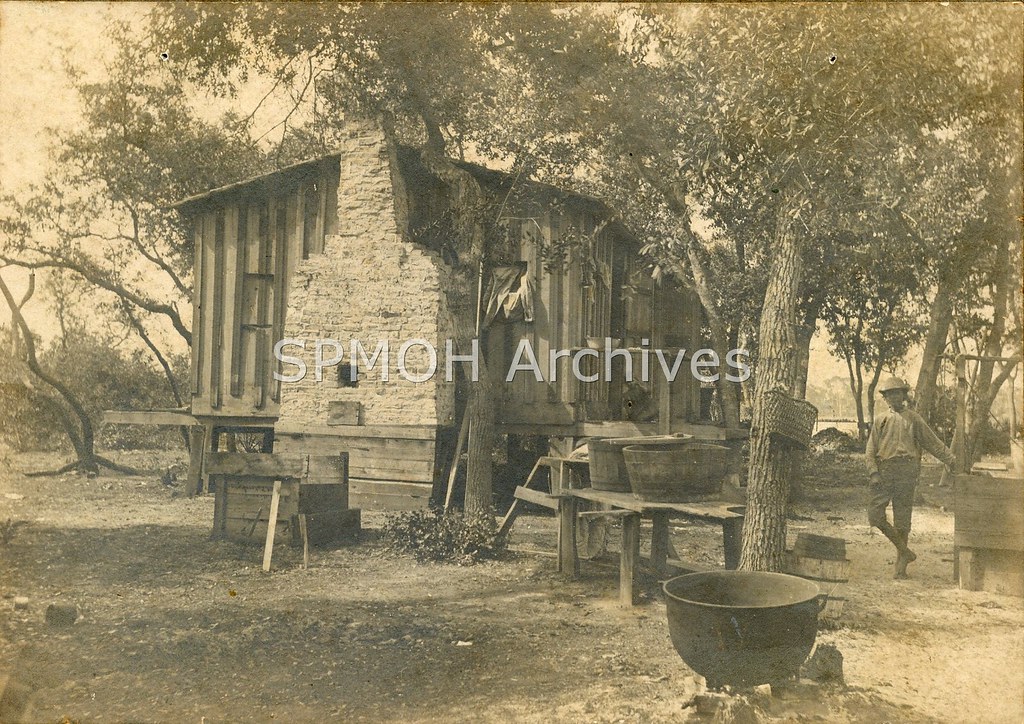 ~1900
~1900One of the earliest documented structures on Coffee Pot Bayou — the kind of pioneer cabin that David Griner abandoned in the 1880s 'because he was kept awake nights by the racket of the fish.'
Courtesy of St. Petersburg Museum of History Archives, photo no. P00492.
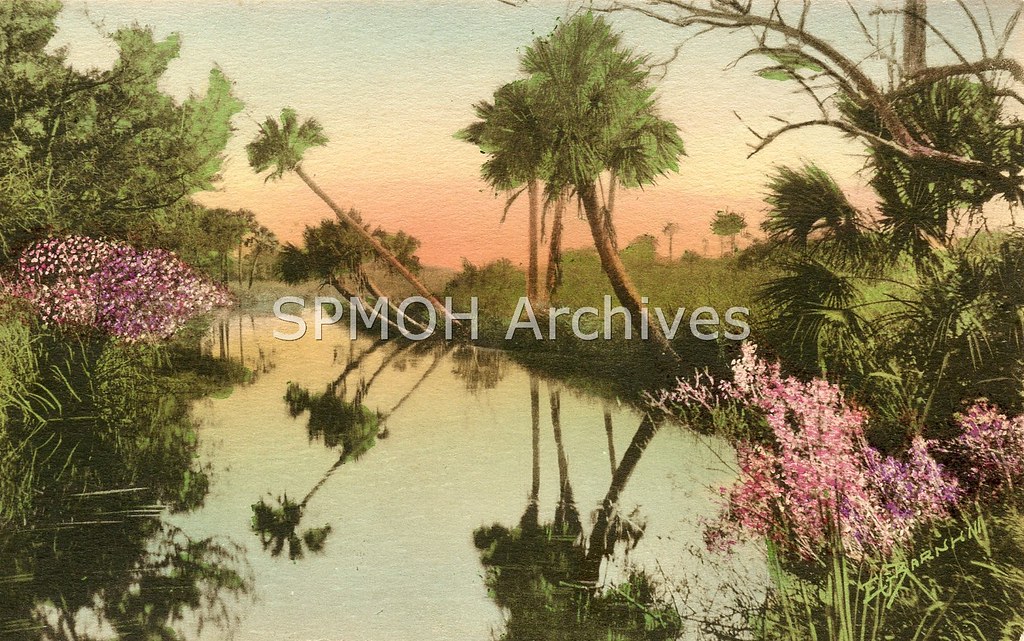
1910-1932Postcard view of Coffee Pot Bayou during the Snell development era, 1910-1932 — the period when Brightwaters, Coffee Pot Boulevard, and Granada Terrace were being platted and built out.
Courtesy of St. Petersburg Museum of History Archives, photo no. 40-9-970.
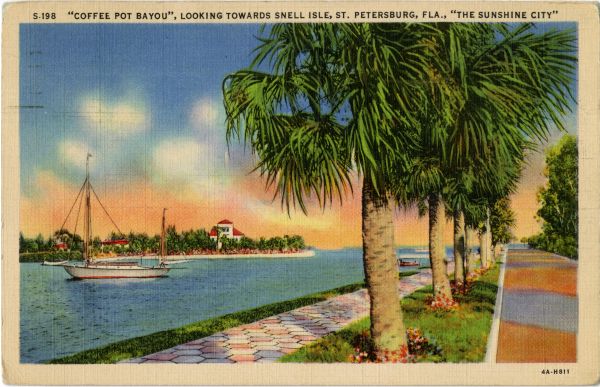 1934
1934'Coffee Pot Bayou,' looking toward Snell Isle — published 1934, a few years after the Snell Isle Bridge opened on Christmas Day 1931.
Courtesy of State Archives of Florida, Florida Memory. PC14048. https://www.floridamemory.com/items/show/PC14048
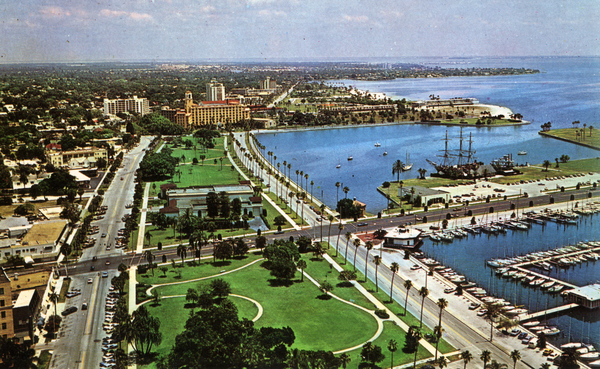 ~1900
~1900Early bird's-eye view of the waterfront drive that became today's North Shore Drive and Coffee Pot Boulevard — the spine of Snell's North Shore development.
Courtesy of State Archives of Florida, Florida Memory. PC11958. https://www.floridamemory.com/items/show/PC11958
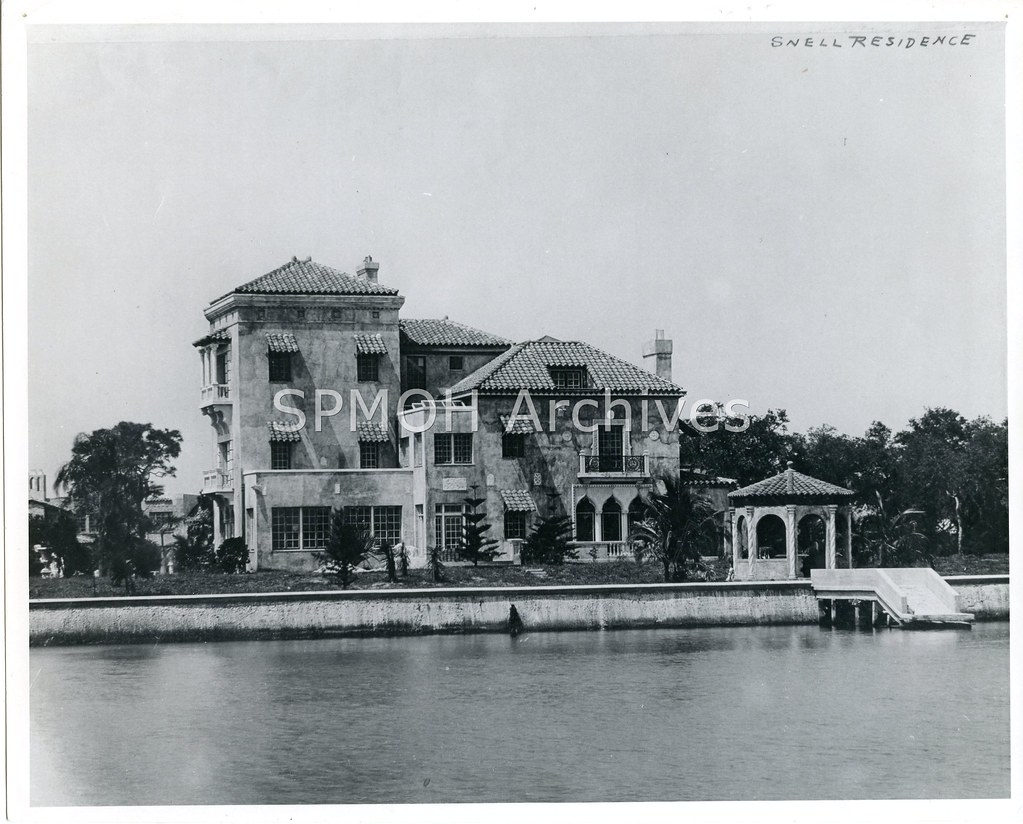 ~1931
~1931C. Perry Snell's own home at 375 Brightwaters Blvd — the $125,000 Italian villa Snell built for himself in 1928 with materials imported from Italy. Sat on nearly two acres with 400 feet of waterfront on Coffee Pot Bayou. Sold in 2005 for $5.1 million.
Courtesy of St. Petersburg Museum of History Archives, photo no. P00466.
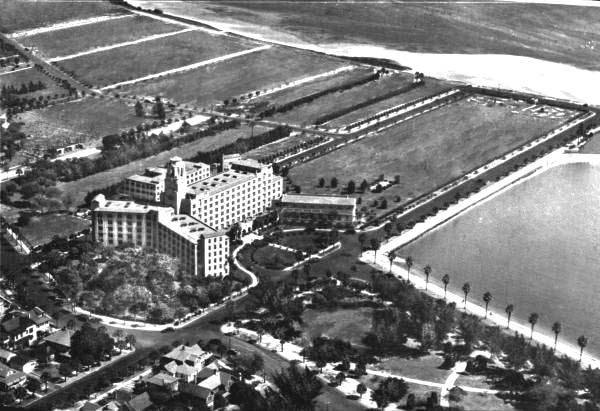 ~1920
~1920Aerial view from circa 1920 showing the Vinoy and the early Old Northeast / Coffee Pot Bayou waterfront — the period when Snell's development was still under active construction.
Courtesy of State Archives of Florida, Florida Memory. PHA201. https://www.floridamemory.com/items/show/PHA201
Commute Times
Click any destination to see the mapped route with real-time traffic estimates.
Pros & Cons
The Pros
- The iconic 2-mile Coffee Pot walking and biking path along the bayou — arguably St. Pete's single best urban amenity
- Manatees winter in the bayou (cluster at 23rd Ave NE and Coffee Pot Blvd) and Bird Island hosts a continuous nesting rookery for 13+ species
- 10-minute walk to downtown St. Pete restaurants, the Pier, and the Saturday Morning Market
- Architectural depth — 1920s Mediterranean estates next to Craftsman bungalows next to mid-century ranches, all on the same loop
- Waterfront blocks have direct bay access — yacht mooring on the larger lots, kayak launches at Coffee Pot Park
- Granada Terrace local historic district protections preserve the streetscape on the south end
- North Shore Aquatic Complex (50-meter pool, splash pad, slides) and North Shore Park beach/tennis/volleyball within walking distance
- The bayou itself is an idle-speed, no-wake zone — quieter on the water than busier downtown waterfront corridors
The Cons
- Bayou-front blocks (Coffee Pot Blvd, parts of North Shore Dr) are AE flood zone and saw significant Helene surge in September 2024 — many homes had first-floor flooding
- Insurance on waterfront historic homes is its own conversation — flood, wind, and 4-point inspections all required, and replacement-cost coverage on a 1928 estate is not cheap
- Inventory turnover on the iconic streets is brutal — Brightwaters and Coffee Pot Blvd may see 3-6 sales per year, and the best homes go quietly
- Granada Terrace's local historic district means Certificate of Appropriateness review is required for exterior changes — some buyers underprice this constraint
- The 'cabin at Coffee Pot Bayou' and original 1920s structures are aging; many waterfront homes need significant systems work despite recent cosmetic renovations
- No grocery within walking distance — Trader Joe's and Fresh Market are at the north end of 4th Street, a short drive but not walkable
- Bird Island and the bayou waters periodically have water-quality events (a 2017 pelican die-off prompted citywide testing) — generally cleared, but worth knowing
What You Need to Know
Who Should Live Here
Buyers who want active, urban waterfront life — morning runs along the bayou, manatee-spotting in the winter, sunset bike rides into downtown — and who can clearly tier their water exposure against their risk tolerance. If you want the trophy estate on Brightwaters or Coffee Pot Blvd, you're signing up for AE flood-zone reality, surge events like Helene, and insurance premiums that match the address. If you want the lifestyle without the surge exposure, the inland Old Northeast blocks one or two streets back deliver almost the same daily experience at roughly half the price. This is not the right neighborhood for someone who wants a low-maintenance new build, suburban yard, or a neighborhood without rules — Granada Terrace's historic district is real, and the Old Northeast HOA culture is a genuine front-porch, neighbors-knowing-neighbors community.
What to Watch For
Verify the elevation certificate before falling in love with a waterfront block. The line between flood zone X and AE runs through the neighborhood — sometimes within a single street — and the difference shows up in your insurance quote and your future surge risk. Get a proper inspection on any home built before 1940: hollow tile and Magnesite Stucco walls have specific failure modes, original cast iron drains and galvanized supply lines are common, and the 1920s electrical service almost certainly needs updating. Check whether the property is in the Granada Terrace local district, the broader North Shore National Register district, or both — the local district triggers Certificate of Appropriateness review for exterior changes; the National Register designation alone does not. Pull a permit history with the city for any home that's been substantially renovated; unpermitted exterior work in a local district can become your problem at closing.
What to Expect
A neighborhood where the iconic activity is walking. People are out at sunrise and sunset, every day, on the 2-mile path that hugs the bayou. You'll learn to spot manatees — the cluster at 23rd Ave NE and Coffee Pot Blvd is the reliable spot — and you'll watch herons, egrets, roseate spoonbills, and pelicans nest on Bird Island in the middle of the bayou. Expect Halloween on 17th and 18th Ave NE to be a community institution; expect the HONNA Candlelight Tour of Homes to be a December tradition. Expect to see a wide mix of architecture on every block, expect brick streets and granite curbs that slow traffic to a crawl, and expect the front-porch culture to be real. Expect, also, that on the worst storm days the waterfront blocks of this neighborhood are on TV, and that the inland blocks are not.
Aaron's Honest Take
Aaron & Aubrey Chand
Living in St. Pete · Excellecore Real Estate
Coffee Pot Bayou is the easiest neighborhood in St. Pete to fall in love with on a first walk and the hardest to underwrite correctly on a closing statement. The bayou path, the 1920s estates, the manatees, the 10-minute walk to downtown — every buyer I take here on a Saturday morning gets it instantly. The trick is figuring out which version of Coffee Pot Bayou you actually want to buy, because there are basically two markets stacked on top of each other.
Market one is the trophy waterfront. Brightwaters, Eden Isle, the Coffee Pot Boulevard frontage. Two-million-dollar floor, eight-million-dollar ceiling, AE flood zone, surge exposure that Helene proved in September 2024. If you are going to live here, you are going to insure here, and you should run actual flood premium and wind quotes on the specific address before you write the offer — not after. We have helped over 50 buyers relocate to Tampa Bay, and the ones who skip that step on a waterfront historic home are the ones who get surprised. The math can absolutely work — the views, the boat access, and the appreciation history are all real — but it has to be a math you've actually done.
Market two is the inland version. Two streets off the water, flood zone X, same neighborhood feel, same walk to the manatees and to downtown, same Coffee Pot path you cross every morning. Those blocks trade in the $700K-$1.4M range and almost none of them flooded in Helene. For a lot of buyers, that's the smarter buy — you get 90% of the lifestyle at half the cost basis and a fraction of the insurance and surge risk. If you're set on waterfront, do it with eyes open. If you're set on the neighborhood, the inland version is one of the best long-term holds in St. Pete.
The Buying Reality
Inland: ~25-40 days. Bayou-front: 60-180+ days post-Helene as buyers reprice surge risk
Tight inland (3-7 active listings); thin on iconic streets (often 2-4 actives on Brightwaters + Coffee Pot Blvd combined)
Common on renovated inland bungalows under $1M; less common on bayou-front since Helene
Get pre-approved, line up flood + wind insurance quotes BEFORE going under contract on any waterfront block, work with a contractor familiar with hollow tile and Magnesite Stucco for the historic estates, and don't ask for cosmetic repair credits on Granada Terrace homes — the seller pool there walks from those buyers.
Schools & Zoning
Magnet Options
Private / Independent
North Shore Elementary at 200 35th Ave NE is the zoned elementary for most Coffee Pot Bayou addresses — a small neighborhood school in the heart of Old Northeast. John Hopkins Middle and St. Pete High serve the area as well, with St. Pete High home to Florida's first International Baccalaureate Diploma Programme. Pinellas County uses a controlled-choice attendance system, so magnet placement is not guaranteed by zoning. Many Coffee Pot Bayou families also choose Shorecrest Prep, which sits less than a mile north on 22nd Ave NE — buyers should confirm the specific assigned school for any address using the Pinellas County Schools locator.
Insurance & Maintenance Reality
Pre-War Home Considerations
Insurance for a Coffee Pot Bayou waterfront home is a separate underwriting exercise from a typical St. Pete purchase — start the conversation before you make an offer, not after. Carriers will require a 4-point inspection, wind mitigation report, and an elevation certificate that reflects the post-Helene flood zone. On AE-zone bayou-front addresses, expect flood premium quotes that materially affect the deal math; some carriers have re-rated the entire post-2024-storm Tampa Bay coast and a previous owner's policy is not a useful comp.
On the historic estates specifically, the insurable replacement cost for a hollow-tile-and-stucco 1920s home with imported tile, original woodwork, and custom plaster is much higher than the market price — and finding a carrier who will write that replacement cost on a 100-year-old structure narrows your options sharply. Magnesite Stucco walls and original cast iron drains are common in the 1929 boom-era homes; both can drive carrier scrutiny.
The inland blocks — flood zone X, no surge exposure in Helene, conventional construction — quote close to standard Old Northeast rates. That gap between AE and X premiums on otherwise comparable neighborhood addresses is one of the clearest financial reasons to consider buying two streets off the water rather than directly on it.
Storm Impact: Helene & Milton
Helene's September 2024 surge was the defining storm event of the modern era for Coffee Pot Bayou. Bayou-front blocks (Coffee Pot Blvd, parts of North Shore Drive, the lower numbers on 22nd-25th Ave NE) saw extensive first-floor flooding consistent with the 5-foot-plus surge that the city declared 'unprecedented.' Inland blocks two or more streets back were largely dry — the elevation gradient from the bayou up to 4th Street is small but real, and it changed who flooded and who didn't. Milton two weeks later was a wind-and-rain event for the area; the storm tracked south and pulled water OUT of Tampa Bay, sparing the bayou-front homes a second surge.
Hurricane Helene
Sep 2024September 26, 2024. Mayor Welch called the surge 'unprecedented.' The northeast St. Pete oft-flooded zones — Snell Isle, Shore Acres, Coquina Key, Venetian Isles — were covered by bay water by midday Thursday. Coffee Pot Bayou-front blocks were hit hard: residents reported water as far west as the Coffee Pot Boulevard frontage but not generally further inland. One DC Urban Mom forum poster who walked the area reported 'the water got as far west as 4th street, but assume that is just up in shore acres,' then clarified after walking through that 'there was still a lot of flooding there, but it doesn't look like it reached the houses on that street; I don't think it got any higher than Coffee Pot Boulevard in Old NE.' Wind damage was typical for the storm category: limbs down, scattered roof and fence damage.
Hurricane Milton
Oct 2024October 9-10, 2024. Milton tracked south of Tampa Bay and pulled a reverse storm surge — water levels in Tampa Bay actually dropped 5 feet at the peak of the storm. Coffee Pot Bayou-front homes saw little to no surge from Milton. The damage was wind-driven: 18+ inches of rain in some St. Pete neighborhoods, 100+ mph gusts, and significant tree and roof damage on already-stressed structures. Most insurance claims in the neighborhood that came from the second storm were roof and wind-related rather than surge.
Blocks to Watch
Coffee Pot Boulevard frontage (Granada Park section through the 2000-block); North Shore Drive directly on the water; the lower block numbers of 22nd through 25th Ave NE where they reach the bayou. These are AE flood zone and were the first to flood in Helene. Verify the specific elevation certificate and check Helene high-water marks before buying.
Tax & Preservation Incentives
Historic District Status
Granada Terrace is a locally-designated historic district (since April 1988 — the second in St. Pete after Roser Park). Properties inside Granada Terrace boundaries qualify for the city's tax incentive programs and are subject to Certificate of Appropriateness review for exterior changes. Bayou-front blocks of Old Northeast outside Granada Terrace sit within the North Shore National Register Historic District (2003) but are NOT in any local district unless they fall within one of the small Old Northeast block-level local LHDs (200 Block of 10th Ave NE LHD, Welch's Mediterranean Row LHD on 100 block of 19th Ave NE, or 700 Block of 18th Avenue NE LHD).
10-Year Ad Valorem Exemption
Properties inside the Granada Terrace local historic district (or one of the Old Northeast block-level LHDs) are eligible for St. Petersburg's 10-year ad valorem tax exemption on the increased value attributable to approved historic renovations — capped at $100,000 per single-family residence. Approval must be obtained from the city's preservation staff BEFORE construction begins. National Register listing alone (without local designation) does NOT qualify a property for the city ad valorem program.
Federal 20% Rehab Tax Credit
Income-producing certified historic structures (rentals, true short-term rental businesses, mixed-use) within either the Granada Terrace local district or the National Register North Shore Historic District qualify for the federal 20% Historic Rehabilitation Tax Credit on certified rehabilitation expenditures. Owner-occupied primary residences do NOT qualify for the federal credit. The credit is taken against federal income tax liability and can be carried forward.
If you are buying inside Granada Terrace, talk to City of St. Petersburg preservation planning staff BEFORE pulling any permits. Out-of-process work is not eligible retroactively for either the city ad valorem exemption or the federal rehab credit. Place Economics' study found St. Pete homes inside local historic districts appreciated 119% over 14 years versus 85% citywide — Granada Terrace addresses participate in that, the rest of Coffee Pot Bayou does not.
Community & Events
HONNA Candlelight Tour of Homes
Annual — first Sunday of December
Now in its 26th edition. The Historic Old Northeast Neighborhood Association's signature event — 7-8 historic homes opened to ticketed guests, live music, refreshment station, trolley transport between homes. Frequently includes Coffee Pot Bayou and Granada Terrace addresses. Typically sells out.
18th Avenue NE Halloween
October 31 annually
The single most popular Halloween street in St. Pete. Houses on 17th and 18th Ave NE go all-out — one of the city's true community institutions. A community event, not an HONNA-organized one. Expect heavy foot traffic, street closures by neighbor agreement, and thousands of trick-or-treaters.
HONNA Porch Parties
Quarterly (March, June, September, December)
Neighborhood Appreciation Potluck Dinners hosted by the Old Northeast neighborhood association — informal gatherings on neighbor porches, with HONNA providing the entrée and neighbors bringing salads, sides, and desserts.
Saturday Morning Market
October-May, Saturdays 9am-2pm
Held at Al Lang Stadium — one of the largest weekly markets in the Southeast, a 10-minute walk from Coffee Pot Bayou's southern edge. Local produce, prepared foods, live music.
Manatee Watching at 23rd & Coffee Pot
November-March (cold-water months)
Not a formal event — a year-round neighborhood ritual. Manatees congregate where freshwater discharge from Crescent Lake's main outfall enters Coffee Pot Bayou near 23rd Ave NE. The freshwater layer floats on top of the brackish bay water and gives the manatees a drinking source. The cluster pulls daily small crowds during cold snaps.
What Residents Are Saying Online
Pulled from public discussion threads on Trulia, DC Urban Moms forum, and Tampa Bay-area journalism. Residents and visitors consistently call out four things: the daily walking experience along the bayou, the manatee culture, the front-porch / neighbor-knowing-neighbor community feel of Old Northeast, and the brick streets that physically slow traffic. Honest concerns mentioned include flood-zone exposure on waterfront blocks (especially post-Helene), parking pressure on event days, and the limited yard space typical of close-in urban lots.
“Terrific safe neighborhood for kids. Tree lined streets with sidewalks and people drive slowly through the neighborhood, partly because of the speed limit but also because the brick streets (beautiful) slow people down. Easy commute to Shorecrest Prep. Close to the parks on the bay (beach, tennis, pool, ball fields) and Crescent Lake on the other side of 4th St. All this and is isn't the 'burbs, but rather a cool urban community with diversity.”
“It's a lovely waterfront walk to downtown from the Old Northeast neighborhood. Very walkable area with public transportation around. Easy drive to 275.”
“I've lived in this neighborhood for 33 years, and it's a wonderful place to live with lots of trees, families, dogs oh, and more. It's a 5-minute walk to the waterfront parks, and a 10 minute walk to downtown, with restaurants, museums, the new pier and lots of shops.”
“I am the OP and I am in St Pete in that area. I walked around by Coffee Pot this morning, and there was still a lot of flooding there, but it doesn't look like it reached the houses on that street; I don't think it got any higher than Coffee Pot Boulevard in Old NE.”
“As you run, stroll, skate, or bike along the picturesque two-mile path bordering Coffee Pot Bayou across from Bird Island and Snell Isle, you may occasionally see a cluster of rapt spectators peering into the water across from a magnificent flowering tree at the intersection of 23rd Avenue NE and Coffee Pot Boulevard.”
“Two broad snouts snuffle up from the water at the edge of the walking path along Coffee Pot Bayou. A manatee and her baby drift over to the storm drain to drink fresh water coming down from nearby Lake Crescent.”
Further Reading & Resources
Civic & Preservation
City of St. Petersburg — Historic Preservation Program
Official city .gov page for the historic preservation program — design guidelines, Certificate of Appropriateness process, and the local register that includes Granada Terrace.
City of St. Pete — Property Owner Tax Incentives
10-year ad valorem tax exemption program for qualifying historic-district renovations — applies to Granada Terrace addresses.
City of St. Petersburg — Community Planning & Preservation Commission
The body that reviews historic-district renovations and Certificates of Appropriateness in St. Pete (functions as the Architectural Review Commission).
Granada Terrace Historic District profile (Visit St. Pete-Clearwater)
Official profile of the Granada Terrace local historic district — 1924 Snell plat, parkways with circular plazas (Plaza Andalusia, Plaza Valencia), pergolas along Coffee Pot Boulevard.
Preserve the 'Burg
Local historic preservation nonprofit — advocates for North Shore, Granada Terrace, and other St. Pete historic districts.
National Register — North Shore Historic District
Background on the National Register district (listed February 20, 2003) that includes the bayou-front blocks of Coffee Pot Bayou.
Journalism
Tampa Bay Times — How Coffee Pot Bayou Got Its Name
Long-form Times investigation into the bayou's name — earliest reference traced to an 1882 map and an 1889 Tampa Journal article. Quotes USF historian Ray Arsenault on the coffee-pot-shape theory.
St. Pete Catalyst — Candlelight Tour of Homes Returns
Local Catalyst coverage of HONNA's 26th annual Candlelight Tour — includes recent Granada Terrace and Coffee Pot Bayou-area homes on tour.
Tampa Bay Times — Bay Magazine on a Coffee Pot Bayou home
Times Bay Magazine architectural feature on a contemporary Coffee Pot Bayou home — useful context on what current waterfront builds look like.
Northeast Journal — Crescent Lake and Coffee Pot Bayou Manatees
Long-form local journalism explaining why manatees congregate in the bayou — Crescent Lake's freshwater outflow creates a drinkable layer at the 23rd Ave NE / Coffee Pot Blvd discharge point.
The Gabber — Before Earth Day in Tampa Bay
Local history piece referencing David Griner's pioneer cabin on Coffee Pot Bayou — pre-railroad documentation of the area as 'otherwise unsettled.'
Tampa Bay Times — Watchers Wonder: What's Up With Bird Island?
Times archive piece on Bird Island in the middle of Coffee Pot Bayou — the rookery hosts 13+ species of nesting birds including roseate spoonbills.
Cultural
St. Petersburg Audubon Society — History
Society history page documenting the 2007 land-use changes that protected Bird Island in Coffee Pot Bayou from development, plus the anonymous purchase of the rookery island.
AFAR Magazine — Coffee Pot Bayou in the Historic Old Northeast
Travel-writer feature on the 2-mile walking path, manatee viewing, and the bayou's daily rhythm.
More
City of St. Pete — Coffee Pot Park (boat ramp + playground)
City description of Coffee Pot Park between 30th-31st Ave NE — boat ramp, kayak launch, playground, picnic shelter at the north end of the bayou.
TrailLink — North Bay Trail
Trail map and reviews for the 6.3-mile North Bay Trail — the multi-use path that includes the Coffee Pot Bayou waterfront sidewalk and connects south to the Pinellas Trail.
What's Nearby
Coffee Pot Park (boat ramp, kayak launch, playground)
in district
Coffee Pot Bayou walking path / North Bay Trail
in district
Bird Island rookery (mid-bayou)
in district
North Shore Park & Beach
0.4 mi
North Shore Aquatic Complex
0.5 mi
Gizella Kopsick Palm Arboretum
0.4 mi
Vinoy Park & Renaissance Vinoy Resort
0.7 mi
Snell Isle / Vinoy Golf Club
0.6 mi (across bridge)
St. Pete Pier
1.2 mi
Sunken Gardens
0.9 mi
Old Northeast Tavern
0.4 mi
Trader Joe's & Fresh Market (4th Street)
0.6 mi
Saturday Morning Market (Al Lang Stadium)
1.3 mi
Elevation & Flood Risk
8ft average elevation
FEMA Flood Zone X (most inland blocks), AE on bayou-front blocks (Coffee Pot Blvd, North Shore Dr) — flood insurance required
Thinking about Coffee Pot Bayou?
We've helped over 50 buyers relocate to Tampa Bay. Let's talk about whether Coffee Pot Bayou is the right fit for you.
Explore more neighborhoods
View All in Relocation Guide