Allendale Terrace
St. Pete's Highest-and-Driest Historic Neighborhood
1923 (Cade B. Allen, 160 acres of Foster Grove)
Established
34th–42nd Ave N, 7th St N to MLK Jr St N
Boundaries
X — entire neighborhood, non-evacuation
Flood Zone
40–55 ft (one of the highest in the city)
Elevation
~40 originals built 1923–1954
Total Cade Allen homes
60
Walk Score
Neighborhood Overview
Allendale Terrace is the inland historic neighborhood that gets quietly recommended by St. Pete agents who actually live and work in the city. Cade B. Allen platted these 160 acres in 1923 after watching the 1921 hurricane park three feet of saltwater on the first floor of the St. Petersburg Yacht Club downtown. He bought a citrus grove called Foster Grove specifically because it was high ground — 40 to 55 feet above sea level, well inland from the bay — and spent the next thirty years building roughly 40 stone-and-stucco homes on oversized lots along brick streets. The result is the closest St. Pete has to a country-club neighborhood without a country club: giant oaks, broad lawns, and houses that don't look like anything else in Florida.
Allen had been a brick mason in upstate New York before he came to St. Pete, and that's the thing that makes Allendale homes recognizable from a block away. While the rest of 1920s Florida was building in stucco, Allen was shipping coquina, marble, granite, fieldstone, and sandstone in by rail and laying it himself. His architectural language was Mediterranean Revival and Spanish Mission, but with stone walls, twisted Solomonic columns, and chimneys instead of the lighter masonry his contemporaries used. Historian Ray Arsenault called the result "a curious but striking mixture of Westchester County, New York-style stone mansions and hollow tile-and-stucco Spanish Castles, some looking like fortresses and others like California-style missions." The most photographed example is the Allendale "Castle" at 3601 Foster Hill Drive — a 4,500-square-foot stone Mission Revival home Allen built for his own family in 1925 and that was designated a local historic landmark in 2014.
What makes Allendale work today is the combination almost nobody else in St. Pete offers. The entire neighborhood sits in flood zone X — non-evacuation, no flood insurance required by your lender — and Helene's surge stopped well short of these blocks. It's eight minutes to downtown, twenty to the beach, walkable in patches but not Kenwood-level walkable, and significantly cheaper than the historic neighborhoods that get most of the relocation attention. The trade-off: it's not a designated local historic district, so the protections that limit demolitions in Old Northeast and Roser Park don't apply here. Doc Webb's 1920 home was demolished in 2019 to make room for four new David Weekley houses — a reminder that what's standing in Allendale is standing because owners and buyers chose to keep it standing, not because the city forced anyone's hand.
History & Origins
1923 (Foster Grove purchase); first home 1923–24
Cade Bush Allen (1882–1959)
Florida Land Boom + Depression-era build-out (1923–1954)
Cade Bush Allen was born in Elmira, New York in 1882 and worked as a brick mason in Albany before he came to St. Petersburg in 1911 at age 30. His first house was at 145 17th Avenue NE, in what's now Old Northeast. He opened C. Allen and Riggs Real Estate at 510 Central Avenue and ran a truck garden and dairy farm on the land between 4th Street N and Crescent Lake — historian Walter Fuller wrote that Allen brought the first Guernsey cows to St. Pete, three carloads at a time. In 1922, Allen and broker Harold Smith bought 160 acres of citrus grove called Foster Grove from 7th Street N west to MLK and 34th Avenue N up to 42nd Avenue N for $186,000. After buying out Smith around 1923, Allen built his first Allendale home at 3410 9th Street N and started laying out the rest of the neighborhood himself.
What Allen was actually doing was building a refuge from the waterfront. The 1921 hurricane had flooded the first floor of the St. Petersburg Yacht Club almost completely; a famous photograph circulated showing how badly the water had hit the bay-side neighborhoods. Allen made the calculation that high ground would matter, and he was right — Allendale today sits in evacuation Zone D and flood zone X, which means flood insurance isn't required and most carriers don't even bother quoting it. Ray Arsenault has called Allendale "the finest non-waterfront neighborhood in the city," and the city's historic preservation planner Rick Smith told the Tampa Bay Times in 2002 that "Allendale is probably the most valuable of any inland development in the city."
Allen kept building through the Florida bust and the Depression. While other developers stopped, he kept laying stone — and he insisted on stone. "His houses had to have a stone exterior and a chimney," 40-year resident Eleanor Porter told the Tampa Bay Times. "He would bring a straight edge and check the plasterers as they worked. He was a perfectionist." Between 1922 and 1954 he and his sons built around 40 homes inside Allendale Terrace, plus a dozen more on contract for individual owners on 39th and 40th Avenues outside the neighborhood. The original brick streets were laid by the Georgia Engineering Co. and most of them are still in place. In 1924, seven people gathered in Allen's home to organize Allendale Methodist Episcopal Church (now Allendale United Methodist) at 3803 Haines Road N — Allen supervised and largely financed the $56,372 construction; first services were held in 1926. Allen lived in roughly six different homes inside Allendale at various points, including the 1925 stone "Castle" at 3601 Foster Hill Drive that's still the neighborhood's defining building. He died in 1959; his wife Eva in 1971.
Architecture & What You'll Be Buying
Predominant Styles
Typical Year Built
1923–1954 for the historic core; 1950s–1970s block infill; 2018+ new David Weekley and Canopy Builders homes scattered throughout
Typical Size
1,800–4,800 sq ft; lots commonly 60×120 to 120×120, with a handful of double lots and 0.3–0.5 acre estates on Foster Hill Drive and Monticello Blvd
Construction
Cade Allen homes use thick load-bearing masonry — interlocking hollow tile or solid stone exterior, often 12 inches or more thick — with clay tile roofs, arch-top windows, vaulted wood-beam ceilings, hardwood floors, plaster walls, and built-in cabinetry. Many have crawlspace foundations rather than slabs. Mid-century block homes are simpler and easier to insure; new infill is concrete block with engineered roof trusses. The neighborhood's original Augusta red brick streets are still in place on most blocks.
Materials & Streetscape
Stone is the signature material in Allendale and almost nowhere else in Florida. Allen sourced coquina from Florida's east coast, marble and granite from the Carolinas and Georgia, sandstone from Indiana, and fieldstone and silica from Alabama, and he shipped it in by rail. According to his son Donald, he chose stone because "he wanted something unique that everybody else wasn't doing — it was as inexpensive as stucco." Solomonic (twisted) stone columns are common at Allen-built front entries. Other characteristic details: arched front doors, copper gutters, mission tile roofs, ornate iron balconies, and stone chimneys that Allen insisted every house include.
Notable Homes & Landmarks
3601 Foster Hill Dr N ("The Allendale Castle")
Built 1925
Cade Allen's most famous home and the visual icon of the neighborhood — a 4,500-square-foot Mission/Spanish Revival stone fortress on the corner of Foster Hill Drive and MLK Jr. Street. Sat empty for years and was known locally as the "haunted house," with squatters and a 13-foot-deep pool full of frogs and decades-old beehives. Chris Wescott bought it, spent about $400,000 restoring it, and in 2014 it became one of the few Allendale homes designated a local historic landmark by the city's Community Planning and Preservation Commission.
Built and lived in by Cade B. Allen and his family. Restored ~2013–14 by Chris Wescott. Designated local historic landmark 2014. On and off the market through the late 2010s; listed at $999,000 in 2019.
944 39th Ave N
Built 1927
Cade Allen's primary family home for years. Living room with fireplace, dining room, breakfast room, sunroom, four bedrooms and two large baths upstairs, two-car garage, hot-air heat plus electric heaters, twelve closets (seven walk-in), on a lot exceeding one acre. The lot itself is one of the largest in the neighborhood and a textbook example of why Allen kept it for his own family.
Cade and Eva Allen and their eight children. Allen also built and lived in roughly five other Allendale homes at various points across the 1920s–1950s.
955 39th Ave N
Built 1931–32
An original Cade Allen home, three bedrooms, two full tile baths, sunroom, breakfast nook, den, steam heat, two-car garage. Now 3,591 square feet of living space with the original French doors and wood floors, plus a chef's kitchen, a master suite with a private portico, and a pool — an example of how an Allen original holds up after a careful renovation.
Original owners Webb and Ida Shelly (Buffalo, NY; bakery operator in Calgary, Alberta who retired to St. Pete in 1931). Subsequently Frank and Mary Crisp — Frank was a realtor and developer of NE St. Pete who donated land for baseball fields; combined Shelly + Crisp tenure ~25 years.
915 41st Ave N
Built August 1950
Built by Cade B. Allen & Sons for $22,000 — a rare late-Allen home on a 2.5-lot site with seven rooms, three bedrooms, two and a half baths, a three-exposure room with a fireplace, and a large garage with an upstairs section. Documents the family's continued building well into the 1950s.
William Jacob Garrison (1880–1954), a civil engineer and president of Fox Silica Sand & Stone Co. Notable: eldest son Dean later sued the parents over stock-sale proceeds — the case went to the Florida Supreme Court (Dean won).
774 36th Ave N ("Doc Webb House" — demolished 2019)
Built 1920 (Neoclassical)
James E. "Doc" Webb — the founder of Webb's City, "the World's Most Unusual Drug Store" with its mermaids, dancing chickens, and 5-cent haircuts — lived in this Allendale home from 1935 to 1974. In 2019 the city's Community Planning and Preservation Commission recommended designating it a local historic landmark, but the City Council voted 4–2 against full designation. The property sold to David Weekley Homes for $960,000; the original house was demolished and four new homes were built on the site. The episode is the cautionary story longtime residents tell about why Allendale-the-neighborhood looks the way it does today: without district-wide protection, individual landmarks can be lost on a single Council vote.
James E. "Doc" Webb (1935–1974), Merrill and Karen King (later owners), David Weekley Homes (developer, 2019).
Then & Now
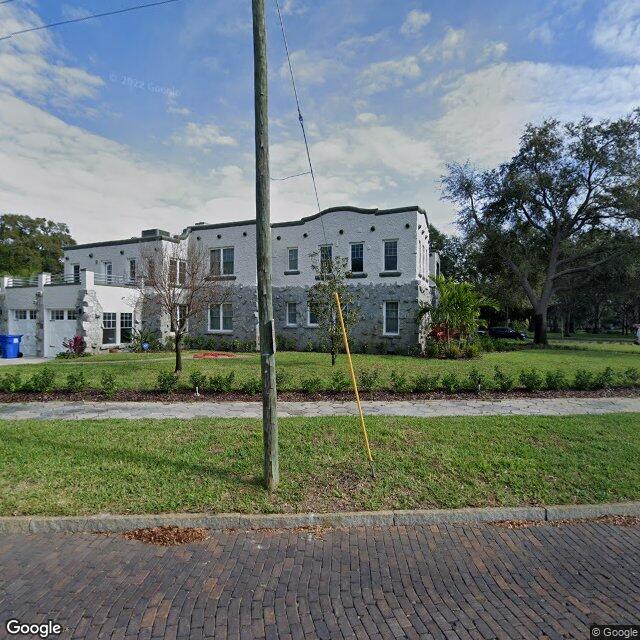
1925The Allendale Castle (3601 Foster Hill Drive N) — Cade B. Allen's most photographed home and the visual icon of Allendale Terrace. Built 1925 in stone-clad Mission Revival style; designated a local historic landmark in 2014.
© Google Street View, captured 2026-04-28 (placeholder pending Aaron's field shoot)
Commute Times
Click any destination to see the mapped route with real-time traffic estimates.
Pros & Cons
The Pros
- Entire neighborhood sits in flood zone X with elevation of 40–55 feet — non-evacuation, no flood insurance required by lenders, and homes were largely dry through Helene and Milton
- Cade Allen-built stone homes are one of the few genuinely distinctive housing stocks in Florida — Mediterranean and Spanish Revival in stone instead of stucco, with Solomonic columns and clay tile roofs
- Original Augusta red brick streets and giant old-growth oaks intact on most blocks
- Oversized lots — many 60×120 to 120×120, with 0.3–0.5 acre estates on Foster Hill Drive — rare in central St. Pete
- 8 minutes to downtown St. Pete, 22 minutes to the beach, easy I-275 access for Tampa commutes
- Significantly cheaper entry point into historic St. Pete than Old Northeast, Crescent Lake, or Snell Isle — typical Cade Allen original is $700K–$1.2M vs. $1M–$2M+ in Old Northeast
- Allendale Neighborhood Association is active; strong holiday/Halloween/Christmas culture; a separate "Allendale Terrace Neighbors United" association also exists
- Allendale is in evacuation Zone D — the lowest priority zone, called only in the most catastrophic storms
The Cons
- NOT a designated local historic district — no neighborhood-wide protection against demolitions or unsympathetic infill (the Doc Webb House was demolished in 2019 over neighborhood objections)
- Walk Score around 60 — you'll drive for groceries and most dinners; not the walk-everywhere experience of Kenwood or Old Northeast
- Cade Allen originals are 90–100 years old — expect to budget for roof, electrical, plumbing, and stone-wall repointing on any unrenovated example
- Mix of architectural eras and quality is the norm — a Cade Allen estate can sit next to a 1955 block ranch next to a 2020 David Weekley new build
- Stone-construction homes need specialty contractors who actually know how to repoint masonry and replace clay tile — not every St. Pete contractor qualifies
- Stay south of 54th Avenue N — once you cross 54th the neighborhood character changes and flood zone AE returns in pockets to the north
- MLK Jr Street and 38th Avenue N are busy throughfares; some blocks are quieter than others
What You Need to Know
Who Should Live Here
Buyers who want a historic stone home on a brick street with no flood insurance bill — and who don't need the marketing brand of Old Northeast or Snell Isle to feel good about the purchase. Allendale is the right call for the buyer who's willing to do their own homework on Cade Allen's body of work, who's comfortable with a neighborhood that doesn't have city-imposed historic-district rules, and who values elevation and tree canopy more than a five-minute walk to Central Avenue. Particularly strong for buyers relocating from northern markets who want a real masonry house — the kind they grew up with — at a Florida-inland price.
What to Watch For
Verify three things before you write an offer. First, the address — Allendale Terrace proper is bounded roughly by 34th–42nd Avenues N and 7th Street to MLK; outside those lines you're in The Allendale, Allendale Park, or Magnolia Heights, which are different neighborhoods with different character. Second, the construction — if it's a Cade Allen original, get an inspector who has worked on stone and hollow-tile masonry, not just block. Third, insurance and permit history — even though the neighborhood isn't a local historic district, individual properties (the Castle, partial designation on the Doc Webb lot) carry restrictions, and any 90-plus-year-old roof needs a 4-point inspection and likely a wind-mitigation report before a carrier will write the policy.
What to Expect
Variety. Some blocks feel like a New York stone-mansion district transplanted to Florida. Others feel like a 1950s ranch neighborhood with mature oaks. New David Weekley and Canopy Builder homes are scattered throughout, mostly on lots created when older homes were demolished. The brick streets are real and original. The oaks are the real selling point on most days. Halloween and Christmas displays are outsized for the neighborhood's population — residents from across St. Pete drive in to see them. You'll need a car for almost everything, but most errands are 5–10 minutes away on 4th Street, MLK, or 38th Ave.
Aaron's Honest Take
Aaron & Aubrey Chand
Living in St. Pete · Excellecore Real Estate
Here's how I usually frame Allendale to buyers. Most relocation buyers hear "historic St. Pete" and immediately think Old Northeast or Snell Isle, where you're paying $1.2M-plus for a renovated bungalow on a 50-foot lot. Allendale is what we point to when somebody wants the historic character — real stone houses, real brick streets, real 100-year-old oaks — but doesn't want the Old Northeast price or the Old Northeast flood-zone exposure. Cade Allen built this whole neighborhood specifically because of the 1921 hurricane. He went inland and went up to high ground on purpose. A hundred years later that decision is the single biggest reason it's worth buying here.
The honest con is that Allendale isn't a designated local historic district. That's a real difference from Roser Park or any of the Kenwood sub-districts. There's no architectural review board telling your neighbor he can't tear down his 1925 Allen home and put up four cookie-cutter new builds, because that's exactly what happened to the Doc Webb House in 2019. So you're buying into the character of the streetscape, not into a guaranteed protection of it. That makes the surrounding homes and the larger Allen originals more important to look at, not less. If the block already has three demolitions and three new builds, you're buying a different neighborhood than the one you toured at the corner of Foster Hill and MLK.
What I tell people who are serious about it: target the original Cade Allen homes, get an inspector who has actually worked on stone masonry, line up insurance before you go under contract because 90-plus-year-old roofs narrow your carrier list fast, and verify the address is south of 54th Avenue N — that's the line where flood zone X ends and AE picks back up. If you do those four things and you're patient enough to wait for the right Allen original, Allendale is one of the best long-term holds in inland St. Pete. In the past couple years, we've helped over 50 buyers relocate to Tampa Bay, and the ones who landed in Allendale are some of the happiest with what they got for the money.
The Buying Reality
~30–60 days for fairly priced homes; renovated Cade Allen originals can move in under three weeks
Moderate — typical 5–10 active listings between Allendale Terrace, Allendale, and the broader Allendale Association map
Common on renovated Cade Allen originals under $1M and on new David Weekley builds; rare on tear-down candidates
Get pre-approved, line up insurance before you go under contract, lead with a clean inspection contingency rather than an asking-price haircut, and don't ask for cosmetic credits — Allendale sellers will walk. On Cade Allen originals, write an offer that respects the home as a piece of the city's history; sellers are protective of who they hand it to.
Schools & Zoning
Magnet Options
Private / Independent
Pinellas County operates a controlled-choice attendance system, so the zoned schools above are one factor among several. The biggest magnet draw for Allendale families is the IB Program at St. Petersburg High — one of the highest-ranked high school programs in Florida and a major reason inland north St. Pete neighborhoods stay competitive with the more affluent zip codes. Always verify the specific address with the Pinellas County Schools School Zone Locator before assuming.
Insurance & Maintenance Reality
Pre-War Home Considerations
Allendale sits in flood zone X across the entire neighborhood, which means flood insurance is not required by federally backed lenders. This is the single biggest insurance advantage Allendale has over almost any historic St. Pete neighborhood — a typical flood policy on a coastal St. Pete home runs $1,500–$5,000 a year and you simply don't have that line item here.
What you do have is wind. Carriers will require a 4-point inspection (roof, electrical, plumbing, HVAC) and a wind-mitigation report on any home older than ~30 years. Roof age matters most: anything over 15 years on a Cade Allen original or older block home will narrow your carrier list sharply, and over 20 years can become uninsurable through standard markets without a roof replacement first.
The specific complications in Allendale: the original clay tile roofs on Cade Allen homes are beautiful and structurally appropriate, but most insurance carriers underwrite them based on age regardless of material. Stone exterior walls are insurance-positive (non-combustible) but can complicate wind-mitigation reports — make sure the inspector understands they're load-bearing masonry, not stone veneer over wood frame. And because Allendale isn't a designated historic district, you don't get the federal 20% rehab tax credit on income-producing properties or the city's 10-year ad valorem exemption on historic renovations — incentives that are real money on a $200K renovation in Roser Park or Kenwood. Plan your renovation budget accordingly.
Storm Impact: Helene & Milton
Allendale came through Hurricane Helene (Sept 26, 2024) and Hurricane Milton (Oct 9, 2024) extraordinarily well — better than virtually any other historic-character neighborhood in St. Pete. The combination of 40–55 ft elevation, distance from Tampa Bay, and flood zone X designation means storm surge is not a meaningful threat here. The damage that did occur was wind-driven: downed limbs, scattered roof damage on older homes, and fence loss. There was no widespread interior flooding the way there was in Shore Acres, Snell Isle, the eastern half of Old Northeast, and most of the barrier islands.
Hurricane Helene
Sep 2024Helene's surge stopped at the bayfront. Allendale, sitting roughly two miles inland and 40+ feet above sea level, saw essentially no storm-surge impact. Wind damage was typical for the broader region — downed oak limbs were the main story given the neighborhood's mature canopy — but homes stayed dry. Several days of power outages affected the area along with the rest of north St. Pete.
Hurricane Milton
Oct 2024Milton came in from the south two weeks after Helene; the storm dumped 18+ inches of rain on parts of St. Pete and brought 100 mph wind gusts. Allendale's elevation kept rainwater moving rather than pooling in homes, and the absence of surge meant the primary insurance event was wind damage on already-stressed roofs. Some homes lost clay tiles or had leak intrusions through aging roofs; tree damage was extensive given the oak canopy.
Blocks to Watch
Stay south of 54th Avenue N. Within Allendale Terrace proper (34th–42nd Avenues N), the entire neighborhood is in flood zone X. Once you cross 54th Avenue heading north, flood zone AE returns in pockets and the elevation drops — that's a different insurance and storm-risk reality than Allendale itself. Verify the specific address on FEMA's Flood Map Service Center or the City of St. Petersburg's flood-zone lookup before assuming.
Community & Events
Allendale Terrace Halloween Display Tradition
Late October — annual
Allendale's Halloween and Christmas displays are oversized for the neighborhood's population — residents from across St. Pete make annual trips just to drive the brick streets and see the houses lit up. It's the closest thing the neighborhood has to a signature seasonal event.
Allendale Neighborhood Association meetings
Periodic — see association website
The active neighborhood association coordinates safety, beautification, and character-preservation efforts. It's the venue for hearing about pending demolitions, infill construction, and city-level zoning changes that affect the neighborhood. There's also a separate Allendale Terrace Neighbors United group formed during the 2019 Doc Webb House preservation fight.
Allendale United Methodist Church services & community programs
Sundays + weekday programming
The church Cade Allen helped found and finance in 1924, now a Reconciling Congregation at 3803 Haines Road N. Active community partner for neighborhood events.
Saturday Morning Market
October–May, Saturdays
Held downtown at Al Lang Stadium (with a summer location at Williams Park). One of the largest weekly markets in the Southeast — a 10-minute drive from Allendale.
What Residents Are Saying Online
Public discussion of Allendale Terrace consistently calls out three things: the high-and-dry elevation ("the higher the dryer" is the local agent shorthand), the brick streets and oak canopy as the visual draw, and the strong sense of community on the neighborhood's quiet streets. Honest cons mentioned by residents and visitors: the architectural mix is uneven (Cade Allen estates next to mid-century block ranches), and there's a gap between the marquee Foster Hill Drive blocks and other parts of the neighborhood. Reddit-specific discussion of Allendale is thin compared to Old Northeast or Kenwood; the strongest first-hand voices are on Niche, Trulia, and in journalism rather than the subreddits.
“Community oriented, brick streets and close to everything without being filled with new constriction and McMansions. Old Saint Pete graciousness abounds.”
“Allendale is the most sought after, non-waterfront area in St Pete. It's elevation and beautiful tree lined streets make it very sought after. People are super friendly and there's a great sense of community.”
“You don't even need to go downtown to take advantage of the restaurants and shops. But another big draw is the elevation in the area; we say the higher the dryer, and it's huge not to have to worry about flood insurance.”
“Allendale's natural topography, combined with well-maintained infrastructure, makes it a top choice for buyers looking for long-term security against flooding.”
“Allendale is probably the most valuable of any inland development in the city.”
“100% say neighbors are friendly. 100% say they plan to stay for at least 5 years. 100% say it's quiet. 100% say yards are well-kept.”
Further Reading & Resources
Civic & Preservation
City of St. Petersburg — Historic Preservation Program
Official city .gov page for historic preservation in St. Pete. Allendale is not a designated local historic district, but individual landmarks within Allendale (the Castle at 3601 Foster Hill, the partial Doc Webb designation) are governed under this program.
City of St. Petersburg — Community Planning & Preservation Commission
The body that reviews historic landmark designations and Certificates of Appropriateness — including the 2014 Castle designation and the 2019 Doc Webb House case.
Preserve the 'Burg
St. Pete's local historic preservation nonprofit. Wrote a feature on Cade Allen's architectural legacy and continues to advocate for preservation of Allen-built homes.
Preserve the 'Burg — Restoring Cade Allen's Architectural Legacy on Mirror Lake
Long-form profile of the Cade Allen restoration at 250 Mirror Lake Drive — the best single overview of Allen's architectural signature: Solomonic columns, stone cladding, Mediterranean-Revival-with-stone construction. Useful context for any Allendale buyer.
Journalism
Tampa Bay Times — "Allendale builder elegantly marries style and substance" (2002)
The definitive long-form Tampa Bay Times piece on Cade B. Allen — biographical detail, founding-of-the-neighborhood narrative, quotes from city historians and Allen family members. Primary-source quality.
Tampa Bay Times — "Haunted House no more: Allendale historic gem nears city landmark status" (2014)
Coverage of Chris Wescott's $400K restoration of the Allendale Castle at 3601 Foster Hill Drive and its 2014 local historic landmark designation.
Tampa Bay Times — "St. Pete panel approves partial historic designation for Doc Webb house" (2019)
Original coverage of the Community Planning & Preservation Commission's compromise on the Doc Webb estate at 774 36th Ave N — and the broader Allendale preservation politics.
Tampa Bay Times — "Doc Webb House cleared for demolition after St. Pete City Council rejects historic status" (2019)
Final outcome of the Doc Webb landmark fight — 4–2 City Council vote against designation, $960K sale to David Weekley Homes, demolition cleared. The cautionary tale that defines Allendale's preservation reality today.
Creative Loafing Tampa — "The historic Allendale 'castle' is still on the market" (2019)
Creative Loafing feature on the Castle at 3601 Foster Hill Drive — restoration history, ghost stories, the bee hives in the upstairs porch.
Creative Loafing Tampa — "This 1965 Allendale home, once owned by the Allen family, is now for sale" (2021)
Profile of 1247 Monticello Blvd N, a 1965 Allen-family home — useful for understanding the later Cade Allen build aesthetic and the family's continued presence in Allendale through mid-century.
Creative Loafing Tampa — "An original Allendale home is now for sale" (2023)
Feature on 955 39th Ave N — a 1932 Cade Allen original. Best single recent piece on what an Allen home looks and feels like as a current listing.
St Pete Catalyst — "History repeats with Cade Allen home viewing" (2025)
Coverage of Backstreets Capital's restoration of the 1937 Cade Allen home at 250 Mirror Lake Drive — context for the broader Cade Allen body of work and his architectural signature.
St Pete Catalyst — "Places This Week: Allendale Terrace home sells for asking price" (2025)
Local market reporting — an Allendale Terrace home at 3611 8th Street N sold January 2025 for the asking price of $1.01M, useful comparable for the neighborhood's price point.
St Pete Rising — "Local developer files plan to preserve historic building and build condos on Mirror Lake"
Background on another Cade Allen building — the 1937 home at 250 Mirror Lake Drive — and how Allen's stone-clad work is being treated by developers in 2024–25.
Neighborhood Association
Allendale Neighborhood Association
The neighborhood's primary association — events, history, safety committee, and how to volunteer. Site notes that 'the history of Allendale is written largely in the life of Cade B. Allen.'
St. Petersburg Council of Neighborhood Associations (CONA) directory
Lists the registered neighborhood associations in Allendale: Allendale Oaks, Allendale Neighborhood Association, and Allendale Terrace Neighbors United Neighborhood Association. Useful for understanding which association covers which sub-area.
What's Nearby
Allendale Park
in district
Allendale United Methodist Church
in district
Crescent Lake Park
1.5 mi
Northeast Park
0.7 mi
4th Street N corridor (dining + retail)
0.3–1 mi
Trip's Diner (4th St N)
1.0 mi
Downtown St. Pete waterfront
2.5 mi
The St. Pete Pier
3.0 mi
Sundial St. Pete
2.5 mi
St. Pete Beach
10 mi
Tropicana Field / Historic Gas Plant District
3.0 mi
St. Petersburg High School
1.8 mi
Elevation & Flood Risk
45ft average elevation
FEMA Flood Zone X (entire neighborhood — non-evacuation, no flood insurance required) — flood insurance required
Thinking about Allendale Terrace?
We've helped over 50 buyers relocate to Tampa Bay. Let's talk about whether Allendale Terrace is the right fit for you.
Explore more neighborhoods
View All in Relocation Guide